Navigating AI in Antitrust: Challenges in Market Misuse and Regulatory Responses
Animesh Chaturvedi1 , Ayush Agrawal2
1Student, National Law Institute University, Bhopal, India; 2Student, National Law Institute University, Bhopal, India.
10.46679/9789349926141ch06
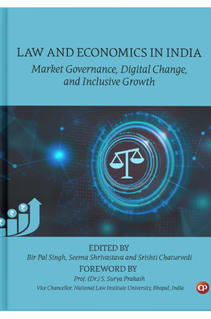
This chapter is a part of: Law and Economics in India: Market Governance, Digital Change, and Inclusive Growth from India
ISBN (Ebook): 978-93-49926-14-1
ISBN (Hardcover Print): 978-93-49926-73-8
ISBN (Softcover Print): 978-93-49926-54-7
© CSMFL Publications & its authors.
Published: April 15, 2026
Abstract
In the twenty-first century, all the nations are competing with each other to outgrow their economy. There are a number of transactions from agreements to mergers and acquisitions taking place in the market, and new players coming into the sector because they see the potential for development. To regulate all these activities there are Antitrust laws that foster business competition by guaranteeing that economic power distribution stays stable and economies continue to grow. But as technology is growing, new ways have developed to distort the competition in the market. In the present study, the authors focus on the current standing of the leading economies such as India, the UK, and the USA about their competition laws and their limitations to regulate technological advancements such as artificial intelligence which is/can be used to distort the healthy competition in the economy. The study further focuses on the involvement of artificial intelligence in cartelization, merger and acquisition, price fluctuation, etc by the players in the economy to perform anti-trust practices. To overcome such obstacles where the technology growing faster than human understanding the competition authorities need technological advancement “to fight technology with technology”. Competition law needs to be adapted and shaped according to the evolution of the economy and enforcement agencies need to follow the same trend. The study primarily focuses on the usage of artificial intelligence by the competition authorities to regulate the market and whether there are any provisions in the existing laws of the above-mentioned country under which authorities can take action. If not, then the suggestions provided in this study can be incorporated as a preliminary action.
Keywords: Artificial Intelligence (AI), Competition Law, Investigation, Scope of AI, Comparative Law
This book is available worldwide via EBSCOhost Academic Collection, EBSCO E- books, Google Play Books, Amazon, World Cat Discovery Service/OCLC, CSMFL Bookstore, and 200+ book resellers and academic content vendors.
Statement on Publication Ethics
We, at CSMFL Publications, are committed to ensure the unbiased and transparent publishing, and upholding the high standards of editorial integrity in our publications. To know more, please read our Statement on Publication Ethics, Editorial Integrity & Misconduct