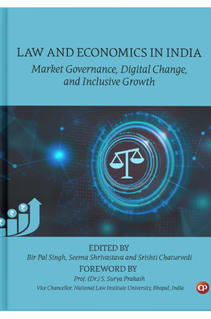
Preface: Law and Economics in India: Market Governance, Digital Change, and Inclusive Growth
Bir Pal Singh1 , Seema Shrivastava2 , and Srishti Chaturvedi3
1Professor of Panchayat Administration and Nyaya Panchayat; Chairperson – Centre for Tribal Studies and Research, Director- Department of Online and Distance Education, National Law Institute University, Bhopal, India;
2Assistant Professor of Economics and Chairperson of the Centre for Law and Economics at the National Law Institute University (NLIU), Bhopal, India;
3Academician, Ph.D. from National Law Institute University, Bhopal, Madhya Pradesh, India.
10.46679/97893499261410
This chapter is a part of: Law and Economics in India: Market Governance, Digital Change, and Inclusive Growth from India
ISBN (Ebook): 978-93-49926-14-1
ISBN (Hardcover Print): 978-93-49926-73-8
ISBN (Softcover Print): 978-93-49926-54-7
© CSMFL Publications & its authors.
Published: April 15, 2026
Preface
The interface of law and economics has emerged as a vibrant field of scholarly inquiry and practical relevance in the twenty-first century. In the era of rapid globalization, technological disruption, and market-driven governance, legal frameworks no longer operate in isolation. Every regulation, judicial pronouncement, and policy reform reverberates through markets and society, producing tangible economic consequences. Conversely, economic forces increasingly shape the creation, interpretation, and application of law. This dynamic and symbiotic relationship underscores the importance of a nuanced understanding of law and economics, a discipline that situates law within the broader context of resource allocation, market efficiency, and social welfare.
Over the past few decades, the study of law and economics has transformed from a niche academic pursuit into a mainstream analytical tool for both policymakers and jurists. Today, courts are called upon to consider the economic implications of their decisions, legislatures are expected to anticipate the market impact of their enactments, and regulatory agencies are compelled to balance efficiency with equity in their interventions. In the Indian context, the stakes are particularly high. As the country navigates the twin imperatives of inclusive growth and digital transformation, the legal system must keep pace with the changing contours of markets, technology, and society.
This book, Law and Economics in India: Market Governance, Digital Change, and Inclusive Growth, seeks to contribute to this evolving discourse. Conceived as a collaborative effort, it brings together diverse voices from academia and research to explore the intersections of law and economics in contemporary India. The collection is not only timely but also thematically comprehensive, reflecting the multi dimensional nature of the subject. The relevance of law and economics has never been more pronounced than in the current moment. India’s economic landscape is marked by rapid liberalization, the rise of digital markets, and the increasing significance of corporate governance. Each of these developments poses unique challenges that demand legal and economic insight.
Corporate governance and market regulation represent one such arena. The Indian corporate sector has witnessed episodes that have tested the limits of statutory safeguards and regulatory oversight. Issues of minority shareholder protection, corporate mismanagement, and the balance of power between boards and stakeholders underscore the economic implications of corporate law. Judicial interventions—whether in cases of oppression and mismanagement or in regulating political funding through corporate contributions—carry profound consequences for market confidence and democratic accountability. Equally pressing are the transformations brought by digital technologies. The emergence of cryptocurrencies, central bank digital currencies (CBDCs), and non fungible tokens (NFTs) has disrupted traditional financial systems and challenged regulators to rethink the very definition of money, ownership, and economic value. The economic promise of these technologies is intertwined with the risks of market abuse, money laundering, and cyber fraud, demanding a delicate balance between innovation and regulation.
At the same time, economic development cannot be measured solely by GDP or market capitalization. Issues such as workplace equality, the growth of the pink economy, corporate social responsibility (CSR) toward marginalized communities, and the governance of indigenous and tribal regions demand a legal economic perspective that is as sensitive to social justice as it is to market efficiency. A holistic law and economics approach thus extends beyond corporate boardrooms to the lived realities of diverse communities. By situating these challenges within the Indian socio economic context, this book aims to provide readers with a deeper understanding of how law both shapes and is shaped by economic forces. It aspires to foster critical thinking about the effectiveness, fairness, and efficiency of legal rules, and how they may be re imagined to serve broader developmental goals.
To ensure coherence while capturing the richness of the subject, the book is divided into three thematic sections, each reflecting a major axis of the law and economics discourse in India. The first theme- Law, Markets and Corporate Governance, addresses the regulation of markets and corporate entities, highlighting the economic dimensions of legal rules in traditional business domains. Beginning with Dr. Kondaiah Jonnalgadda’s foundational chapter on the economic analysis of law in India, the chapter sets the theoretical stage by examining how efficiency, cost-benefit analysis, and judicial reasoning interact in shaping the legal order. Subsequent chapters of the theme tackle pressing issues in corporate and market governance. Dr. Padma Singh’s contribution on the Supreme Court’s ruling on electoral bonds illustrates how corporate funding intersects with democratic integrity and economic policy. Aarya Shrivastava’s analysis of the Tata–Cyrus dispute sheds light on the delicate balance between majority control and minority shareholder protection, while Poulami Dasgupta, Sukhmandeep Singh, and Sonali Rana explore the economic impact of key business laws and consumer rights in the marketplace. The section concludes with Animesh Chaturvedi and Ayush Agrawal’s timely exploration of artificial intelligence in antitrust, demonstrating how emerging technologies challenge conventional competition law frameworks.
The second theme- Digital Economy, Financial Systems and Emerging Technologies, shifts focus to technological disruption and financial innovation. It begins with Dr. Ankit Singh and Anugrah Pratap Singh Rajawat’s critical study of India’s blue economy and ocean governance, situating resource management within broader market dynamics. The next chapters delve into the cutting-edge terrain of digital assets and financial regulation. Surya Prakash Maurya analyses NFTs in the Indian art and entertainment industries, unpacking their legal and economic implications. Pallavi Minz examines the Central Bank Digital Currency from a legal perspective, while Divyansh Rai and Amitabh Kumar Saxena scrutinize the regulatory and ethical challenges of cryptocurrencies. Vansh Chadha and Cherry Singhal close this section with an exploration of cryptocurrency’s intersections with money laundering, a subject of both domestic and global concern.
The final theme- Legal Frameworks for Inclusive and Sustainable Development, underscores that economic growth must be inclusive and socially responsible. It opens with Dr. Ankit Singh and Dr. Yogendra Kumar Srivastava’s chapter on the pink economy, highlighting both the opportunities and systemic barriers faced by LGBTQ+ communities in India’s economic landscape. Dibyansh Bagaria’s research examines the economic toll of workplace sexual harassment, connecting gender justice to labor market outcomes. Roshant Pawar’s chapter on CSR and disability integration demonstrates how corporate responsibility can unlock developmental potential for marginalized groups. The book concludes with Bar Yakar’s field rooted study of panchayats and indigenous governance, illustrating how local institutions and legal frameworks can advance economic self determination for tribal communities.
The editors wish to extend their deepest gratitude to all the contributors, whose research, insights, and dedication have made this volume possible. Each chapter reflects a commitment to rigorous scholarship and an awareness of the broader societal implications of legal and economic frameworks. We thank our reviewers, Dr. Manish Yadav, Dr. Padma Singh and Dr. Pooja Kiyawat, for their meticulous and insightful comments, which have substantially enhanced the quality of contributions in this edited work. We also acknowledge our publisher, CSMFL Publications, for supporting the vision of this work and facilitating its journey from concept to print. We extend our heartfelt gratitude to Prof. (Dr.) S. Surya Prakash, Hon’ble Vice Chancellor, National Law Institute University, Bhopal, for agreeing to write the Foreword for this book and for his unconditional support and guidance in this academic endeavour. Our sincere thanks are due to our families whose encouragement and support sustained us during the conceptualization and compilation of this book.
This book is intended for a diverse readership. Academics and researchers in law, economics, public policy, and related disciplines will find theoretical and empirical insights for further scholarship. Students and aspiring legal professionals will gain an interdisciplinary perspective, equipping them to understand the market implications of legal rules and judgments. Policymakers, regulators, and corporate professionals will benefit from the case studies and critical analyses, which illuminate the real world economic stakes of legal frameworks.
As editors, our aspiration is that this volume stimulates debate, encourages interdisciplinary thinking, and inspires actionable change. Law is not merely a system of commands and sanctions; it is a social and economic instrument that shapes and reflects the aspirations of a nation. By examining law through the economic lens, we gain not only analytical clarity but also a sense of responsibility—to design, interpret, and apply laws that advance both prosperity and justice.
We present this work with the hope that it will engage, educate, and empower its readers, and contribute meaningfully to the pursuit of market governance, digital change, and inclusive growth in India.
This book is available worldwide via EBSCOhost Academic Collection, EBSCO E- books, Google Play Books, Amazon, World Cat Discovery Service/OCLC, CSMFL Bookstore, and 200+ book resellers and academic content vendors.
Statement on Publication Ethics
We, at CSMFL Publications, are committed to ensure the unbiased and transparent publishing, and upholding the high standards of editorial integrity in our publications. To know more, please read our Statement on Publication Ethics, Editorial Integrity & Misconduct