Beyond the Business Plan: An Integrated Framework for Entrepreneurial Success
Satish Sharma
Lead Management Consultant, SKS Consulting & Advisors, India.
10.46679/9789349926219ch01
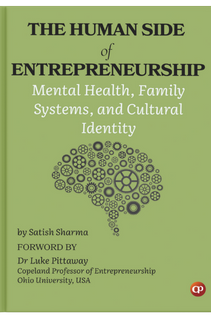
This chapter is a part of: The Human Side of Entrepreneurship: Mental Health, Family Systems, and Cultural Identity from India
ISBN (Ebook):978-93-49926-21-9
ISBN (Hardcover Print):978-93-49926-09-7
ISBN (Softcover Print):978-93-49926-53-0
© CSMFL Publications & its authors.
Published: March 5, 2026
Abstract
There are various conceptual foundations necessary for comprehending entrepreneurship as a multidimensional journey shaped by psychological, familial, and cultural factors. This chapter goes beyond traditional definitions that focus solely on venture creation to present entrepreneurship as a complex human experience embedded within social contexts. The chapter delineates four interconnected dimensions—mental processes, family systems, cultural contexts, and entrepreneurial phases—that influence entrepreneurial trajectories. The scholarly literature from psychology, family business studies, cultural anthropology, and entrepreneurship theory, has been reviewed to suggest an integrated framework to guide subsequent chapters. This model portrays entrepreneurship not merely as an economic activity but as a profoundly human endeavor influenced by cognitive patterns, family relationships, and cultural narratives. We introduce the concept of entrepreneurial sustainability as contingent upon the harmony between personal well-being, family interactions, and cultural adaptability.
Keywords: Entrepreneurial Ventures, Family Systems, Mental Health, Cultural Context, Entrepreneurial Identity
References
- Ahmetoglu, G., Leutner, F., & Chamorro-Premuzic, T. (2011). EQ-nomics: Understanding the relationship between individual differences in trait emotional intelligence and entrepreneurship. Personality and Individual Differences, 51(8), 1028-1033.
- Aldrich, H. E., & Cliff, J. E. (2003). The pervasive effects of family on entrepreneurship: Toward a family embeddedness perspective. Journal of Business Venturing, 18(5), 573-596.
- Aldrich, H. E., & Martinez, M. A. (2001). Many are called, but few are chosen: An evolutionary perspective for the study of entrepreneurship. Entrepreneurship Theory and Practice, 25(4), 41-56.
- Audretsch, D. B. (2012). Entrepreneurship research. Management Decision, 50(5), 755-764.
- Bandura, A. (1986). Social foundations of thought and action: A social cognitive theory. Prentice-Hall.
- Baron, R. A. (2006). Opportunity recognition as pattern recognition: How entrepreneurs “connect the dots” to identify new business opportunities. Academy of Management Perspectives, 20(1), 104-119.
- Brannon, D. L., Wiklund, J., & Haynie, J. M. (2013). The varying effects of family relationships in entrepreneurial teams. Entrepreneurship Theory and Practice, 37(1), 107-132.
- Cardon, M. S., Foo, M. D., Shepherd, D., & Wiklund, J. (2012). Exploring the heart: Entrepreneurial emotion is a hot topic. Entrepreneurship Theory and Practice, 36(1), 1-10.
- Carr, J. C., & Sequeira, J. M. (2007). Prior family business exposure as intergenerational influence and entrepreneurial intent: A theory of planned behavior approach. Journal of Business Research, 60(10), 1090-1098.
- Dacin, M. T., Dacin, P. A., & Tracey, P. (2011). Social entrepreneurship: A critique and future directions. Organization Science, 22(5), 1203-1213.
- Delmar, F., & Shane, S. (2004). Legitimating first: Organizing activities and the survival of new ventures. Journal of Business Venturing, 19(3), 385-410.
- DeTienne, D. R. (2010). Entrepreneurial exit as a critical component of the entrepreneurial process: Theoretical development. Journal of Business Venturing, 25(2), 203-215.
- Drori, I., Honig, B., & Wright, M. (2009). Transnational entrepreneurship: An emergent field of study. Entrepreneurship Theory and Practice, 33(5), 1001-1022.
- Eddleston, K. A., & Powell, G. N. (2012). Nurturing entrepreneurs’ work-family balance: A gendered perspective. Entrepreneurship Theory and Practice, 36(3), 513-541.
- Gupta, V., & Levenburg, N. (2010). A thematic analysis of cultural variations in family businesses: The CASE project. Family Business Review, 23(2), 155-169.
- Hayton, J. C., George, G., & Zahra, S. A. (2002). National culture and entrepreneurship: A review of behavioral research. Entrepreneurship Theory and Practice, 26(4), 33-52.
- Hofstede, G. (1980). Culture’s consequences: International differences in work-related values. Sage Publications.
- Jaskiewicz, P., Combs, J. G., & Rau, S. B. (2015). Entrepreneurial legacy: Toward a theory of how some family firms nurture transgenerational entrepreneurship. Journal of Business Venturing, 30(1), 29-49.
- Khavul, S., Bruton, G. D., & Wood, E. (2009). Informal family business in Africa. Entrepreneurship Theory and Practice, 33(6), 1219-1238.
- Krueger, N., Liñán, F., & Nabi, G. (2013). Cultural values and entrepreneurship. Entrepreneurship & Regional Development, 25(9-10), 703-707.
- Lounsbury, M., & Glynn, M. A. (2001). Cultural entrepreneurship: Stories, legitimacy, and the acquisition of resources. Strategic Management Journal, 22(6-7), 545-564.
- McMullen, J. S., & Dimov, D. (2013). Time and the entrepreneurial journey: The problems and promise of studying entrepreneurship as a process. Journal of Management Studies, 50(8), 1481-1512.
- McMullen, J. S., & Shepherd, D. A. (2006). Entrepreneurial action and the role of uncertainty in the theory of the entrepreneur. Academy of Management Review, 31(1), 132-152.
- Mitchell, R. K., Busenitz, L., Lant, T., McDougall, P. P., Morse, E. A., & Smith, J. B. (2002). Toward a theory of entrepreneurial cognition: Rethinking the people side of entrepreneurship research. Entrepreneurship Theory and Practice, 27(2), 93-104.
- Politis, D. (2005). The process of entrepreneurial learning: A conceptual framework. Entrepreneurship Theory and Practice, 29(4), 399-424.
- Randerson, K., Bettinelli, C., Fayolle, A., & Anderson, A. (2015). Family entrepreneurship as a field of research: Exploring its contours and contents. Journal of Family Business Strategy, 6(3), 143-154.
- Rauch, A., & Frese, M. (2007). Let’s put the person back into entrepreneurship research: A meta-analysis on the relationship between business owners’personality traits, business creation, and success. European Journal of Work and Organizational Psychology, 16(4), 353-385.
- Rogoff, E. G., & Heck, R. K. Z. (2003). Evolving research in entrepreneurship and family business: Recognizing family as the oxygen that feeds the fire of entrepreneurship. Journal of Business Venturing, 18(5), 559-566.
- Sarasvathy, S. D. (2001). Causation and effectuation: Toward a theoretical shift from economic inevitability to entrepreneurial contingency. Academy of Management Review, 26(2), 243-263.
- Schumpeter, J. A. (1934). The theory of economic development: An inquiry into profits, capital, credit, interest, and the business cycle. Harvard University Press.
- Shane, S. (2000). Prior knowledge and the discovery of entrepreneurial opportunities. Organization Science, 11(4), 448-469.
- Shane, S., & Venkataraman, S. (2000). The promise of entrepreneurship as a field of research. Academy of Management Review, 25(1), 217-226.
- Shepherd, D. A. (2015). Party On! A call for entrepreneurship research that is more interactive, activity based, cognitively hot, compassionate, and prosocial. Journal of Business Venturing, 30(4), 489-507.
- Shepherd, D. A., & Patzelt, H. (2017). Trailblazing in entrepreneurship: Creating new paths for understanding the field. Palgrave Macmillan.
- Shepherd, D. A., Wennberg, K., Suddaby, R., & Wiklund, J. (2019). What are we explaining? A review and agenda on initiating, engaging, performing, and contextualizing entrepreneurship. Journal of Management, 45(1), 159-196.
- Steier, L. (2007). New venture creation and organization: A familial sub-narrative. Journal of Business Research, 60(10), 1099-1107.
- Stephan, U. (2018). Entrepreneurs’ mental health and well-being: A review and research agenda. Academy of Management Perspectives, 32(3), 290-322.
- Stephan, U., & Uhlaner, L. M. (2010). Performance-based vs socially supportive culture: A cross-national study of descriptive norms and entrepreneurship. Journal of International Business Studies, 41(8), 1347-1364.
- Terjesen, S., & Elam, A. (2009). Transnational entrepreneurs’ venture internationalization strategies: A practice theory approach. Entrepreneurship Theory and Practice, 33(5), 1093-1120.
- Wasserman, N. (2012). The founder’s dilemmas: Anticipating and avoiding the pitfalls that can sink a startup. Princeton University Press.
- Weick, K. E. (1995). Sensemaking in organizations. Sage Publications.
- Welter, F. (2011). Contextualizing entrepreneurship—conceptual challenges and ways forward. Entrepreneurship Theory and Practice, 35(1), 165-184.
- Wiklund, J., Hatak, I., Patzelt, H., & Shepherd, D. A. (2018). Mental disorders in the entrepreneurship context: When being different can be an advantage. Academy of Management Perspectives, 32(3), 182-206.
- Wyrwich, M. (2015). Entrepreneurship and the intergenerational transmission of values. Small Business Economics, 45(1), 191-213.
- Zhao, H., & Seibert, S. E. (2006). The big five personality dimensions and entrepreneurial status: A meta-analytical review. Journal of Applied Psychology, 91(2), 259-271.
This book is available worldwide via EBSCOhost Academic Collection, EBSCO E- books, Google Play Books, Amazon, World Cat Discovery Service/OCLC, CSMFL Bookstore, and 200+ book resellers and academic content vendors.
Statement on Publication Ethics
We, at CSMFL Publications, are committed to ensure the unbiased and transparent publishing, and upholding the high standards of editorial integrity in our publications. To know more, please read our Statement on Publication Ethics, Editorial Integrity & Misconduct