Digital Wellness: Technology Tools for Entrepreneurial Mental Health
Satish Sharma
Lead Management Consultant, SKS Consulting & Advisors, India.
10.46679/9789349926219ch07
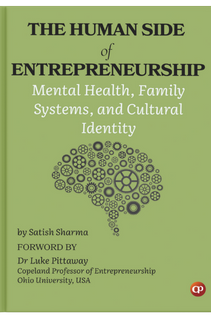
This chapter is a part of: The Human Side of Entrepreneurship: Mental Health, Family Systems, and Cultural Identity from India
ISBN (Ebook):978-93-49926-21-9
ISBN (Hardcover Print):978-93-49926-09-7
ISBN (Softcover Print):978-93-49926-53-0
© CSMFL Publications & its authors.
Published: March 5, 2026
Abstract
Digital tools can both enhance and harm the mental health and work-life balance of entrepreneurs, creating a complex relationship that deserves careful analysis. This chapter draws from psychology, entrepreneurship studies, and information systems research to evaluate digital mental health resources, boundary management applications, virtual support communities, and mindful technology practices for entrepreneurs. The chapter reviews the theoretical frameworks on techno-stress, digital mindfulness, and online social support with empirical research and develops evidence-based recommendations for practitioners. Technology creates novel opportunities for entrepreneurs to improve their well-being. However, effective implementation requires intentional and strategic approaches to avoid potential negative consequences. The chapter proposes a framework for technology-enabled entrepreneurial well-being that stresses upon four key dimensions: personalization, integration, community, and mindfulness. These elements work together to maximize the positive impact of digital tools on entrepreneur health and business sustainability.
Keywords: Entrepreneurial Well-being, Digital Mental Health, Technostress
References
- Allen, T. D., Merlo, K., Lawrence, R. C., Slutsky, J., & Gray, C. E. (2021). Boundary management and work-nonwork balance while working from home. Applied Psychology, 70(1), 60-84.
- Anderson, J., & Rainie, L. (2018). The future of well-being in a tech-saturated world. Pew Research Center.
- Bakker, D., Kazantzis, N., Rickwood, D., & Rickard, N. (2016). Mental health smartphone apps: Review and evidence-based recommendations for future developments. JMIR Mental Health, 3(1), e7.
- Barber, L. K., & Santuzzi, A. M. (2015). Please respond ASAP: Workplace telepressure and employee recovery. Journal of Occupational Health Psychology, 20(2), 172-189.
- Barley, S. R., Meyerson, D. E., & Grodal, S. (2011). E-mail as a source and symbol of stress. Organization Science, 22(4), 887-906.
- Benlian, A., Klumpe, J., & Hinz, O. (2020). Mitigating the intrusive effects of smart home assistants by using anthropomorphic design features: A multimethod investigation. Information Systems Journal, 30(6), 1010-1042.
- Benz, M., & Frey, B. S. (2008). Being independent is a great thing: Subjective evaluations of self-employment and hierarchy. Economica, 75(298), 362-383.
- Boudreaux, E. D., Waring, M. E., Hayes, R. B., Sadasivam, R. S., Mullen, S., & Pagoto, S. (2014). Evaluating and selecting mobile health apps: Strategies for healthcare providers and healthcare organizations. Translational Behavioral Medicine, 4(4), 363-371.
- Cardon, M. S., & Patel, P. C. (2015). Is stress worth it? Stress-related health and wealth trade-offs for entrepreneurs. Applied Psychology, 64(2), 379-420.
- Cardon, M. S., Foo, M. D., Shepherd, D., & Wiklund, J. (2012). Exploring the heart: Entrepreneurial emotion is a hot topic. Entrepreneurship Theory and Practice, 36(1), 1-10.
- Carter, M., & Grover, V. (2015). Me, my self, and I(T): Conceptualizing information technology identity and its implications. MIS Quarterly, 39(4), 931-958.
- Champion, L., Economides, M., & Chandler, C. (2018). The efficacy of a brief app-based mindfulness intervention on psychosocial outcomes in healthy adults: A pilot randomised controlled trial. PloS One, 13(12), e0209482.
- Cirillo, F. (2018). The Pomodoro technique: The acclaimed time-management system that has transformed how we work. Currency.
- Clark, M. A., Michel, J. S., Zhdanova, L., Pui, S. Y., & Baltes, B. B. (2016). All work and no play? A meta-analytic examination of the correlates and outcomes of workaholism. Journal of Management, 42(7), 1836-1873.
- Cohen, S., & Brissette, I. (1997). Social ties and susceptibility to the common cold. JAMA, 277(24), 1940-1944.
- Crawford, G. C., Aguinis, H., Lichtenstein, B., Davidsson, P., & McKelvey, B. (2015). Power law distributions in entrepreneurship: Implications for theory and research. Journal of Business Venturing, 30(5), 696-713.
- Eddleston, K. A., & Powell, G. N. (2012). Nurturing entrepreneurs’ work-family balance: A gendered perspective. Entrepreneurship Theory and Practice, 36(3), 513-541.
- Firth, J., Torous, J., Nicholas, J., Carney, R., Pratap, A., Rosenbaum, S., & Sarris, J. (2017). The efficacy of smartphone-based mental health interventions for depressive symptoms: A meta-analysis of randomized controlled trials. World Psychiatry, 16(3), 287-298.
- Fischer, D., Stanszus, L., Geiger, S., Grossman, P., & Schrader, U. (2017). Mindfulness and sustainable consumption: A systematic literature review of research approaches and findings. Journal of Cleaner Production, 162, 544-558.
- Goleman, D., & Davidson, R. J. (2017). Altered traits: Science reveals how meditation changes your mind, brain, and body. Avery.
- Harris, T. (2016). How technology hijacks people’s minds—from a magician and Google’s design ethicist. Medium.
- Holesh, K. (2018). Moment – Screen time tracker. Apple App Store. https://apps.apple.com/us/app/moment-screen-time-tracker/id771541926
- Huang, H. C., Lai, M. C., Lin, L. H., & Chen, C. T. (2013). Overcoming organizational inertia to strengthen business model innovation: An open innovation perspective. Journal of Organizational Change Management, 26(6), 977-1002.
- Kossek, E. E., Ruderman, M. N., Braddy, P. W., & Hannum, K. M. (2012). Work-nonwork boundary management profiles: A person-centered approach. Journal of Vocational Behavior, 81(1), 112-128.
- Kuhn, K. M., & Galloway, T. L. (2015). With a little help from my competitors: Peer networking among artisan entrepreneurs. Entrepreneurship Theory and Practice, 39(3), 571-600.
- Kuhn, K., Galloway, T., & Collins-Williams, M. (2016). Near, far, and online: Small business owners’ advice-seeking from peers. Journal of Small Business and Enterprise Development, 23(1), 189-206.
- Kushlev, K., & Dunn, E. W. (2015). Checking email less frequently reduces stress. Computers in Human Behavior, 43, 220-228.
- Lattie, E. G., Adkins, E. C., Winquist, N., Stiles-Shields, C., Wafford, Q. E., & Graham, A. K. (2019). Digital mental health interventions for depression, anxiety, and enhancement of psychological well-being among college students: Systematic review. Journal of Medical Internet Research, 21(7), e12869.
- Li, J., Wong, S. C., Yang, X., & Bell, A. (2020). Using feedback to promote student participation in online learning programs: Evidence from a quasi-experimental study. Educational Technology Research and Development, 68(1), 485-510.
- Linardon, J., Cuijpers, P., Carlbring, P., Messer, M., & Fuller-Tyszkiewicz, M. (2019). The efficacy of app-supported smartphone interventions for mental health problems: A meta-analysis of randomized controlled trials. World Psychiatry, 18(3), 325-336.
- Loué, C., & Baronet, J. (2012). Toward a new entrepreneurial skills and competencies framework: A qualitative and quantitative study. International Journal of Entrepreneurship and Small Business, 17(4), 455-477.
- Lupton, D. (2016). The quantified self: A sociology of self-tracking. Polity.
- Mark, G., Iqbal, S. T., Czerwinski, M., Johns, P., Sano, A., & Lutchyn, Y. (2016). Email duration, batching and self-interruption: Patterns of email use on productivity and stress. Proceedings of the 2016 CHI Conference on Human Factors in Computing Systems, 1717-1728.
- Mark, G., Czerwinski, M., & Iqbal, S. T. (2018). Effects of individual differences in blocking workplace distractions. Proceedings of the 2018 CHI Conference on Human Factors in Computing Systems, Paper No. 92.
- Martinez, M. A., & Aldrich, H. E. (2011). Networking strategies for entrepreneurs: Balancing cohesion and diversity. International Journal of Entrepreneurial Behavior & Research, 17(1), 7-38.
- Mazmanian, M., Orlikowski, W. J., & Yates, J. (2013). The autonomy paradox: The implications of mobile email devices for knowledge professionals. Organization Science, 24(5), 1337-1357.
- McKeever, E., Jack, S., & Anderson, A. (2015). Embedded entrepreneurship in the creative re-construction of place. Journal of Business Venturing, 30(1), 50-65.
- Motoyama, Y., Goetz, S., & Han, Y. (2018). Where do entrepreneurs get information? An analysis of Twitter-following patterns. Journal of Small Business & Entrepreneurship, 30(3), 253-274.
- Murnieks, C. Y., Arthurs, J. D., Cardon, M. S., Farah, N., Stornelli, J., & Haynie, J. M. (2020). Close your eyes or open your mind: Effects of sleep and mindfulness exercises on entrepreneur exhaustion. Journal of Business Venturing, 35(2), 105918.
- Nambisan, S. (2017). Digital entrepreneurship: Toward a digital technology perspective of entrepreneurship. Entrepreneurship Theory and Practice, 41(6), 1029-1055.
- Newport, C. (2019). Digital minimalism: Choosing a focused life in a noisy world. Portfolio.
- Peake, J. M., Kerr, G., & Sullivan, J. P. (2018). A critical review of consumer wearables, mobile applications, and equipment for providing biofeedback, monitoring stress, and sleep in physically active populations. Frontiers in Physiology, 9, 743.
- Pollack, J. M., Vanepps, E. M., & Hayes, A. F. (2012). The moderating role of social ties on entrepreneurs’ depressed affect and withdrawal intentions in response to economic stress. Journal of Organizational Behavior, 33(6), 789-810.
- Porter, C. E., & Ispa, J. M. (2013). Mothers’ online message board questions about parenting infants and toddlers. Journal of Advanced Nursing, 69(3), 559-568.
- Przybylski, A. K., Murayama, K., DeHaan, C. R., & Gladwell, V. (2019). Motivational, emotional, and behavioral correlates of fear of missing out. Computers in Human Behavior, 29(4), 1841-1848.
- Ratten, V. (2020). Coronavirus (Covid-19) and entrepreneurship: Changing life and work landscape. Journal of Small Business & Entrepreneurship, 32(5), 503-516.
- Shepherd, D. A. (2020). COVID 19 and entrepreneurship: Time to pivot? Journal of Management Studies, 57(8), 1750-1753.
- Shepherd, D. A., & Haynie, J. M. (2009). Birds of a feather don’t always flock together: Identity management in entrepreneurship. Journal of Business Venturing, 24(4), 316-337.
- Shepherd, D. A., & Patzelt, H. (2015). The “heart” of entrepreneurship: The impact of entrepreneurial action on health and health on entrepreneurial action. Journal of Business Venturing Insights, 4, 22-29.
- Shepherd, D. A., & Williams, T. A. (2018). Hitting rock bottom after job loss: Bouncing back to create a new positive work identity. Academy of Management Review, 43(1), 28-49.
- Shir, N., Nikolaev, B. N., & Wincent, J. (2019). Entrepreneurship and well-being: The role of psychological autonomy, competence, and relatedness. Journal of Business Venturing, 34(5), 105875.
- Sonnentag, S., & Fritz, C. (2015). Recovery from job stress: The stressor-detachment model as an integrative framework. Journal of Organizational Behavior, 36(S1), S72-S103.
- Stephan, U. (2018). Entrepreneurs’ mental health and well-being: A review and research agenda. Academy of Management Perspectives, 32(3), 290-322.
- Stich, J. F., Tarafdar, M., Stacey, P., & Cooper, S. C. (2019). Appraisal of email use as a source of workplace stress: A person-environment fit approach. Journal of the Association for Information Systems, 20(2), 132-160.
- Syvertsen, T., & Enli, G. (2019). Digital detox: Media resistance and the promise of authenticity. Convergence: The International Journal of Research into New Media Technologies, 26(5-6), 1269-1283.
- Tarafdar, M., Cooper, C. L., & Stich, J. F. (2019). The technostress trifecta – techno eustress, techno distress and design: Theoretical directions and an agenda for research. Information Systems Journal, 29(1), 6-42.
- Terry, D. J., Nielsen, M., & Perchard, L. (1993). Effects of work stress on psychological well-being and job satisfaction: The stress-buffering role of social support. Australian Journal of Psychology, 45(3), 168-175.
- Torous, J., Wisniewski, H., Liu, G., & Keshavan, M. (2018). Mental health mobile phone app usage, concerns, and benefits among psychiatric outpatients: Comparative survey study. JMIR Mental Health, 5(4), e11715.
- Van Gordon, W., Shonin, E., Dunn, T. J., Garcia-Campayo, J., Demarzo, M. M., & Griffiths, M. D. (2017). Meditation awareness training for the treatment of workaholism: A controlled trial. Journal of Behavioral Addictions, 6(2), 212-220.
- Verduyn, P., Ybarra, O., Résibois, M., Jonides, J., & Kross, E. (2017). Do social network sites enhance or undermine subjective well-being? A critical review. Social Issues and Policy Review, 11(1), 274-302.
- Ward, A. F. (2013). Supernormal: How the internet is changing our memories and our minds. Psychological Inquiry, 24(4), 341-348.
- Weinstein, N., Przybylski, A. K., & Ryan, R. M. (2012). The index of autonomous functioning: Development of a scale of human autonomy. Journal of Research in Personality, 46(4), 397–413.
- Wiklund, J., Nikolaev, B., Shir, N., Foo, M. D., & Bradley, S. (2019). Entrepreneurship and well-being: Past, present, and future. Journal of Business Venturing, 34(4), 579-588.
- Williamson, A. J., Battisti, M., Leatherbee, M., & Gish, J. J. (2018). Rest, Zest, and My Innovative Best: Sleep and Mood as Drivers of Entrepreneurs’ Innovative Behavior. Entrepreneurship Theory and Practice, 43(3), 582-610.
- Yang, E., Schamber, E., Meyer, R. M., & Gold, J. I. (2018). Happier healers: Randomized controlled trial of mobile mindfulness for stress management. The Journal of Alternative and Complementary Medicine, 24(5), 505-513.
This book is available worldwide via EBSCOhost Academic Collection, EBSCO E- books, Google Play Books, Amazon, World Cat Discovery Service/OCLC, CSMFL Bookstore, and 200+ book resellers and academic content vendors.
Statement on Publication Ethics
We, at CSMFL Publications, are committed to ensure the unbiased and transparent publishing, and upholding the high standards of editorial integrity in our publications. To know more, please read our Statement on Publication Ethics, Editorial Integrity & Misconduct