Entrepreneurship Across The Lifespan: Age, Stage, and Support Systems
Satish Sharma
Lead Management Consultant, SKS Consulting & Advisors, India.
10.46679/9789349926219ch09
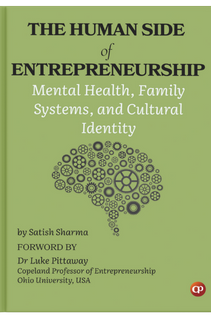
This chapter is a part of: The Human Side of Entrepreneurship: Mental Health, Family Systems, and Cultural Identity from India
ISBN (Ebook):978-93-49926-21-9
ISBN (Hardcover Print):978-93-49926-09-7
ISBN (Softcover Print):978-93-49926-53-0
© CSMFL Publications & its authors.
Published: March 5, 2026
Abstract
Entrepreneurship manifests differently across various age groups. This chapter investigates how life circumstances fundamentally influence entrepreneurial paths, possibilities, and results. We examine existing research and theoretical models to address four key dimensions: emerging entrepreneurs developing core competencies, established professionals leaving traditional careers, mature adults entering business ownership as a new phase, and the changing support structures required throughout the entrepreneurial process. Emerging entrepreneurs possess technological skills and willingness to take risks. They struggle with securing investment and establishing professional reputation. Established professionals bring industry knowledge and professional connections while balancing competing priorities and family responsibilities. Mature entrepreneurs offer substantial experience and financial resources yet confront age-related biases and technological learning curves.
Different life phases demand specialized support structures that include education, mentorship, financing, and network development. This chapter shows that entrepreneurs from various age groups contribute distinct value to innovation environments. Ventures succeed across all life phases when suitable support mechanisms exist. Recognizing developmental patterns helps entrepreneurs, support institutions, and government officials create better strategies that optimize business success while acknowledging the specific benefits and obstacles that characterize different age categories. Research indicates that universal entrepreneurship support may prove insufficient. Focused interventions addressing particular developmental considerations can substantially improve individual business success and wider economic influence.
Keywords: Entrepreneurship, Life Phases, Emerging Entrepreneurs, Career Transitions, Mature Entrepreneurship
References
- Azoulay, P., Jones, B. F., Kim, J. D., & Miranda, J. (2020). Age and high-growth entrepreneurship. American Economic Review: Insights, 2(1), 65-82.
- Kautonen, T., Down, S., & Minniti, M. (2014). Ageing and entrepreneurial preferences. Small Business Economics, 42(3), 579-594.
- Kautonen, T., Kibler, E., & Minniti, M. (2017). Late-career entrepreneurship, income and quality of life. Journal of Business Venturing, 32(3), 318-333.
- Levesque, M., & Minniti, M. (2006). The effect of aging on entrepreneurial behavior. Journal of Business Venturing, 21(2), 177-194.
- Morris, M. H., Webb, J. W., Fu, J., & Singhal, S. (2013). A competency-based perspective on entrepreneurship education: Conceptual and empirical insights. Journal of Small Business Management, 51(3), 352-369.
- Neck, H. M., & Greene, P. G. (2011). Entrepreneurship education: Known worlds and new frontiers. Journal of Small Business Management, 49(1), 55-70.
- Shane, S. (2003). A general theory of entrepreneurship: The individual-opportunity nexus. Edward Elgar Publishing.
This book is available worldwide via EBSCOhost Academic Collection, EBSCO E- books, Google Play Books, Amazon, World Cat Discovery Service/OCLC, CSMFL Bookstore, and 200+ book resellers and academic content vendors.
Statement on Publication Ethics
We, at CSMFL Publications, are committed to ensure the unbiased and transparent publishing, and upholding the high standards of editorial integrity in our publications. To know more, please read our Statement on Publication Ethics, Editorial Integrity & Misconduct