Industry-Specific Mental Health: Challenges Across Business Sectors
Satish Sharma
Lead Management Consultant, SKS Consulting & Advisors, India.
10.46679/9789349926219ch10
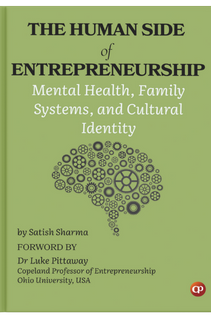
This chapter is a part of: The Human Side of Entrepreneurship: Mental Health, Family Systems, and Cultural Identity from India
ISBN (Ebook):978-93-49926-21-9
ISBN (Hardcover Print):978-93-49926-09-7
ISBN (Softcover Print):978-93-49926-53-0
© CSMFL Publications & its authors.
Published: March 5, 2026
Abstract
Entrepreneurs across different industries face distinct mental health challenges that vary significantly based on their sectoral context. Every sector has unique psychological stressors and demands unique coping strategies from business founders. This chapter analyses high-stress sectors including technology, finance, and hospitality to study how these industry specific characteristics directly influence entrepreneurial mental health outcomes. Creative entrepreneurs encounter particular difficulties related to emotional labor requirements. Social entrepreneurs frequently experience compassion fatigue from their mission-driven work. Rural and remote entrepreneurs face geographic isolation challenges that compound typical business stresses. This analysis draws from occupational health psychology research, entrepreneurship studies, and sector-specific investigations to understand how industry context shapes mental health experiences for business founders. Entrepreneurship presents common mental health challenges regardless of sector. However, industry-specific factors either intensify or alter these experiences substantially. This variation requires customized mental health support systems and intervention strategies tailored to each sector’s unique demands.
Keywords: Entrepreneurial Mental Health, Industry-specific Stress, Emotional Labor, Compassion Fatigue
References
- Bacq, S., & Alt, E. (2018). Feeling capable and valued? A prosocial perspective on the link between empathy and social entrepreneurial intentions. Journal of Business Venturing, 33(3), 333-350.
- Bakker, A. B., & Demerouti, E. (2017). Job demands–resources theory: Taking stock and looking forward. Journal of Occupational Health Psychology, 22(3), 273-285.
- Banks, M., & O’Connor, J. (2017). Inside the whale (and how to get out of there): Moving on from two decades of creative industries research. European Journal of Cultural Studies, 20(6), 637-654.
- Lattie EG, Adkins EC, Winquist N, Stiles-Shields C, Wafford QE, Graham AK. (2019). Digital Mental Health Interventions for Depression, Anxiety, and Enhancement of Psychological Well-Being Among College Students: Systematic Review. Journal of Medical Internet Research, 21(7), e12869.
- Bridgstock, R. (2013). Not a dirty word: Arts entrepreneurship and higher education. Arts and Humanities in Higher Education, 12(2-3), 122-137.
- Buttner, E. H., & Moore, D. P. (1997). Women’s organizational exodus to entrepreneurship: Self-reported motivations and correlates with success. Journal of Small Business Management, 35(1), 34-46.
- Dees, J. G. (2012). A tale of two cultures: Charity, problem solving, and the future of social entrepreneurship. Journal of Business Ethics, 111(3), 321-334.
- Ebrahim, A., & Rangan, V. K. (2014). What impact? A framework for measuring the scale and scope of social performance. California Management Review, 56(3), 118-141.
- Edwards, J. R., Caplan, R. D., & Van Harrison, R. (1998). Person-environment fit theory: Conceptual foundations, empirical evidence, and directions for future research. In C. L. Cooper (Ed.), Theories of organizational stress (pp. 28-67). Oxford University Press.
- Eikhof, D. R., & Haunschild, A. (2007). For art’s sake! Artistic and economic logics in creative production. Journal of Organizational Behavior, 28(5), 523-538.
- Figley, C. R. (2002). Compassion fatigue: Psychotherapists’ chronic lack of self care. Journal of Clinical Psychology, 58(11), 1433-1441.
- Freeman, M. A., Johnson, S. L., Staudenmaier, P. J., & Zisser, M. R. (2015). Are entrepreneurs “touched with fire”?
- Grandey, A. A., & Gabriel, A. S. (2015). Emotional labor at a crossroads: Where do we go from here? Annual Review of Organizational Psychology and Organizational Behavior, 2(1), 323-349.
- Hmieleski, K. M., & Powell, E. E. (2018). The psychological foundations of university science commercialization: A review of the literature and directions for future research. Academy of Management Perspectives, 32(1), 43-77.
- Hobfoll, S. E. (1989). Conservation of resources: A new attempt at conceptualizing stress. American Psychologist, 44(3), 513-524.
- Hochschild, A. R. (1983). The managed heart: Commercialization of human feeling. University of California Press.
- Kapoulitsas, M., & Corcoran, T. (2015). Compassion fatigue and resilience: A qualitative analysis of social work practice. Qualitative Social Work, 14(1), 86-101.
- Kim, J. S., & Stoner, M. (2008). Burnout and turnover intention among social workers: Effects of role stress, job autonomy and social support. Administration in Social Work, 32(3), 5-25.
- Korsgaard, S., Ferguson, R., & Gaddefors, J. (2015). The best of both worlds: how rural entrepreneurs use placial embeddedness and strategic networks to create opportunities. Entrepreneurship & Regional Development, 27(9–10), 574–598.
- Marshall, N. A., Park, S. E., Adger, W. N., Brown, K., & Howden, S. M. (2012). Transformational capacity and the influence of place and identity. Environmental Research Letters, 7(3), 034022.
- McRobbie, A. (2016). Be creative: Making a living in the new culture industries. Polity Press.
- Miller, T. L., Grimes, M. G., McMullen, J. S., & Vogus, T. J. (2012). Venturing for others with heart and head: How compassion encourages social entrepreneurship. Academy of Management Review, 37(4), 616-640.
- Munoz, P., Kibler, E., Mandakovic, V., & Amorós, J. E. (2022). Local entrepreneurial ecosystems as configural narratives: A new way of seeing and evaluating antecedents and outcomes. Research Policy, 51(9), 104065.
- Nanda, R., & Rhodes-Kropf, M. (2013). Investment cycles and startup innovation. Journal of Financial Economics, 110(2), 403-418.
- Nicholls, A. (2010). The institutionalization of social investment: The interplay of investment logics and investor rationalities. Journal of Social Entrepreneurship, 1(1), 70-100.
- Peters, M., & Kallmuenzer, A. (2018). Entrepreneurial orientation in family firms: The case of the hospitality industry. Current Issues in Tourism, 21(1), 21-40.
- Pollack, J. M., Vanepps, E. M., & Hayes, A. F. (2012). The moderating role of social ties on entrepreneurs’ depressed affect and withdrawal intentions in response to economic stress. Journal of Organizational Behavior, 33(6), 789-810.
- Yec. (2019). The psychological price of entrepreneurship. Inc. Magazine.
- Smalley, K. B., Yancey, C. T., Warren, J. C., Naufel, K., Ryan, R., & Pugh, J. L. (2010). Rural mental health and psychological treatment: A review for practitioners. Journal of Clinical Psychology, 66(5), 479-489.
- Stathopoulou, S., Psaltopoulos, D., & Skuras, D. (2004). Rural entrepreneurship in Europe: A research framework and agenda. International Journal of Entrepreneurial Behavior & Research, 10(6), 404-425.
- Stephan, U. (2018). Entrepreneurs’ mental health and well-being: A review and research agenda. Academy of Management Perspectives, 32(3), 290-322.
- Throsby, D., & Zednick, A. (2010). Do you really expect to get paid? An economic study of professional artists in Australia. Australia Council for the Arts.
This book is available worldwide via EBSCOhost Academic Collection, EBSCO E- books, Google Play Books, Amazon, World Cat Discovery Service/OCLC, CSMFL Bookstore, and 200+ book resellers and academic content vendors.
Statement on Publication Ethics
We, at CSMFL Publications, are committed to ensure the unbiased and transparent publishing, and upholding the high standards of editorial integrity in our publications. To know more, please read our Statement on Publication Ethics, Editorial Integrity & Misconduct