Redefining Success: Comprehensive Metrics for Entrepreneurial Flourishing
Satish Sharma
Lead Management Consultant, SKS Consulting & Advisors, India.
10.46679/9789349926219ch13
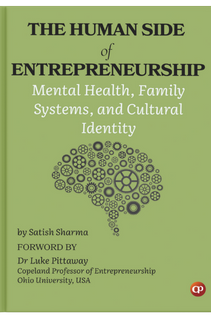
This chapter is a part of: The Human Side of Entrepreneurship: Mental Health, Family Systems, and Cultural Identity from India
ISBN (Ebook):978-93-49926-21-9
ISBN (Hardcover Print):978-93-49926-09-7
ISBN (Softcover Print):978-93-49926-53-0
© CSMFL Publications & its authors.
Published: March 5, 2026
Abstract
Success is rarely just about money. This chapter measure entrepreneurial achievements that go beyond typical financial data, looking at well-being, societal contribution, and lasting viability. It highlights the shortcomings of focusing only on profits under the light of existing scholarly findings. It then outlines inclusive models for gauging entrepreneurial thriving. The discussion integrates ideas from positive psychology, stakeholder theory, and sustainable enterprise studies to suggest multiple success criteria that balance financial results with personal satisfaction, family cohesion, and community benefit. By examining longitudinal investigations and practical cases, this chapter shows how entrepreneurs can craft definitions of success that reflect their principles and life aims while keeping their businesses afloat.
Keywords: Entrepreneurial Success, Holistic Metrics, Well-Being, Work-Life Balance, Sustainable Entrepreneurship
References
- Acs, Z. J., & Armington, C. (2006). Entrepreneurship, geography, and American economic growth. Cambridge University Press.
- Adler, P. S., & Kwon, S. W. (2002). Social capital: Prospects for a new concept. Academy of Management Review, 27(1), 17-40.
- Aldrich, H. E., & Cliff, J. E. (2003). The pervasive effects of family on entrepreneurship: Toward a family embeddedness perspective. Journal of Business Venturing, 18(5), 573-596.
- Anderson, R. C., & White, R. (2009). Confessions of a radical industrialist: Profits, people, purpose–doing business by respecting the Earth. St. Martin’s Press.
- Baron, R. A. (2008). The role of affect in the entrepreneurial process. Academy of Management Review, 33(2), 328-340.
- Cardon, M. S., Wincent, J., Singh, J., & Drnovsek, M. (2009). The nature and experience of entrepreneurial passion. Academy of Management Review, 34(3), 511-532.
- Cassar, G. (2007). Money, money, money? A longitudinal investigation of entrepreneur career reasons, growth preferences and achieved growth. Entrepreneurship and Regional Development, 19(1), 89-107.
- Chen, H., Chiang, R. H., & Storey, V. C. (2012). Business intelligence and analytics: From big data to big impact. MIS Quarterly, 36(4), 1165-1188.
- Chouinard, Y. (2005). Let my people go surfing: The education of a reluctant businessman. Penguin Books.
- Collins, J. C., & Porras, J. I. (1994). Built to last: Successful habits of visionary companies. Harper Business.
- Davidsson, P., & Honig, B. (2003). The role of social and human capital among nascent entrepreneurs. Journal of Business Venturing, 18(3), 301-331.
- Davidsson, P., Steffens, P., & Fitzsimmons, J. (2009). Growing profitable or growing from profits: Putting the horse in front of the cart? Journal of Business Venturing, 24(4), 388-406.
- Dean, T. J., & McMullen, J. S. (2007). Toward a theory of sustainable entrepreneurship: Reducing environmental degradation through entrepreneurial action. Journal of Business Venturing, 22(1), 50-76.
- Dees, J. G. (1998). The meaning of social entrepreneurship. The Kauffman Center for Entrepreneurial Leadership, 1-6.
- Diener, E., Emmons, R. A., Larsen, R. J., & Griffin, S. (1985). The satisfaction with life scale. Journal of Personality Assessment, 49(1), 71-75.
- Duflo, E., Glennerster, R., & Kremer, M. (2007). Using randomization in development economics research: A toolkit. Handbook of Development Economics, 4, 3895-3962.
- Elkington, J. (1997). Cannibals with forks: The triple bottom line of 21st century business. Capstone Publishing.
- Fisher, R., Maritz, A., & Lobo, A. (2016). Does individual resilience influence entrepreneurial success? Academy of Entrepreneurship Journal, 22(2), 39-53.
- Freeman, R. E. (1984). Strategic management: A stakeholder approach. Pitman.
- Freeman, R. E., Harrison, J. S., Wicks, A. C., Parmar, B. L., & De Colle, S. (2010). Stakeholder theory: The state of the art. Cambridge University Press.
- Gartner, W. B. (2007). Entrepreneurial narrative and a science of the imagination. Journal of Business Venturing, 22(5), 613-627.
- Greenhaus, J. H., & Allen, T. D. (2011). Work-family balance: A review and extension of the literature. In J. C. Quick & L. E. Tetrick (Eds.), Handbook of occupational health psychology (2nd ed., pp. 165-183). American Psychological Association.
- Greenhaus, J. H., & Powell, G. N. (2006). When work and family are allies: A theory of work-family enrichment. Academy of Management Review, 31(1), 72-92.
- Hmieleski, K. M., & Corbett, A. C. (2008). The contrasting interaction effects of improvisational behavior with entrepreneurial self-efficacy on new venture performance and entrepreneur work satisfaction. Journal of Business Venturing, 23(4), 482-496.
- Hockerts, K., & Wüstenhagen, R. (2010). Greening Goliaths versus emerging Davids—Theorizing about the role of incumbents and new entrants in sustainable entrepreneurship. Journal of Business Venturing, 25(5), 481-492.
- Hofstede, G. H. (2001). Culture’s consequences: Comparing values, behaviors, institutions and organizations across nations. Sage Publications.
- Honeyman, R. (2014). The B Corp handbook: How to use business as a force for good. Berrett-Koehler Publishers.
- Isenberg, D. J. (2011). The entrepreneurship ecosystem strategy as a new paradigm for economic policy: Principles for cultivating entrepreneurship. Presentation at the Institute of International and European Affairs, 1(781), 1-13.
- Jaskiewicz, P., Combs, J. G., & Rau, S. B. (2015). Entrepreneurial legacy: Toward a theory of how some family firms nurture transgenerational entrepreneurship. Journal of Business Venturing, 30(1), 29-49.
- Jennings, J. E., & McDougald, M. S. (2007). Work-family interface experiences and coping strategies: Implications for entrepreneurship research and practice. Academy of Management Review, 32(3), 747-760.
- Kautonen, T., Down, S., & Minniti, M. (2014). Ageing and entrepreneurial preferences. Small Business Economics, 42(3), 579-594.
- Kossek, E. E., Ruderman, M. N., Braddy, P. W., & Hannum, K. M. (2012). Work–nonwork boundary management profiles: A person-centered approach. Journal of Vocational Behavior, 81(1), 112-128.
- Kreiner, G. E., Hollensbe, E. C., & Sheep, M. L. (2009). Balancing borders and bridges: Negotiating the work-home interface via boundary work tactics. Academy of Management Journal, 52(4), 704-730.
- Kuratko, D. F., Hornsby, J. S., & Naffziger, D. W. (1997). An examination of owner’s goals in sustaining entrepreneurship. Journal of Small Business Management, 35(1), 24-33.
- Levie, J., & Lichtenstein, B. B. (2010). A terminal assessment of stages theory: Introducing a dynamic states approach to entrepreneurship. Entrepreneurship Theory and Practice, 34(2), 317-350.
- Lyubomirsky, S., King, L., & Diener, E. (2005). The benefits of frequent positive affect: Does happiness lead to success? Psychological Bulletin, 131(6), 803-855.
- Mackey, J., & Sisodia, R. (2013). Conscious capitalism: Liberating the heroic spirit of business. Harvard Business Review Press.
- Marquis, C., & Park, A. (2014). Inside the buy-one give-one model. Stanford Social Innovation Review, 12(2), 28-33.
- Miller, D., & Le Breton-Miller, I. (2005). Managing for the long run: Lessons in competitive advantage from great family businesses. Harvard Business Review Press.
- Nambisan, S. (2017). Digital entrepreneurship: Toward a digital technology perspective of entrepreneurship. Entrepreneurship Theory and Practice, 41(6), 1029-1055.
- Nicholls, J., Lawlor, E., Neitzert, E., & Goodspeed, T. (2012). A guide to social return on investment. The SROI Network.
- Parker, S. C. (2009). The economics of entrepreneurship. Cambridge University Press.
- Parker, S. C. (2016). Family firms and the “willing successor” problem. Entrepreneurship Theory and Practice, 40(6), 1241-1259.
- Parmar, B. L., Freeman, R. E., Harrison, J. S., Wicks, A. C., Purnell, L., & De Colle, S. (2010). Stakeholder theory: The state of the art. Academy of Management Annals, 4(1), 403-445.
- Porter, M. E. (1985). Competitive advantage: Creating and sustaining superior performance. Free Press.
- Reynolds, P., & Curtin, R. (2008). Business creation in the United States: Panel study of entrepreneurial dynamics II initial assessment. Foundations and Trends in Entrepreneurship, 4(3), 155-307.
- Ryff, C. D. (1989). Happiness is everything, or is it? Explorations on the meaning of psychological well-being. Journal of Personality and Social Psychology, 57(6), 1069-1081.
- Ryff, C. D., & Keyes, C. L. M. (1995). The structure of psychological well-being revisited. Journal of Personality and Social Psychology, 69(4), 719-727.
- Santos, F. M. (2012). A positive theory of social entrepreneurship. Journal of Business Ethics, 111(3), 335-351.
- Seligman, M. E. P. (1999). The president’s address: The advantages of psychology. American Psychologist, 54(8), 559-562.
- Seligman, M. E. P. (2011). Flourish: A visionary new understanding of happiness and well-being. Free Press.
- Shane, S. (2000). Prior knowledge and the discovery of entrepreneurial opportunities. Organization Science, 11(4), 448-469.
- Shane, S., & Venkataraman, S. (2000). The promise of entrepreneurship as a field of research. Academy of Management Review, 25(1), 217-226.
- Shepherd, D. A., & Patzelt, H. (2011). The new field of sustainable entrepreneurship: Studying entrepreneurial action linking “what is to be sustained” with “what is to be developed.” Entrepreneurship Theory and Practice, 35(1), 137-163.
- Stam, E. (2015). Entrepreneurial ecosystems and regional policy: A sympathetic critique. European Planning Studies, 23(9), 1759-1769.
- Stephan, U. (2018). Entrepreneurs’ mental health and well-being: A review and research agenda. Academy of Management Perspectives, 32(3), 290-322.
- Triandis, H. C. (1995). Individualism and collectivism. Westview Press.
- Wach, D., Stephan, U., & Gorgievski, M. (2016). More than money: Developing an integrative multi-factorial measure of entrepreneurial success. International Small Business Journal, 34(8), 1098-1121.
- Watson, D., Clark, L. A., & Tellegen, A. (1988). Development and validation of brief measures of positive and negative affect: The PANAS scales. Journal of Personality and Social Psychology, 54(6), 1063-1070.
- Yin, R. K. (2014). Case study research: Design and methods (5th ed.). Sage Publications.
- York, J. G., & Venkataraman, S. (2010). The entrepreneur–environment nexus: Uncertainty, innovation, and allocation. Journal of Business Venturing, 25(5), 449-463.
- Yunus, M. (2007). Creating a world without poverty: Social business and the future of capitalism. Public Affairs.
- Zahra, S. A., Gedajlovic, E., Neubaum, D. O., & Shulman, J. M. (2009). A typology of social entrepreneurs: Motives, search processes and ethical challenges. Journal of Business Venturing, 24(5), 519-532.
This book is available worldwide via EBSCOhost Academic Collection, EBSCO E- books, Google Play Books, Amazon, World Cat Discovery Service/OCLC, CSMFL Bookstore, and 200+ book resellers and academic content vendors.
Statement on Publication Ethics
We, at CSMFL Publications, are committed to ensure the unbiased and transparent publishing, and upholding the high standards of editorial integrity in our publications. To know more, please read our Statement on Publication Ethics, Editorial Integrity & Misconduct