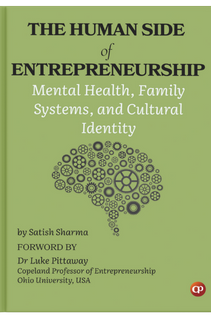
Foreword: The Human Side of Entrepreneurship: Mental Health, Family Systems, and Cultural Identity
Dr. Luke Pittaway
Copeland Professor of Entrepreneurship,Ohio University, USA.
10.46679/97893499262190
This chapter is a part of: The Human Side of Entrepreneurship: Mental Health, Family Systems, and Cultural Identity from India
ISBN (Ebook):978-93-49926-21-9
ISBN (Hardcover Print):978-93-49926-09-7
ISBN (Softcover Print):978-93-49926-53-0
© CSMFL Publications & its authors.
Published: March 5, 2026
Editorial
As a Professor of Entrepreneurship, I have researched entrepreneurship education and learning for over thirty years. It is a topic that has developed considerably during this period. However, it is only in the last ten years that the darker aspects of the entrepreneurial journey have begun to feature in studies. My colleagues and I recently published a study on entrepreneurial failure, its impact on the grief recovery process, and we explored how entrepreneurs learn as they navigate such grief. Such topics have been absent from the subject for too long. An assumption in entrepreneurship that failure is a good thing and that entrepreneurs should embrace it coexists alongside many upbeat assumptions that tend to overlook the negative aspects of the entrepreneurial experience, such as its impacts on mental health, family stresses, and one’s cultural identity. It is time for a different perspective on entrepreneurship, and Satish Sharma’s book provides an essential departure from the overly rosy picture, helping entrepreneurs navigate the human challenges involved in the entrepreneurial process.
The Human Side of Entrepreneurship marks a significant milestone in the topic, offering numerous valuable insights into this often turbulent and complex journey. The book is written in an accessible manner, aiming to provide a general resource for entrepreneurs, family business members, educators, advisors, and policymakers. My family once owned a British pub and restaurant in North Yorkshire. It wasn’t always easy going. Family relationships influenced decisions, business difficulties created psychological stresses, and sudden crises happened, which needed to be overcome. Such subjects are rarely featured in entrepreneurship education textbooks; therefore, this book is timely. As I reviewed it, I found myself drawn to several of the book’s themes. I enjoyed the emphasis on family influences. Entrepreneurship is often a family effort, rather than an individual endeavor. Family engagement, family dynamics, relationships, and socialization all play a role in how entrepreneurial efforts unfold. I appreciated the focus on mental processes and particularly mental health. As our work in grief recovery and entrepreneurship shows, mental health is impacted by business dynamics and influences entrepreneurial behaviors, decisions, and outcomes. Likewise, the book’s recognition that entrepreneurial endeavors occur in cultural contexts allowed me to see how different national and regional cultures, as well as the stories that are told, influence various communities to engage in entrepreneurial efforts. Immigrant entrepreneurship was also covered, which I felt was an important acknowledgement and recognition of the role immigrants play in economic development. The book then brings all of this together by providing a toolkit of resources that entrepreneurs can use to manage the human aspects of the process.
When I pick up a new book on entrepreneurship, I only do so if it presents a fresh angle or offers a new perspective on old topics. I was pleased to endorse this book. It stands out, offering something new and distinctive. Many of the often-neglected topics are covered diligently. The book is well-researched, and it presents these critical considerations in a clear, highly readable manner. For new and established entrepreneurs, the book offers a space to reflect on important issues that are valuable for oneself and one’s family. Navigating entrepreneurship is not easy. It has implications for mental health, spousal relationships, and family. It is conducted within the cultural expectations of the community to which the entrepreneur belongs, and these contexts influence attitudes towards important aspects, such as profit, insolvency, and failure. I encourage you to read the book in its entirety. It provides a significant contribution that will enable you to manage the numerous stresses associated with an entrepreneurial endeavor. If you support or work with an entrepreneur, or aspire to be one, it will also give you greater empathy for their life world.
This book is available worldwide via EBSCOhost Academic Collection, EBSCO E- books, Google Play Books, Amazon, World Cat Discovery Service/OCLC, CSMFL Bookstore, and 200+ book resellers and academic content vendors.
Statement on Publication Ethics
We, at CSMFL Publications, are committed to ensure the unbiased and transparent publishing, and upholding the high standards of editorial integrity in our publications. To know more, please read our Statement on Publication Ethics, Editorial Integrity & Misconduct