Introduction: The Human Side of Entrepreneurship: Mental Health, Family Systems, and Cultural Identity
Satish Sharma
Lead Management Consultant, SKS Consulting & Advisors, India.
10.46679/9789349926219ch00
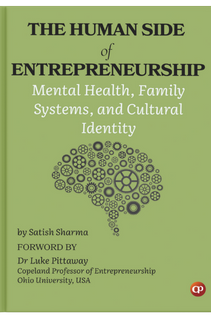
This chapter is a part of: The Human Side of Entrepreneurship: Mental Health, Family Systems, and Cultural Identity from India
ISBN (Ebook):978-93-49926-21-9
ISBN (Hardcover Print):978-93-49926-09-7
ISBN (Softcover Print):978-93-49926-53-0
© CSMFL Publications & its authors.
Published: March 5, 2026
Editorial
Popular culture has romanticized the entrepreneurial journey as one of endless optimism. This vision portrays visionary individuals who transform ambitious ideas into successful businesses through determination and strategic thinking alone. Such narratives inspire many but mask a far more complicated reality that millions of entrepreneurs face every day: the deep psychological, relational, and cultural factors that fundamentally influence both business results and personal health.
Traditional approaches treat entrepreneurship mainly as an economic or strategic pursuit. This perspective ignores the deeply human experience that forms its foundation—an experience filled with mental health struggles, family complications, cultural identity questions, and the complex network of relationships that either strengthen or weaken entrepreneurial achievement.
Studies in entrepreneurial research have begun to confirm what practitioners have known instinctively for years. The boundary between personal and professional life in entrepreneurship is mostly imaginary. Traditional employees can often separate their work from their home lives, but entrepreneurs discover these areas are completely connected. Kitchen table decisions affect boardroom strategies, while business stress changes family dinners and weekend activities.
Cultural backgrounds shape everything from how people network to how they lead. Yet these influences receive little attention in standard entrepreneurship education and support programs. The mental health consequences of this connection are severe and widespread.
Entrepreneurs experience anxiety, depression, and burnout at higher rates than the general population. Despite this reality, the business world continues to promote myths about invulnerability and constant positivity. The need to project confidence while managing uncertainty, financial pressure, and decision-making responsibility creates conditions ripe for psychological problems. The isolation common in entrepreneurial work—especially during early phases—makes these difficulties worse, leaving many founders without proper support when they need it most.
Family systems theory offers an important framework for understanding these patterns. Entrepreneurial businesses do not operate alone but function within larger family networks that both shape and are shaped by business activities. Spouses, children, parents, and extended family members all contribute to entrepreneurial experiences through direct participation, emotional support, financial assistance, or simply by adjusting to entrepreneurial life demands.
The quality of these relationships often determines not only personal happiness but also business survival. Family tension inevitably impacts decision-making, willingness to take risks, and long-term planning approaches.
Cultural identity introduces another dimension that entrepreneurship literature has largely overlooked. An entrepreneur’s cultural background affects communication methods, negotiation tactics, and definitions of success and failure. For many people, entrepreneurship means more than personal ambition—it represents cultural expression, community responsibility, or family advancement across generations. Recognizing these cultural aspects is necessary for building inclusive support systems and acknowledging different paths to entrepreneurial achievement.
This book responds to the recognition that entrepreneurship education and support systems have traditionally addressed only part of the human experience. Business schools teach market analysis, financial modeling, and operational strategy effectively, but they rarely provide future entrepreneurs with tools for managing stress, preserving relationships, or handling cultural conflicts. Incubators and accelerators concentrate heavily on product development and fundraising while offering little help with psychological and relational challenges that can destroy even promising ventures.
The integrated framework outlined in this book represents a fundamental change toward complete entrepreneurship. This approach recognizes and addresses the full range of human needs within entrepreneurial settings. It does not reduce the importance of traditional business basics but acknowledges that lasting success requires attention to mental health, relationship patterns, and cultural authenticity along with market strategy and financial planning.
The chapters combine insights from psychology, family systems theory, cultural studies, and entrepreneurship research to build a thorough understanding of entrepreneurial well-being. Starting with basic concepts of integrated success, the book moves through specific areas—mental health, family relationships, cultural identity—before presenting practical tools and implementation strategies. Later sections cover crisis management, life-stage considerations, industry-specific challenges, and global perspectives, eventually arguing for systematic changes in how society supports entrepreneurial ventures.
This work targets multiple groups: current and aspiring entrepreneurs seeking more sustainable methods for building their businesses; family members and partners of entrepreneurs who want to understand and support their loved ones’ paths; educators and advisors developing more complete entrepreneurship programs; and policymakers and ecosystem builders interested in creating more supportive environments for entrepreneurial activity.
The primary objective is not simply helping entrepreneurs survive their experiences but enabling them to flourish as complete human beings while creating meaningful businesses. This requires rejecting the false choice between personal well-being and business success, instead adopting an integrated approach that sees these as complementary rather than competing goals. Only by addressing the complete human aspect of entrepreneurship can we hope to generate more sustainable, satisfying, and ultimately successful entrepreneurial experiences for individuals, families, and communities.
This book is available worldwide via EBSCOhost Academic Collection, EBSCO E- books, Google Play Books, Amazon, World Cat Discovery Service/OCLC, CSMFL Bookstore, and 200+ book resellers and academic content vendors.
Statement on Publication Ethics
We, at CSMFL Publications, are committed to ensure the unbiased and transparent publishing, and upholding the high standards of editorial integrity in our publications. To know more, please read our Statement on Publication Ethics, Editorial Integrity & Misconduct