Notes on the Improvement and Innovation of Variational
Peihang Li1, Chuanmao Tian2
1School of Foreign Studies, Yangtze University, Jingzhou, China; 2School of Foreign Studies, Yangtze University, Jingzhou, China.
10.46679/9789349926769ch01
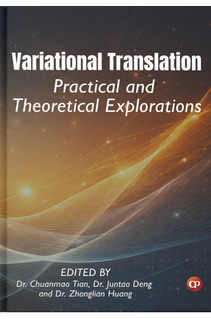
This chapter is a part of: Variational Translation: Practical and Theoretical Explorations from India
ISBN (Ebook):978-93-49926-76-9
ISBN (Hardcover Print):978-93-49926-38-7
ISBN (Softcover Print):978-93-49926-07-3
© CSMFL Publications & its authors.
Published: January 5, 2026
Abstract
After more than two decades’ exploration, Variational Translation Theory has gradually become mature, but some weaknesses are still with it. In the new era, as a translation theory with Chinese characteristics, Variational Translation Theory calls for substantial improvements and innovations. The methods of the innovation includes (1) search for theoretical foundations; (2)revision, integration or re-creation of some concepts; (3) correction,improvement or abandonment of some improper viewpoints; (4) search fornew breakthroughs in research perspective or domain of study.
Keywords: Variational Translation Theory, Weaknesses, Improvement, Innovation
References
- Dumas, A. (2008). The Count of Monte Cristo. Adapted by Richard Barton. Translated and annotated by Zhang, X., & Li, G. Beijing: Aviation Industry Press.
- Gouadec, D. (2007). Translation as a Profession. Amsterdam and Philadelphia: John Benjamins.
- Hawkes, D. (1959). Ch’u Tz’u: The Songs of the South: An Ancient Chinese Anthology. Oxford: Oxford University Press.
- Hong, T. (2007). The Interpretation and Dissemination of Jiu Ge of Chu Ci·in the English-Speaking World: A Focus on Two Works by British Sinologists. In Chinese Qu Yuan Society (Ed.), Chinese Chu Ci Studies (Vol. 14, pp. 334-350). Beijing: Chinese Qu Yuan Society.
- Huang, Z.L. (2012). A New Interpretation of “Translation”—A Response to Mr. Zhou Lingshun on “Variational Translation.” Foreign Language Research, (1): 81-84.
- Huang, Z.L. (2002). Studies on Translation Variants. Beijing: China Translation and Publishing Corporation.
- Huang, Z.L. (2000). Variational Translation Theory. Beijing: China Translation and Publishing Corporation.
- Huang, Z.L., & Li, Y.S. (2004). Science of Translation. Beijing: China Translation and Publishing Corporation.
- Huang, Z.L., et al. (2009). Methodology of Translation. Beijing: China Social Sciences Press.
- Jakobson, R. (1959). On Linguistic Aspects of Translation. In R. A. Brower (Ed.), On Translation (pp. 232-239). London and New York: Routledge.
- Luo, Z.C., & Yeh, M. (2003). On Encountering Sorrow. Manoa, (1): 20-25.
- Steiner, G. (2001). After Babel: Aspects of Language and Translation. Shanghai: Shanghai Foreign Language Education Press.
- Stern, H. H. (1983). Fundamental Concepts of Language Teaching: Historical and Interdisciplinary Perspectives on Applied Linguistic Research. Oxford: Oxford University Press.
- Watson, B. (1984). The Columbia Book of Chinese Poetry: From Early Times to the Thirteenth Century. New York: Columbia University Press.
- Xu, C.Y. (2006). Two Major Issues in Variational Translation Theory—A Discussion with Mr. Huang Zhonglian. Foreign Language Research, (4): 1-5.
- Xu, M.W., & Tian, C.M. (2013). Cultural Deformations and Reformulations: A Study of Disney’s Mulan in English and Chinese. Critical Arts: South-North Cultural and Media Studies, (2): 182-210.
- Yi, Z.T. (2008). Philadelphia: The Birth of the U.S. Constitution and Our Reflections. Nanning: Guangxi Normal University Press.
- Yu, D. (2006). Yu Dan’s Insights into The Analects. Beijing: Zhonghua Book Company.
- Zhou, L.S. (2012). The Name and Essence of “Variational Translation”—A Study on Translator Behavior (Part 9). Foreign Language Research, (1): 74-80.
This book is available worldwide via EBSCOhost Academic Collection, EBSCO E- books, Google Play Books, Amazon, World Cat Discovery Service/OCLC, CSMFL Bookstore, and 200+ book resellers and academic content vendors.
Statement on Publication Ethics
We, at CSMFL Publications, are committed to ensure the unbiased and transparent publishing, and upholding the high standards of editorial integrity in our publications. To know more, please read our Statement on Publication Ethics, Editorial Integrity & Misconduct