A Bibliometric Study of Variational Translation Theory’s Development in China (1998-2025): A Citespace-Based Analysis
Juan Wang1, Tianxia Liu2
1School of Foreign Studies, Yangtze University, Jingzhou, China; 2Dongfanghong Middle School, Jingzhou, China.
10.46679/9789349926769ch04
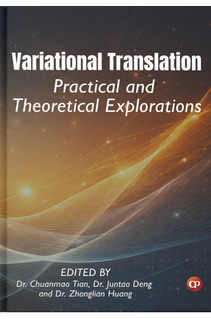
This chapter is a part of: Variational Translation: Practical and Theoretical Explorations from India
ISBN (Ebook):978-93-49926-76-9
ISBN (Hardcover Print):978-93-49926-38-7
ISBN (Softcover Print):978-93-49926-07-3
© CSMFL Publications & its authors.
Published: January 5, 2026
Abstract
This study employs bibliometric methods to map the evolution of Variational Translation Theory (VTT) in China from 1998 to 2025, analyzing 799 journal articles retrieved from the CNKI database using CiteSpace. The research reveals three key phases of VTT’s development: initial conceptualization (1989-2005), theoretical systematization (2006-2015), and interdisciplinary expansion (2016-2025). Core scholars like Huang Zhonglian and institutions such as Guangdong University of Foreign Studies (GUFS) are identified as pivotal forces driving VTT’s growth. Keyword co-occurrence and citation burst analyses highlight shifting research hotspots, from foundational debates (e.g., “complete translation”) to emerging applications (e.g., “subtitle translation”). While VTT demonstrates adaptability to globalization and cultural diplomacy demands, critiques reveal theoretical gaps requiring further interdisciplinary validation. The findings underscore VTT’s transformative role in Chinese translation studies and its potential to address cross-linguistic challenges in an era of cultural exchange.
Keywords: Variational Translation Theory, Citespace, Bibliometric Analysis, Translation Adaptation, Chinese Translation Studies, Interdisciplinary Research
References
- Chen, Y. F. (2018). Criticism and Reflection on the Translation Variation Theory. Foreign Languages Bimonthly, 41(4): 21-24+33.
- Fang, W. (2019). Ethical Debate on Variational Translation. Foreign Language Research, (5): 95-101.
- Feng, Z. B. (2010). On Translator’s Subjectivity in Variational Translation. Forward Position, (10): 136-138+155.
- Huang, Z. L. (1999). On Variational Translation. Foreign Language Research, (3): 80-83.
- Huang, Z. L. (2002a). Variational Translation Theory: A New Approach to Translation Studies. Foreign Language Learning Theory and Practice, (1): 19-22.
- Huang, Z. L. (2002b). Seven Adaptation Methods in Variational Translation. Foreign Language Research, (1): 93-96.
- Huang, Z. L. (2002c). Variational Translation vs. Complete Translation: A New Pair of Translation Categories. Shanghai Journal of Translators, (3): 5-7.
- Huang, Z. L. (2002d). Variational Translation Theory. Beijing: China Translation & Publishing Corporation.
- Huang, Z. L. (2009). An Introduction to Parallel Corpus of Translation Variation: A Case Study of Yan Fu’s Evolution and Ethics. Foreign Language Research, (1): 116-119.
- Huang, Z. L., & Chen, Y. F. (2016). The Process from Adaptation Techniques to Translation Variation Theory. Foreign Languages and Their Teaching, (1): 98-106+149.
- Huang, Z. L., & Zhang, Y. Z. (2007). Variational Translation: A New Perspective on Translation Studies—A Response to Mr. Xu Chaoyou. Foreign Languages Research, (2): 66-68.
- Li, C. G. (2013). The Transformation and Evolution of Contemporary Translation Studies in China. Journal of Tianjin Normal University (Social Sciences), (5): 61-64.
- Li, P. (2014). Translation Variation Theory: Retrospection and Reflection. Foreign Language Research, (1): 94-98.
- Li, X. Y., & Xin, C. H. (2005). The Concept of Variational Translation and Its Implications for Translation Teaching. Education and Vocation, (33): 77-78.
- Luo, J. S., & Li, M. J. (2015). A Study on the English Translation of Public Signs in Western Ethnic Tourist Attractions Guided by Variational Translation Theory. Journal of South-Central Minzu University (Humanities and Social Sciences), 35(3): 168-171.
- Ma, W. L. (2009). Cultivating Variational Translation Competence in College Translation Teaching: A Case Study of Tourism Texts. Theory Monthly, (7): 91-93.
- Peng, J. S. (2010). Linguistic Adaptation Theory and Its Interpretation of Variation Translation in International Publicity Translation. Journal of Guangxi Normal University (Philosophy and Social Sciences), 46(1): 49-52.
- Wang, D., & Gao, M. (2022). A Study on Film Subtitle Translation from the Perspective of Variational Translation Theory: A Case Study of the Chinese Translation of Mulan. English Square, (8): 16-19.
- Wang, L. (2018). Handling Metaphors in English-Chinese Interpretation from the Perspective of Functional Translation Theory: Taking President Obama’s Inaugural Address of 2013 as an Example. Journal of Jiangxi Normal University (Philosophy and Social Sciences Edition), 51(1): 139-144.
- Wang, X. Z. (2024). On the Variational Translation of Culture-Loaded Words in Border Town. JinGu Creative Literature, (32): 103-105.
- Wen, L. X. (2008). Philosophical Hermeneutics and Its Explanation of Variational Translation. Foreign Languages and Literature, (3): 112-117.
- Wu, J. (2018). On the Bianyi (Changeability) in the Translation of the Yijing. Studies of Zhouyi, (5): 92-96.
- Xu, C. Y. (2006). Two Major Problems with Prof. Huang Zhonglian’s Theory of Translation Variation. Foreign Languages Research, (4): 48-51+80.
- Xu, H., & Xu, L. Q. (2008). Strategies of Variational Translation in Interpretation. Jiangxi Social Sciences, (12): 210-213.
- Xu, X. M., & Wang, W. B. (2018). A Brief Discussion on Zhao Yuanren’s View of Words and Characters: With Comments on Wang Hongjun’s Chinese Translation. Shanghai Journal of Translators, (1): 39-44.
- Yu, C. F. (2014). Elaborating “Accommodation” as the Essence of Translation Variation from the Perspective of “Sublimation” as the Essence of Complete Translation. Foreign Language Research, (1): 99-103.
- Yu, C. F., & He, M. L. (2024). Zhou Xuliang’s Translation and Publication of Philosophy and Social Sciences (1958-1966) from the Perspective of Socio-Translation Studies. Shanghai Journal of Translators, (3): 71-76.
- Yu, C. F., & Wan, G. R. (2018). A Study on Academic Reference Translation: A Case Study of Qian Zhongshu’s On the Art of Poetry. Foreign Languages Bimonthly, 41(4): 11-15+159.
- Zeng, J. X., & Wang, S. X. (2022). Cultural Exposition of Translation Variation in Publicity Film Subtitling. Journal of Zhejiang Sci-Tech University (Social Sciences), 48(6): 656-664.
- Zhang, W., & Zhao, Y. F. (2022). Retrospecting “Transformation” in Early Buddhist Translation. Shanghai Journal of Translators, (3): 27-32.
- Zhang, Y. G. (2007). Strategies for Chinese-English Tourism Translation Under the Guidance of Variational Translation Theory. Academic Journal of Zhongzhou, (5): 247-248+251.
- Zhang, Y. Z. (2014). Translation Variation: Horizon Fusion of Inter-subjectivity. Foreign Language Research, (1): 89-93.
- Zhang, Y. Z. (2018). Remarks on Shortened Translation vs. Full Translation in Cross-Cultural Communication. Shanghai Journal of Translators, (4): 78-82+95.
- Zhou, Y. J. (2022). English Translation of Exhibition Titles from the Perspective of Skopos Theory: A Case Study of China National Silk Museum. Chinese Museum, (3): 81-86.
This book is available worldwide via EBSCOhost Academic Collection, EBSCO E- books, Google Play Books, Amazon, World Cat Discovery Service/OCLC, CSMFL Bookstore, and 200+ book resellers and academic content vendors.
Statement on Publication Ethics
We, at CSMFL Publications, are committed to ensure the unbiased and transparent publishing, and upholding the high standards of editorial integrity in our publications. To know more, please read our Statement on Publication Ethics, Editorial Integrity & Misconduct