Variational Translation Methods in English Translation and Research Texts of The Chu Ci
Feifei Ouyang1, Chuanmao Tian2
1School of Foreign Studies, Yangtze University, Jingzhou, China; 2School of Foreign Studies, Yangtze University, Jingzhou, China.
10.46679/9789349926769ch05
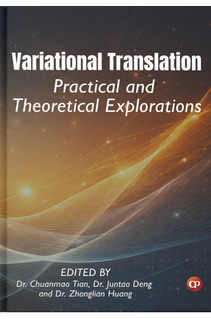
This chapter is a part of: Variational Translation: Practical and Theoretical Explorations from India
ISBN (Ebook):978-93-49926-76-9
ISBN (Hardcover Print):978-93-49926-38-7
ISBN (Softcover Print):978-93-49926-07-3
© CSMFL Publications & its authors.
Published: January 5, 2026
Abstract
Guided by Variational Translation Theory (VTT), this chapter takes the overseas translation and research texts of the Chu ci as the research object, outlining the overall picture of Chu ci dissemination in the West, summarizing the variational translation methods employed in the translation and research texts, analyzing the reasons for using the methods and their intercultural communication functions, and exploring future communication strategies for the canon. The research findings are that the Chu ci dissemination works employ various variational translation methods, such as selective translation, edited translation, condensed translation, translation and comment, translation and writing, adaptation translation, explanatory translation, reference translation, imitation translation, and so on.
Keywords: Chu Ci, English World, Translation Texts, Research Texts, Variational Translation Methods
References
- Baldry, A., & Thibault, P. (2006). Multimodal Transcription and Text Analysis. London: Equinox.
- Bateman, J. (2014). Using Multimodal Corpora for Multimodal Research. In C. Jewitt (Ed.), The Routledge Handbook of Multimodal Analysis (pp. 238-252). Milton Park: Routledge.
- Cai, Zong-qi (Ed.). (2008). How to Read Chinese Poetry: A Guided Anthology. New York: Columbia University Press.
- Chen, L., & Xu, M.D. (2012). Who Introduced the Chu ci to Britain for the First Time? Journal of Chinese Social Sciences, July 4 (B05).
- Dobson, W. (1959). (Untitled) Review. Journal of the American Oriental Society, 79(2): 144-146.
- Fang, A. (1942). On the T’ien-wen “Reconstruction” by Prof. Erkes. Monumenta Serica, (7): 285-287.
- Giles, H. A. (1929). Preface. In Lim B.K. (Trans.), The Li Sao: An Elegy on Encountering Sorrows (pp. xxi-xxii). Shanghai: Commercial Press.
- Giles, H. A. (1898). Chinese Poetry in English Verse. London: Bernard Quaritch.
- Giles, H. A. (1884). Gems of Chinese Literature. London: Bernard Quaritch.
- Goodwin, C. (2000). Action and Embodiment Within Situated Human Interaction. Journal of Pragmatics, (32): 1489-1522.
- Goodwin, C. (1981). Conversational Organization: Interaction Between Speakers and Hearers. New York: Academic Press.
- Gouadec, D. (2007). Translation as a Profession. Amsterdam and Philadelphia: John Benjamins.
- He, W.J. (2010). Translation and Dissemination of the Chu ci in Europe and America. Three Gorges Forum, (5): 42-49.
- Hervouet, Y. (1959). Book Review: David Hawkes, Ch’u Tz’u: The Songs of the South: An Ancient Chinese Anthology. T’oung Pao, (47): 84.
- Hawkes, D. (1959). Ch’ u Tz’ u: The Songs of the South. Oxford: Clarendon.
- Huang, Z.Y. (2000). Review of Chu ci Studies in the 20th Century. Literary Criticism, (2): 14-23,
- Huang, Z.L., et al. (2009). Methodology of Translation. Beijing: China Social Sciences Press.
- Kaindl, K. (2013). Multimodality in the Translation of Humour in Comics. In E. Ventola, C. Charles, & M. Kaltenbacher (Eds), Perspectives on Multimodality (pp. 173-192). Amsterdam: John Benjamins.
- Legge, J. (1895). The Li Sao Poem and Its Author. Journal of the Royal Asiatic Society of Great Britain and Ireland, (Oct.): 839-864.
- Kress, G., & van Leeuwen, T. (2005). Reading Images: The Grammar of Visual Design (2nd Edition). London: Routledge.
- Kirkova, Z. (2016). Roaming into the Beyond: Representations of Xian Immortality in Early Medieval Chinese Verse. Leiden and Boston: Brill.
- Johnson, J. (1959). Li Sao: A Poem on Relieving Sorrows. Miami: Olivant Press.
- Lanciotti, L. (1959). Book Review: Ch’u Tz’u: The Songs of the South—An Ancient Chinese Anthology by David Hawkes. East and West, (4): 307.
- Liu, W., & Lo, I. Y. (Eds). (1975). Sunflower Splendor: Three Thousand Years of Chinese Poetry. Bloomington, IN: Indiana University Press.
- Luo, Z., & Yeh, M. (2003). On Encountering Sorrow. Manoa, (1): 20-25.
- O’Halloran, K. L. (2005). Mathematical Discourse: Language, Symbolism and Visual Images. London: Continuum.
- O’Halloran, K. L. (Ed.). (2004). Multimodal Discourse Analysis: Systemic Functional Perspective. London: Continuum.
- O’Halloran, K. L., & Lim, F. V. (2014). Systemic Functional Multimodal Discourse Analysis. In S. Norris, & C. Maier (Eds), Texts, Images and Interactions: A Reader in Multimodality (pp. 137-154). Berlin: Mouton de Gruyter.
- O’Toole, M. (1994). The Language of Displayed Art. London: Leceister University Press.
- Owen, S. (2010). The Cambridge History of Chinese Literature. Cambridge: Cambridge University Press.
- Parker, E. H. (1879). The Sadness of Separation, or Li Sao. The China Review, 7(5): 309-314.
- Mathieu, Rémi. (2004). Elégies de Chu. Paris: Gallimard.
- Payne, R. (Ed.). (1947). The White Pony: An Anthology of Chinese Poetry from the Earliest Times to the Present Day, Newly Translated. New York: John Day.
- Shadick, H. (1959). Book Review: Ch’u Tz’u: The Songs of the South: An Ancient Chinese Anthology by David Hawkes. Journal of Asian Studies, (1): 77-79.
- Schneider, L. A. (1980). A Madman of Ch’u: The Chinese Myth of Loyalty and Dissent . Berkeley and Los Angeles: University of California Press.
- Scollon, R., & Scollon, S. W. (2003). Discourse in Place: Language in the Material World. London: Routledge.
- Sukhu, G. (2017). The Songs of Chu: An Ancient Anthology of Works by Qu Yuan and Others. New York: Columbia University Press.
- Sukhu, G. (1993). Attraction, Reversal and Repulsion: Prolegomena to the Lisao. New York: Columbia University.
- Tagore, R. (1929). Preface. In Lim B.K. (Trans.), The Li Sao: An Elegy on Encountering Sorrows (pp. xxiii-xxiv). Shanghai: Commercial Press.
- Van Leeuwen, T. (2006). Introducing Social Semiotics. London: Routledge.
- Waley, A. (1960). Book Review: Ch’u Tz’u, the Songs of the South by David Hawkes. Journal of the Royal Asiatic Society of Great Britain and Ireland, (1/2): 64-65.
- Waley, A. (1955). The Nine Songs. A Study of Shamanism in Ancient China. London: Allen & Unwin.
- Walker, R. L. (1949). August Pfizmaier’s Translations from the Chinese. Journal of the American Oriental Society, 69(4): 215-223.
- Wang, C. H. (1988). From Ritual to Allegory: Seven Essays in Early Chinese Poetry. Hong Kong: Chinese University Press.
- Waters, G. A. (1980). Three Elegies of Ch’u: An Introduction to the Traditional Interpretation of the Chuci. Bloomington: Indiana University.
- Watson, B. (1962). Early Chinese Literature. New York: Columbia University Press.
- Whitaker, K. P. K. (1960). (Untitled) Review. Bulletin of the School of Oriental and African Studies, 23(1): 169-170.
- Wu, Fusheng. (2007). Sao Poetry: The Lyrics of Chu (Chuci). In Zong-qi Cai (Ed.), How to Read Chinese Poetry: A Guided Anthology (pp. 36-56). New York: Columbia University Press.
- Xu, M., & Tian, C. (2013). Cultural Deformations and Refomrualtions: A Case Study of Disney’s Mulan in English and Chinese. Critical Arts: South-North Cultural and Media Studies, 27(2): 182-210.
- Yan, J. (2013). An Overview of British Chu ci Studies. Journal of Philology, (8): 54-55.
- Zhou, Z.X. (2005). Chu ci in the West. In H.T. Lin (Ed.), A Dictionary of Chinese Translation (p. 97). Wuhan: Hubei Education Press.
- Zikpi, M. E. M. (2013). Translating the Afterlives of Qu Yuan. Eugene: University of Oregon.
This book is available worldwide via EBSCOhost Academic Collection, EBSCO E- books, Google Play Books, Amazon, World Cat Discovery Service/OCLC, CSMFL Bookstore, and 200+ book resellers and academic content vendors.
Statement on Publication Ethics
We, at CSMFL Publications, are committed to ensure the unbiased and transparent publishing, and upholding the high standards of editorial integrity in our publications. To know more, please read our Statement on Publication Ethics, Editorial Integrity & Misconduct