Introduction: Variational Translation: Practical and Theoretical Explorations
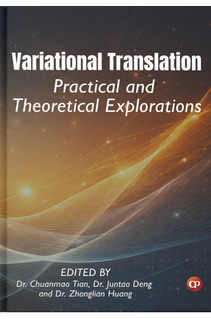
Dr. Tian Chuanmao1 , Dr. Deng Juntao2 & Dr. Zhonglian Huang3
1Director of the Centre for Translation Studies, Yangtze University, China; 2Vice Dean of the School of Foreign Languages, Wuhan Institute of Technology, China; 3Professor, Center for Translation Studies, Guangdong University of Foreign Studies, Guangzhou, China.
10.46679/9789349926769ch00
This chapter is a part of: Variational Translation: Practical and Theoretical Explorations from India
ISBN (Ebook):978-93-49926-76-9
ISBN (Hardcover Print):978-93-49926-38-7
ISBN (Softcover Print):978-93-49926-07-3
© CSMFL Publications & its authors.
Published: January 5, 2026
Editorial
Variational Translation Theory (VTT), first formulated by Professor Huang Zhonglian in 1999, has incorporated both Chinese and foreign thought, especially the philosophy of change embodied in the ancient Chinese classic Book of Changes, and it sees change as a striking, gradual process. Compared with the change a text undergoes in complete translation, a change or “variation” in variational translation (VT) may be viewed as a kind of fast, thorough, and global changes, including instant, immediate, and substantial changes. VTT can help translators do their job more quickly and accurately with higher efficiency and better quality. Therefore, VT can be defined as an intelligent and intersemiotic activity in which a person or/and a machine uses one language to develop flexibly the cultural information in another language so as to meet the specific needs of specific readers under specific conditions (Huang, 2002: 97).
Besides complete translation, VT is very common in human translation practices. It plays an important role in the reconstruction of knowledge and culture in cross-cultural communication. In fact, some scholars have dealt with the phenomenon of VT. For example, Andrew Chesterman (1997) discusses the translation strategy of “transediting”, and Daniel Gouadec (2007) summarizes some VT methods frequently used by professional translators, such as selective translation, synoptic translation, plain translation, no frills translation, and rewriting. Generally speaking, theoretical studies on VT are faced with the precariousness and imprecision in their definition of basic concepts and description of important principles, even though they are gaining more and more attention, at least in China. It seems that scholars across the globe focus only on one or several VT types, and few of them make a sustained, systematic study of it. As a result, VTT has not developed into an independent branch of translation studies as a discipline. In other words, the universality, rationality, value, and functions of the theory have yet to be fully realized.
Therefore, VT practices are in desperate need of effective guiding theories. The relatively newly emerging VTT calls for academic criticisms and reflections. In this respect, Professor Huang Zhonglian has conducted fundamental theoretical studies on it, publishing four research monographs, including Studies on Translation Variation (2000), Variational Translation Theory (2002), Scientific Translatology (2004), and Exploring Yan Fu’s Variational Translation Thoughts (2016). These works shed light on the objects, methods, and reasons with respect to VT and have had a significant impact in China. Based on Huang’s research on VTT, the contributors in this volume make practical and theoretical explorations of VT.
Peihang Li and Chuanmao Tian propose three methods for innovating VTT, including: (1) search for theoretical foundations; (2) revision, integration or re-creation of some concepts; (3) correction, improvement or abandonment of some improper viewpoints; (4) search for new breakthroughs in research perspective or domain of study. Rongguang Yang explores the ethical issues raised by VT practices that involve adaptation, condensation, omission, and rewriting. He claims that existing models of translation ethics often rely on fidelity as a core value, but this standard does not always account for the demands and constraints faced by translators working with variation. Taking this gap as a starting point, Yang argues for the construction of a more flexible and context-sensitive ethical framework. Drawing on both external norms and the translator’s own moral reasoning, Yang’s study outlines how ethical decisions are shaped by institutional pressures, technological tools, and genre conventions, and its aim is not to propose fixed rules but to offer a way of thinking about ethical responsibility in situations where translation is not simply a matter of equivalence, but of negotiation, judgment, and care. Yongzhong Zhang examines the contemporary value of VT from theoretical and practical perspectives. The theoretical value of VT includes: (1) establishing “variational translation” and “complete translation” as two major research categories; (2) expanding the structural framework of traditional “equivalence theory”; (3) refining the operability of the translation theories of Western cultural school; (4) integrating innovative interdisciplinary methodologies; (5) repositioning translation functions. The practical value includes: (1) dissolving cognitive barriers between different civilizations; (2) activating the dialogic potential of diverse civilizations.
Juan Wang and Tianxia Liu use bibliometric methods to map the evolution of VTT in China from 1998 to 2025, analyzing 799 journal articles retrieved from the CNKI database using CiteSpace. Their research reveals three key phases of VTT’s development: initial conceptualization (1989-2005), theoretical systematization (2006-2015), and interdisciplinary expansion (2016-2025). Core scholars like Huang Zhonglian and institutions such as Guangdong University of Foreign Studies are identified as pivotal forces driving VTT’s growth. Keyword co-occurrence and citation burst analyses highlight shifting research hotspots, from foundational debates (e.g., “complete translation”) to emerging applications (e.g., “subtitle translation”). While VTT demonstrates adaptability to globalization and cultural diplomacy demands, critiques reveal theoretical gaps requiring further interdisciplinary validation. Feifei Ouyang and Chuanmao Tian take the overseas translation and research texts of the Chu ci as the research object, outlining the overall picture of Chu ci dissemination in the West, summarizing the VT methods employed in the translation and research texts, analyzing the reasons for using the methods and their intercultural communication functions, and exploring future communication strategies for the canon. The research findings are that the Chu ci dissemination works employ various VT methods, such as selective translation, edited translation, condensed translation, translation and comment, translation and writing, adaptation translation, explanatory translation, reference translation, imitation translation, and so on.
Shenghua Luo explores the pedagogy for machine translation post-editing from the perspective of VTT. Her findings are that altered translation, edited translation, and annotated translation were the most frequently utilized; AI-assisted instruction should shift its focus from lexical correction to syntactic restructuring and discourse optimization. Her study has established VTT as a foundational framework for the pedagogy, potentially transforming conventional practices in college English translation teaching through the theoretical perspectives and practical methodology. Based on VTT, Fang Wang conducts an in-depth analysis of Lin Shu’s Chinese translations of Western novels, aiming to elucidate the strategies employed by the translator, such as adding, deleting, edited translation, and integrating, in order to provide valuable insights and references for the in-depth and substantial development of international dissemination of Chinese literary works.
Yujie Li deals with the Chinese-English translation of web-based Jingchu Culture tourism texts based on VTT. Her findings are that there exist some translation errors in the present Chinese-English translation of the texts which hinder the realization of informative and vocative functions of tourism texts; the main causes of the errors are the careless or irresponsible attitude of translators and their lack of language competence and full consideration on text functions and target readers. She suggests that under the guidance of VTT, translators should overcome the problems, and flexibly adopt addition, deletion, edition, and condensation techniques and their corresponding VT methods to make suitable adjustments to the original, in content, style or form, aiming to provide effective translations which can well achieve the informative and vocation functions of tourism texts, and conform to English readers’ reading habits and cater for their expectations.
It is hoped that this volume can serve as a point of departure for new explorations of VT and VTT, and invite more translation scholars across the globe to study them from new perspectives.
This book is available worldwide via EBSCOhost Academic Collection, EBSCO E- books, Google Play Books, Amazon, World Cat Discovery Service/OCLC, CSMFL Bookstore, and 200+ book resellers and academic content vendors.
Statement on Publication Ethics
We, at CSMFL Publications, are committed to ensure the unbiased and transparent publishing, and upholding the high standards of editorial integrity in our publications. To know more, please read our Statement on Publication Ethics, Editorial Integrity & Misconduct