Foreword: Law and Economics in India: Market Governance, Digital Change, and Inclusive Growth
S. Surya Prakash
Vice Chancellor, National Law Institute University, Bhopal, India.
10.46679/978934992614100
This chapter is a part of: Law and Economics in India: Market Governance, Digital Change, and Inclusive Growth from India
ISBN (Ebook): 978-93-49926-14-1
ISBN (Hardcover Print): 978-93-49926-73-8
ISBN (Softcover Print): 978-93-49926-54-7
© CSMFL Publications & its authors.
Published: April 15, 2026
Foreword
The relationship between law and economics has traditionally been viewed through its practical effects-how laws influence market behaviour, how court decisions reshape incentives, and how regulations try to balance innovation with risk. In a constitutional democracy like India, however, this relationship takes on a deeper importance. Law serves as a key tool for societies to define public welfare goals, resolve disputes over scarce resources, and set the framework for economic activity. The economy isn’t an independent area separate from law; instead, it’s formed and continually shaped by legal rules around property rights, contracts, corporate governance, labour laws, financial systems, and dispute resolution. To truly understand law and economics, we need to look at the purpose of legal rules, who they benefit, the incentives they create, their transaction costs, and the institutional support needed for effective enforcement.
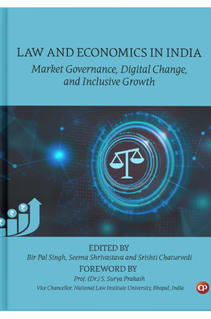
In this light, the book Law and Economics in India: Market Governance, Digital Change, and Inclusive Growth deserves careful study. Today’s Indian regulatory environment is influenced by several overlapping changes: the fast-growing digital economy, new financial innovations, calls for greater corporate accountability, rising competition in tech-driven markets, and expectations for growth that is fair and sustainable. Each of these presents regulatory challenges that go beyond technical details. They raise big questions about institutional capacity, democracy, justice, and whether legal systems can keep up with dynamic markets while safeguarding citizens’ rights and well-being.
The strength of the law and economics approach lies in revealing hidden trade-offs that pure legal analysis might miss. Legal systems work within real-world limits-public resources are limited, agencies face challenges, information is uneven, regulated actors behave strategically, and there’s often a gap between laws on paper and their actual enforcement. Economic tools help us understand how legal rules function day-to-day: how they shift bargaining power, create behavioural incentives, or lead to outcomes different from what lawmakers intended. But in India, legal analysis can’t rely on efficiency alone. A good evaluation must also consider constitutional values, social justice, fairness, and the real-life struggles of individuals facing barriers to fair participation in markets.
This volume connects three important themes: market governance, digital transformation, and inclusive growth. These aren’t separate; they influence each other. Good market governance builds trust; digital change affects how value is created and regulated; and inclusive growth sets the standard to judge whether laws and policies are truly benefiting everyone-by expanding opportunities and freedoms. Looking at these themes together helps us better understand how legal systems both enable and limit economic progress.
From an academic perspective, this book highlights the importance of cross-disciplinary approaches to today’s legal challenges. Issues in corporate law, digital governance, finance, labour, environment, and decentralized systems can’t be fully understood through law alone. Interdisciplinary methods are now essential for legal scholars and practitioners-they need to analyze incentives, inform policy, and connect legal rules to economic and social realities.
The academic value of any edited collection ultimately depends on the rigor and insight of its contributors. The authors in this volume deserve recognition for engaging with complex issues that are both intellectually demanding and socially significant. Special appreciation is due to the editors—Prof. (Dr.) Bir Pal Singh, Dr. Seema Shrivastava, and Dr. Srishti Chaturvedi-for bringing together this collection with clear scholarly vision and thematic coherence. By bringing together diverse ideas around governance, technology, markets, and inclusion, they’ve contributed significantly to interdisciplinary legal scholarship in India.
I recommend this volume to scholars, policymakers, and students interested in the evolving links between law and economics in India. I hope it encourages more research into how incentives, implementation, justice, and institutions shape the relationship between legal systems and economic growth. Undoubtedly, the proposed volume may enrich the existing literature on Law & Economics.
This book is available worldwide via EBSCOhost Academic Collection, EBSCO E- books, Google Play Books, Amazon, World Cat Discovery Service/OCLC, CSMFL Bookstore, and 200+ book resellers and academic content vendors.
Statement on Publication Ethics
We, at CSMFL Publications, are committed to ensure the unbiased and transparent publishing, and upholding the high standards of editorial integrity in our publications. To know more, please read our Statement on Publication Ethics, Editorial Integrity & Misconduct