Cultural Capital: Identity, Heritage, and Authentic Business Building
Satish Sharma
Lead Management Consultant, SKS Consulting & Advisors, India.
10.46679/9789349926219ch04
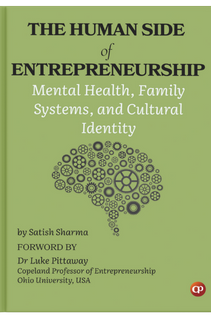
This chapter is a part of: The Human Side of Entrepreneurship: Mental Health, Family Systems, and Cultural Identity from India
ISBN (Ebook):978-93-49926-21-9
ISBN (Hardcover Print):978-93-49926-09-7
ISBN (Softcover Print):978-93-49926-53-0
© CSMFL Publications & its authors.
Published: March 5, 2026
Abstract
Cultural identity shapes entrepreneurial practices in profound ways. This chapter examines the connections between entrepreneurs’ cultural backgrounds and their business approaches to understand how they make decisions and develop strategies. Minority and immigrant business founders face distinct challenges while also possessing unique advantages in global markets. The chapter explores cultural intelligence as an essential entrepreneurial skill. It also discusses methods for maintaining authentic cultural expression while meeting market requirements. Through academic research and case studies, entrepreneurs can learn practical approaches to multicultural business environments. These insights help them build innovative businesses that respect their heritage while embracing necessary adaptation.
Keywords: Cultural Entrepreneurship, Immigrant Entrepreneurship, Cultural Intelligence, Multicultural Business
References
- Adler, N. J., & Gundersen, A. (2008). International dimensions of organizational behavior (5th ed.). Mason, OH: Thomson South-Western.
- Aldrich, H. E., & Waldinger, R. (1990). Ethnicity and entrepreneurship. Annual Review of Sociology, 16(1), 111-135.
- Aliaga-Isla, R., & Rialp, A. (2013). Systematic review of immigrant entrepreneurship literature: Previous findings and ways forward. Entrepreneurship & Regional Development, 25(9-10), 819-844.
- Alvarez, S. A., & Barney, J. B. (2014). Entrepreneurial opportunities and poverty alleviation. Entrepreneurship Theory and Practice, 38(1), 159-184.
- Autio, E., Sapienza, H. J., & Almeida, J. G. (2000). Effects of age at entry, knowledge intensity, and imitability on international growth. Academy of Management Journal, 43(5), 909-924.
- Baker, T., & Nelson, R. E. (2005). Creating Something from Nothing: Resource Construction through Entrepreneurial Bricolage. Administrative Science Quarterly, 50(3), 329-366.
- Basu, A., & Altinay, E. (2002). The interaction between culture and entrepreneurship in London’s immigrant businesses. International Small Business Journal, 20(4), 371-393.
- Bates, T., & Robb, A. (2016). Impacts of owner race and geographic context on access to small-business financing. Economic Development Quarterly, 30(2), 159-170.
- Berry, J. W. (2005). Acculturation: Living successfully in two cultures. International Journal of Intercultural Relations, 29(6), 697-712.
- Beverland, M. B. (2009). Building brand authenticity: 7 habits of iconic brands. London: Palgrave Macmillan.
- Blanchflower, D. G., Levine, P. B., & Zimmerman, D. J. (2003). Discrimination in the small-business credit market. Review of Economics and Statistics, 85(4), 930-943.
- Brett, J., Behfar, K., & Kern, M. C. (2006). Managing multicultural teams. Harvard Business Review, 84(11), 84-91.
- Chouinard, Y. (2016). Let my people go surfing: The education of a reluctant businessman. New York: Penguin.
- Chrysostome, E., & Lin, X. (2010). Immigrant entrepreneurship: Scrutinizing a promising type of business venture. Thunderbird International Business Review, 52(2), 77-82.
- Dana, L. P. (2015). Indigenous entrepreneurship: An emerging field of research. Cheltenham, UK: Edward Elgar Publishing.
- Desiderio, M. V. (2014). Policies to support immigrant entrepreneurship. Washington, DC: Migration Policy Institute.
- Dimitratos, P., Buck, T., Fletcher, M., & Li, N. (2016). The motivation of international entrepreneurship: The case of Chinese transnational entrepreneurs. International Business Review, 25(5), 1103-1113.
- Ely, R. J., & Thomas, D. A. (2001). Cultural diversity at work: The effects of diversity perspectives on work group processes and outcomes. Administrative Science Quarterly, 46(2), 229-273.
- Fairlie, R. W., & Robb, A. M. (2008). Race and entrepreneurial success: Black-, Asian-, and White-owned businesses in the United States. Cambridge, MA: MIT Press.
- Fairlie, R. W., & Robb, A. M. (2018). Why are Black-owned businesses less successful than White-owned businesses? The role of families, inheritances, and business human capital. Journal of Labor Economics, 25(2), 289-323.
- Fletcher, M., & Harris, S. (2012). Knowledge acquisition for the internationalization of the smaller firm: Content and sources. International Business Review, 21(4), 631-647.
- Ghemawat, P. (2001). Distance still matters: The hard reality of global expansion. Harvard Business Review, 79(8), 137-147.
- Hamilton, E., Cruz, A. D., & Jack, S. (2017). Re-framing the status of narrative in family business research: Towards an understanding of families in business. Journal of Family Business Strategy, 8(1), 3-12.
- Hayton, J. C., George, G., & Zahra, S. A. (2002). National culture and entrepreneurship: A review of behavioral research. Entrepreneurship Theory and Practice, 26(4), 33-52.
- Henderson, J. C. (2014). Food tourism reviewed: A Singapore case study. British Food Journal, 116(4), 595-506.
- Hofstede, G. (2011). Dimensionalizing cultures: The Hofstede model in context. Online Readings in Psychology and Culture, 2(1), 8.
- Hofstede, G., & Minkov, M. (2010). Cultures and organizations: Software of the mind (3rd ed.). New York: McGraw-Hill.
- Holland, J., & Gentry, J. W. (1999). Ethnic consumer reaction to targeted marketing: A theory of intercultural accommodation. Journal of Advertising, 28(1), 65-77.
- Johnson, J., Lenartowicz, T., & Apud, S. (2006). Cross-cultural competence in international business: Toward a definition and a model. Journal of International Business Studies, 37(4), 525-543.
- Jones, T., & Ram, M. (2007). Re-embedding the ethnic business agenda. Work, Employment and Society, 21(3), 439-457.
- Jonsson, A., & Foss, N. J. (2011). International expansion through flexible replication: Learning from the internationalization experience of IKEA. Journal of International Business Studies, 42(9), 1079-1102.
- Kerr, S. P., & Kerr, W. R. (2020). Immigrant entrepreneurship in America: Evidence from the survey of business owners 2007 & 2012. Research Policy, 49(3), 103918.
- Kirkman, B. L., Lowe, K. B., & Gibson, C. B. (2006). A quarter century of culture’s consequences: A review of empirical research incorporating Hofstede’s cultural values framework. Journal of International Business Studies, 37(3), 285-320.
- Kloosterman, R. C. (2010). Matching opportunities with resources: A framework for analysing (migrant) entrepreneurship from a mixed embeddedness perspective. Entrepreneurship & Regional Development, 22(1), 25-45.
- Kloosterman, R., & Rath, J. (2001). Immigrant entrepreneurs in advanced economies: Mixed embeddedness further explored. Journal of Ethnic and Migration Studies, 27(2), 189-201.
- Kuppuswamy, V., & Younkin, P. (2020). Testing the theory of consumer discrimination as an explanation for the lack of minority hiring in Hollywood films. Management Science, 66(4), 1627-1649.
- Li, Y., & Zahra, S. A. (2012). Formal institutions, culture, and venture capital activity: A cross-country analysis. Journal of Business Venturing, 27(1), 95-111.
- Light, I. (1972). Ethnic entrepreneurship in America: Business and welfare among Chinese, Japanese, and Blacks. Berkeley: University of California Press.
- Light, I., & Bonacich, E. (1988). Immigrant entrepreneurs: Koreans in Los Angeles 1965-1982. Berkeley: University of California Press.
- Light, I., & Gold, S. J. (2000). Ethnic economies. Bingley, UK: Emerald Publishing Limited.
- Lisak, A., Erez, M., Sui, Y., & Lee, C. (2016). The positive role of global leaders in enhancing multicultural team innovation. Journal of International Business Studies, 47(6), 655-673.
- Livermore, D. (2015). Leading with cultural intelligence: The real secret to success (2nd ed.). New York: AMACOM.
- Lofstrom, M., & Bates, T. (2013). African Americans’ pursuit of self-employment. Small Business Economics, 43(1), 73-86.
- Meyer, E. (2014). The culture map: Breaking through the invisible boundaries of global business. New York: PublicAffairs.
- Min, P. G., & Bozorgmehr, M. (2000). Immigrant entrepreneurship and business patterns: A comparison of Koreans and Iranians in Los Angeles. International Migration Review, 35(2), 386-422.
- Moya-Jones, R. (2019). What it takes: How I built a $100 million business against the odds. New York: Portfolio.
- Njoku, K. C., & Cooney, T. M. (2020). How does the man-know-man network culture influence transnational entrepreneurship? Journal of Small Business and Enterprise Development, 27(6), 893-911.
- Peterson, M. F., & Søndergaard, M. (2011). Traditions and transitions in quantitative societal culture research in organization studies. Organization Studies, 32(11), 1539-1558.
- Phillips, K. W. (2014). How diversity works. Scientific American, 311(4), 42-47.
- Portes, A., & Sensenbrenner, J. (1993). Embeddedness and immigration: Notes on the social determinants of economic action. American Journal of Sociology, 98(6), 1320-1350.
- Ram, M., & Jones, T. (1998). Ethnic-minority businesses in the UK: A review of research and policy developments. Environment and Planning C: Government and Policy, 16(5), 537-557.
- Saxenian, A. (1999). Silicon Valley’s new immigrant entrepreneurs. San Francisco: Public Policy Institute of California.
- Shane, S. (1993). Cultural influences on national rates of innovation. Journal of Business Venturing, 8(1), 59-73.
- Tiessen, J. H. (1997). Individualism, collectivism, and entrepreneurship: A framework for international comparative research. Journal of Business Venturing, 12(5), 367-384.
- Trompenaars, F., & Hampden-Turner, C. (2012). Riding the waves of culture: Understanding diversity in global business (3rd ed.). London: Nicholas Brealey Publishing.
- Victor, D. A. (1992). International business communication. New York: HarperCollins Publishers.
- Whetten, D. A., & Mackey, A. (2002). A social actor conception of organizational identity and its implications for the study of organizational reputation. Business & Society, 41(4), 393-414.
- Whitford, M., & Ruhanen, L. (2016). Indigenous tourism research, past and present: Where to from here? Journal of Sustainable Tourism, 24(8-9), 1080-1099.
- Zellweger, T., & Sieger, P. (2012). Entrepreneurial orientation in long-lived family firms. Small Business Economics, 38(1), 67-84.
- Zhou, M. (2004). Revisiting ethnic entrepreneurship: Convergencies, controversies, and conceptual advancements. International Migration Review, 38(3), 1040-1074.
- Zhu, Y., & Zhu, S. X. (2014). Corporate governance and the cost of capital: An international study. International Review of Finance, 14(3), 393-429.
- Ziff, B., & Rao, P. V. (1997). Borrowed power: Essays on cultural appropriation. New Brunswick, NJ: Rutgers University Press.
This book is available worldwide via EBSCOhost Academic Collection, EBSCO E- books, Google Play Books, Amazon, World Cat Discovery Service/OCLC, CSMFL Bookstore, and 200+ book resellers and academic content vendors.
Statement on Publication Ethics
We, at CSMFL Publications, are committed to ensure the unbiased and transparent publishing, and upholding the high standards of editorial integrity in our publications. To know more, please read our Statement on Publication Ethics, Editorial Integrity & Misconduct