Changing The Game: Systemic Reform for Entrepreneurial Well-Being
Satish Sharma
Lead Management Consultant, SKS Consulting & Advisors, India.
10.46679/9789349926219ch12
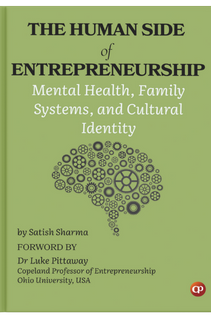
This chapter is a part of: The Human Side of Entrepreneurship: Mental Health, Family Systems, and Cultural Identity from India
ISBN (Ebook):978-93-49926-21-9
ISBN (Hardcover Print):978-93-49926-09-7
ISBN (Softcover Print):978-93-49926-53-0
© CSMFL Publications & its authors.
Published: March 5, 2026
Abstract
The entrepreneurial path brings undeniable innovation and economic benefits. Yet it also creates substantial personal challenges that individual resilience alone cannot address. This chapter examines how broader systems affect entrepreneurial mental health, calling for wide-ranging policy changes, educational reforms, and community support programs. We draw from recent work in entrepreneurship, psychology, and public policy to examine four areas of systematic reform. These include advocacy and policy changes that remove structural obstacles to entrepreneurial wellness, educational programs that build psychological strength and awareness in future business founders, community mental health services designed for business settings, and the changing responsibilities of investors in supporting sustainable business practices. The chapter shows that meaningful change requires cooperation among policymakers, schools, mental health experts, and investors. It also adds to the expanding research on entrepreneurial wellness by presenting research-backed approaches for building environments that support both business achievement and human development.
Keywords: Entrepreneurial Wellness, Systematic Reform, Policy Advocacy, Business Education, Mental Health Awareness
References
- Autio, E., Kenney, M., Mustar, P., Siegel, D., & Wright, M. (2014). Entrepreneurial innovation: The importance of context. Research Policy, 43(7), 1097-1108.
- Bugg-Levine, A., & Emerson, J. (2011). Impact investing: Transforming how we make money while making a difference. Innovations, 6(3), 9-18.
- Bullough, A., Renko, M., & Myatt, T. (2014). Danger zone entrepreneurs: The importance of resilience and self-efficacy for entrepreneurial intentions. Entrepreneurship Theory and Practice, 38(3), 473-499.
- Cardon, M. S., & Patel, P. C. (2015). Is stress worth it? Stress-related health and wealth trade-offs for entrepreneurs. Applied Psychology, 64(2), 379-420.
- Corrigan, P. W., & Watson, A. C. (2002). Understanding the impact of stigma on people with mental illness. World Psychiatry, 1(1), 16-20.
- Doherty, B., Haugh, H., & Lyon, F. (2014). Social enterprises as hybrid organizations: A review and research agenda. International Journal of Management Reviews, 16(4), 417-436.
- Freeman, M. A., Johnson, S. L., Staudenmaier, P. J., & Zisser, M. R. (2015). Are entrepreneurs “touched with fire”? Michael A. Freeman, 1-15.
- Goetzel, R. Z., Henke, R. M., Tabrizi, M., Pelletier, K. R., Loeppke, R., Ballard, D. W., … & White, J. (2014). Do workplace health promotion (wellness) programs work? Journal of Occupational and Environmental Medicine, 56(9), 927-934.
- Gompers, P., & Lerner, J. (2001). The venture capital cycle. MIT Press.
- Hayton, J. C., George, G., & Zahra, S. A. (2002). National culture and entrepreneurship: A review of behavioral research. Entrepreneurship Theory and Practice, 26(4), 33-52.
- Henrekson, M., & Sanandaji, T. (2011). The interaction of entrepreneurship and institutions. Journal of Institutional Economics, 7(1), 47-75.
- Hmieleski, K. M., & Sheppard, L. D. (2019). The Yin and Yang of entrepreneurship: Gender differences in the importance of communal and agentic characteristics for entrepreneurs’ subjective well-being and performance. Journal of Business Venturing, 34(4), 709-730.
- Jorm, A. F. (2012). Mental health literacy: Empowering the community to take action for better mental health. American Psychologist, 67(3), 231-243.
- Kaplan, S. N., & Strömberg, P. (2003). Financial contracting theory meets the real world: An empirical analysis of venture capital contracts. The Review of Economic Studies, 70(2), 281-315.
- Nabi, G., Liñán, F., Fayolle, A., Krueger, N., & Walmsley, A. (2017). The impact of entrepreneurship education in higher education: A systematic review and research agenda. Academy of Management Learning & Education, 16(2), 277-299.
- Nicholas, J., Larsen, M. E., Proudfoot, J., & Christensen, H. (2015). Mobile apps for bipolar disorder: A systematic review of features and content quality. Journal of Medical Internet Research, 17(8), e4581.
- Parasuraman, S., & Simmers, C. A. (2001). Type of employment, work–family conflict and well-being: A comparative study. Journal of Organizational Behavior, 22(5), 551-568.
- Reardon, T., Harvey, K., Baranowska, M., O’Brien, D., Smith, L., & Creswell, C. (2017). What do parents perceive are the barriers and facilitators to accessing psychological treatment for mental health problems in children and adolescents? A systematic review of qualitative and quantitative studies. European Child & Adolescent Psychiatry, 26(6), 623-647.
- Sapienza, H. J., & Korsgaard, M. A. (1996). Procedural justice in entrepreneur-investor relations. Academy of Management Journal, 39(3), 544-574.
- Shepherd, D. A. (2003). Learning from business failure: Propositions of grief recovery for the self-employed. Academy of Management Review, 28(2), 318-328.
- St-Jean, E., & Audet, J. (2012). The role of mentoring in the learning development of the novice entrepreneur. International Entrepreneurship and Management Journal, 8(1), 119-140.
- Stephan, U. (2018). Entrepreneurs’ mental health and well-being: A review and research agenda. Academy of Management Perspectives, 32(3), 290-322.
- Thomas, A. S., & Mueller, S. L. (2000). A case for comparative entrepreneurship: Assessing the relevance of culture. Journal of International Business Studies, 31(2), 287-301.
- Thornicroft, G., Mehta, N., Clement, S., Evans-Lacko, S., Doherty, M., Rose, D., … & Henderson, C. (2016). Evidence for effective interventions to reduce mental-health-related stigma and discrimination. The Lancet, 387(10023), 1123-1132.
- Torrès, O., & Thurik, R. (2019). Small business owners and health. Small Business Economics, 53(2), 311-321.
- Ufuk, H., & Özgen, Ö. (2001). The profile of women entrepreneurs: A sample from Turkey. International Journal of Consumer Studies, 25(4), 299-308.
- van Stel, A., Storey, D. J., & Thurik, A. R. (2007). The effect of business regulations on nascent and young business entrepreneurship. Small Business Economics, 28(2-3), 171-186.
- Wasserman, N. (2008). The founder’s dilemma. Harvard Business Review, 86(2), 102-109.
- Wiklund, J., Nikolaev, B., Shir, N., Foo, M. D., & Bradley, S. (2019). Entrepreneurship and well-being: Past, present, and future. Journal of Business Venturing, 34(4), 579-588.
- Zacharakis, A. L., & Meyer, G. D. (2000). The potential of actuarial decision models: Can they improve the venture capital investment decision? Journal of Business Venturing, 15(4), 323-346.
This book is available worldwide via EBSCOhost Academic Collection, EBSCO E- books, Google Play Books, Amazon, World Cat Discovery Service/OCLC, CSMFL Bookstore, and 200+ book resellers and academic content vendors.
Statement on Publication Ethics
We, at CSMFL Publications, are committed to ensure the unbiased and transparent publishing, and upholding the high standards of editorial integrity in our publications. To know more, please read our Statement on Publication Ethics, Editorial Integrity & Misconduct