The Entrepreneur’s Toolkit: Essential Resources for Integrated Success
Satish Sharma
Lead Management Consultant, SKS Consulting & Advisors, India.
10.46679/9789349926219ch14
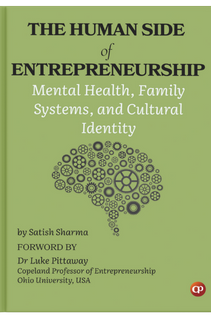
This chapter is a part of: The Human Side of Entrepreneurship: Mental Health, Family Systems, and Cultural Identity from India
ISBN (Ebook):978-93-49926-21-9
ISBN (Hardcover Print):978-93-49926-09-7
ISBN (Softcover Print):978-93-49926-53-0
© CSMFL Publications & its authors.
Published: March 5, 2026
Abstract
The path of starting and growing a venture often involves more than just business-related activities; it also brings challenges related to mental well-being, family interactions, cultural identity, and the need for professional guidance. This chapter offers an in-depth look at the available supports that entrepreneurs can access to shape entrepreneurial success. The chapter combines existing scholarly evidence on support systems while pointing out gaps in accessibility and actual use of these resources. The chapter further discusses that effective support needs to account for the entrepreneurial pressures, with special focus on those from underserved or culturally diverse backgrounds. Practical recommendations have also been discussed for identifying and using these resources are provided, aiding existing understanding of how to build entrepreneurial ecosystems and build-up entrepreneurial capacity.
Keywords: Entrepreneurial Mental Health, Family Support Systems, Cultural Entrepreneurship, Professional Networks
References
- Aldrich, H. E., & Cliff, J. E. (2003). The pervasive effects of family on entrepreneurship: Toward a family embeddedness perspective. Journal of Business Venturing, 18(5), 573-596.
- Anderson, R. B., Dana, L. P., & Dana, T. E. (2006). Indigenous land rights, entrepreneurship, and economic development in Canada: “Opting-in” to the global economy. Journal of World Business, 41(1), 45-55.
- Bagley, C. E., & Dauchy, C. E. (2008). The entrepreneur’s guide to business law (3rd ed.). West Academic Publishing.
- Bates, T. (1997). Race, self-employment, and upward mobility: An illusive American dream. Johns Hopkins University Press.
- Belleflamme, P., Lambert, T., & Schwienbacher, A. (2014). Crowdfunding: Tapping the right crowd. Journal of Business Venturing, 29(5), 585-609.
- Bruneel, J., Ratinho, T., Clarysse, B., & Groen, A. (2012). The evolution of business incubators: Comparing demand and supply of business incubation services across different incubator generations. Technovation, 32(2), 110-121.
- Brush, C. G., Carter, N. M., Gatewood, E. J., Greene, P. G., & Hart, M. M. (2009). Women entrepreneurs 2020: Three decades of change. Babson College.
- Buttner, E. H., & Moore, D. P. (1997). Women’s organizational exodus to entrepreneurship: Self-reported motivations and correlates with success. Journal of Small Business Management, 35(1), 34-46.
- Cardon, M. S., & Patel, P. C. (2015). Is stress worth it? Stress-related health and wealth trade-offs for entrepreneurs. Applied Psychology, 64(2), 379-420.
- Carter, S., Mwaura, S., Ram, M., Trehan, K., & Jones, T. (2015). Barriers to ethnic minority and women’s enterprise: Existing evidence, policy tensions and unsettled questions. International Small Business Journal, 33(1), 49-69.
- Chrisman, J. J., & McMullan, W. E. (2004). Outsider assistance as a knowledge resource for new venture survival. Journal of Small Business Management, 42(3), 229-244.
- Cohen, S., & Hochberg, Y. V. (2014). Accelerating startups: The seed accelerator phenomenon. SSRN Electronic Journal. [https://doi.org/10.2139/ssrn.2418000](https://doi.org/10.2139/ssrn.2418000)
- Danes, S. M., Loy, J. T. C., & Stafford, K. (2008). Business planning practices of family-owned firms within a quality framework. Journal of Small Business Management, 46(3), 395-421.
- Demerouti, E., Bakker, A. B., Nachreiner, F., & Schaufeli, W. B. (2001). The job demands-resources model of burnout. Journal of Applied Psychology, 86(3), 499-512.
- Dennis, W. J. (2003). Raising response rates in mail surveys of small business owners: Results of an experiment. Journal of Small Business Management, 41(3), 278-295.
- Freeman, M. A., Johnson, S. L., Staudenmaier, P. J., & Zisser, M. R. (2015). Are entrepreneurs “touched with fire”?
- Glaub, M. E., Frese, M., Fischer, S., & Hoppe, M. (2014). Increasing personal initiative in small business managers or owners leads to entrepreneurial success: A theory-based controlled randomized field intervention for evidenced-based management. Academy of Management Learning & Education, 13(3), 354-379.
- Gompers, P., & Lerner, J. (2001). The venture capital cycle. MIT Press.
- Hackett, S. M., & Dilts, D. M. (2004). A systematic review of business incubation research. Journal of Technology Transfer, 29(1), 55-82.
- Hathaway, I. (2016). What startup accelerators really do. Harvard Business Review. Harvard Business Review Press.
- Hobfoll, S. E. (1989). Conservation of resources: A new attempt at conceptualizing stress. American Psychologist, 44(3), 513-524.
- Isenberg, D. J. (2011). The entrepreneurship ecosystem strategy as a new paradigm for economic policy: Principles for cultivating entrepreneurship. Presentation at the Institute of International and European Affairs, Dublin, Ireland.
- Jennings, J. E., & McDougald, M. S. (2007). Work-family interface experiences and coping strategies: Implications for entrepreneurship research and practice. Academy of Management Review, 32(3), 747-760.
- Kellermanns, F. W., & Eddleston, K. A. (2007). A family perspective on when conflict benefits family firm performance. Journal of Business Research, 60(10), 1048-1057.
- Kim, P. H., Longest, K. C., & Lippmann, S. (2015). The tortoise versus the hare: Progress and business viability differences between conventional and leisure-based founders. Journal of Business Venturing, 30(2), 185-204.
- Kloosterman, R., van der Leun, J., & Rath, J. (1999). Mixed embeddedness: (In)formal economic activities and immigrant businesses in the Netherlands. International Journal of Urban and Regional Research, 23(2), 252-266.
- Kuratko, D. F. (2005). The emergence of entrepreneurship education: Development, trends, and challenges. Entrepreneurship Theory and Practice, 29(5), 577-597.
- Light, I., & Rosenstein, C. (1995). Race, ethnicity, and entrepreneurship in urban America. Aldine de Gruyter.
- Mallon, M., & Cohen, L. (2001). Time for a change? Women’s accounts of the move from organizational careers to self-employment. British Journal of Management, 12(3), 217-230.
- Miller, D., Steier, L., & Le Breton-Miller, I. (2003). Lost in time: Intergenerational succession, change, and failure in family business. Journal of Business Venturing, 18(4), 513-531.
- Mollick, E. (2014). The dynamics of crowdfunding: An exploratory study. Journal of Business Venturing, 29(1), 1-16.
- Nanda, R., & Khanna, T. (2010). Diasporas and domestic entrepreneurs: Evidence from the Indian software industry. Journal of Economics & Management Strategy, 19(4), 991-1012.
- Ozgen, E., & Baron, R. A. (2007). Social sources of information in opportunity recognition: Effects of mentors, industry networks, and professional forums. Journal of Business Venturing, 22(2), 174-192.
- Peredo, A. M., Anderson, R. B., Galbraith, C. S., Honig, B., & Dana, L. P. (2004). Towards a theory of indigenous entrepreneurship. International Journal of Entrepreneurship and Small Business, 1(1-2), 1-20.
- Pio, E. (2005). Knotted strands: Working lives of Indian women migrants in New Zealand. Human Relations, 58(10), 1277-1299.
- Pittaway, L., & Cope, J. (2007). Entrepreneurship education: A systematic review of the evidence. International Small Business Journal, 25(5), 479-510.
- Pollack, J. M., Vanepps, E. M., & Hayes, A. F. (2012). The moderating role of social ties on entrepreneurs’ depressed affect and withdrawal intentions in response to economic stress. Journal of Organizational Behavior, 33(6), 789-810.
- Portes, A., & Sensenbrenner, J. (1993). Embeddedness and immigration: Notes on the social determinants of economic action. American Journal of Sociology, 98(6), 1320-1350.
- Powell, G. N., & Eddleston, K. A. (2013). Linking family-to-business enrichment and support to entrepreneurial success: Do female and male entrepreneurs experience different outcomes? Journal of Business Venturing, 28(2), 261-280.
- Riemenschneider, C. K., Harrison, D. A., & Mykytyn, P. P. (2003). Understanding IT adoption decisions in small business: Integrating current theories. Information & Management, 40(4), 269-285.
- Rumens, N. (2016). Towards queering the business school: A research agenda for advancing lesbian, gay, bisexual and trans perspectives and issues. Gender, Work & Organization, 23(1), 36-51.
- Sharma, P. (2004). An overview of the field of family business studies: Current status and directions for the future. Family Business Review, 17(1), 1-36.
- Shinnar, R. S., & Young, C. A. (2008). Hispanic immigrant entrepreneurs in the Las Vegas metropolitan area: Motivations for entry into and outcomes of self-employment. Journal of Small Business Management, 46(2), 242-262.
- Spigel, B. (2017). The relational organization of entrepreneurial ecosystems. Entrepreneurship Theory and Practice, 41(1), 49-72.
- St-Jean, E., & Audet, J. (2012). The role of mentoring in the learning development of the novice entrepreneur. International Entrepreneurship and Management Journal, 8(1), 119-140.
- Stephan, U. (2018). Entrepreneurs’ mental health and well-being: A review and research agenda. Academy of Management Perspectives, 32(3), 290-322.
- Sullivan, R. (2000). Entrepreneurial learning and mentoring. International Journal of Entrepreneurial Behavior & Research, 6(3), 160-175.
- Ucbasaran, D., Shepherd, D. A., Lockett, A., & Lyon, S. J. (2013). Life after business failure: The process and consequences of business failure for entrepreneurs. Journal of Management, 39(1), 163-202.
- Wiklund, J., Nikolaev, B., Shir, N., Foo, M. D., & Bradley, S. (2019). Entrepreneurship and well-being: Past, present, and future. Journal of Business Venturing, 34(4), 579-588.
This book is available worldwide via EBSCOhost Academic Collection, EBSCO E- books, Google Play Books, Amazon, World Cat Discovery Service/OCLC, CSMFL Bookstore, and 200+ book resellers and academic content vendors.
Statement on Publication Ethics
We, at CSMFL Publications, are committed to ensure the unbiased and transparent publishing, and upholding the high standards of editorial integrity in our publications. To know more, please read our Statement on Publication Ethics, Editorial Integrity & Misconduct