Reclaiming The Zenana: Rokeya Sakhawat Hossain’s Life-Writings as Feminist Autoethnography
Divya D.
Assistant Professor, Lovely Professional University, Punjab, India.
10.46679/9789349926509ch02
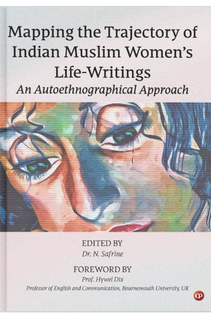
This chapter is a part of: Mapping the Trajectory of Indian Muslim Women’s Life-Writings: An Autoethnographical Approach from India
ISBN (Ebook): 978-93-49926-50-9
ISBN (Hardcover Print): 978-93-49926-84-4
ISBN (Softcover Print): 978-93-49926-34-9
© CSMFL Publications & its authors.
Published: April 15, 2026
Abstract
This chapter explores the writings of Hossain’s as profound and political acts of feminist protest. Constructed in the familiar elements of Indian Muslim women under colonial rule, Hossain’s Sultana’s Dream and Padmarag challenge both patriarchal diagnosis of religion and the colonial smothering of native female voices. Her works carry the roar of her personal history and experience of purdah, pain, and courage, and hence her attempts to envision Muslim womanhood not as compliance but as subversion. In Sultana’s Dream, the dream space becomes a canvas of inversion—men relegated to seclusion while women walk free, govern, and innovate. But it is Padmarag that reveals Hossain’s deeper, more grounded voice. The women in Tarini Bhavan reflect fragments of herself: educators, caretakers, and survivors building a world within a world. Their acts of everyday resistance—opening schools, offering shelter, reading letters in secret—become a powerful archive of Muslim women. In contemporary times, the zenana persists in new forms—whether in digital silencing, domestic expectations, or cultural gatekeeping—making Hossain’s reclamation of that space ever more relevant as women continue to carve out rooms of their own within and beyond inherited boundaries. Through her texts, Hossain blurred the line between fiction and lived truth. Her work speaks not from the margins, but from the heart of struggle—where faith becomes ethical, solidarity becomes sacred, and writing becomes survival. In reading her, we meet a woman who dreamed, fought, and mothered a movement—not only through activism but through storytelling. This chapter offers her voice the space it always deserved: not as exception, but as example.
Keywords: Hossain, Feminism, Purdah, Zenana, Resistance
References
- Bagchi, B. (2005). Feminist visions and the nation: The work of Rokeya Sakhawat Hossain. In A. Loomba & R. Lukose (Eds.), South Asian feminism: Contemporary interventions (pp. 22–38). Duke University Press.
- Bagchi, B. (Ed. & Trans.). (2006). The Sultana’s dream and Padmarag: Two feminist utopias by Rokeya Sakhawat Hossain. Penguin Books.
- Chatterjee, P. (1993). The nation and its fragments: Colonial and postcolonial histories. Princeton University Press.
- Ellis, C. (2004). The ethnographic I: A methodological novel about autoethnography. AltaMira Press.
- Forbes, G. (1996). Women in modern India. Cambridge University Press.
- Hossain, R. S. (1905). Sultana’s Dream. S. K. Lahiri & Co. (also available in Bagchi, 2006 edition)
- Hossain, R. S. (2006). Amader Shiksha [Our Education]. In B. Bagchi (Ed. & Trans.), The Sultana’s dream and Padmarag (pp. 95–100). Penguin Books.
- Hossain, R. S. (2006). Padmarag. In B. Bagchi (Ed. & Trans.), The Sultana’s dream and Padmarag (pp. 103–183). Penguin Books.
- Metcalf, B. D., & Metcalf, T. R. (2006). A concise history of modern India (2nd ed.). Cambridge University Press.
- Minault, G. (1998). Secluded scholars: Women’s education and Muslim social reform in India. Oxford University Press.
- Quayum, M. A. (2017). Introduction. In M. A. Quayum (Ed.), Rokeya Sakhawat Hossain: Selected works (pp. vii–xxviii). Oxford University Press.
- Sarkar, S. (1975). The social background of nationalism: 1858–1947. Orient Longman.
- Smith, S., & Watson, J. (2010). Reading autobiography: A guide for interpreting life narratives (2nd ed.). University of Minnesota Press.
This book is available worldwide via EBSCOhost Academic Collection, EBSCO E- books, Google Play Books, Amazon, World Cat Discovery Service/OCLC, CSMFL Bookstore, and 200+ book resellers and academic content vendors.
Statement on Publication Ethics
We, at CSMFL Publications, are committed to ensure the unbiased and transparent publishing, and upholding the high standards of editorial integrity in our publications. To know more, please read our Statement on Publication Ethics, Editorial Integrity & Misconduct