Mapping the Trajectory of Indian Muslim Women’s Life-Writings: An Autoethnographical Approach
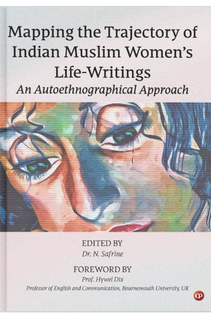
Book: Mapping the Trajectory of Indian Muslim Women's Life-Writings: An Autoethnographical Approach from India by CSMFL Publications

Editor

N. Safrine
Independent Researcher, Chennai, Tamil Nadu, India.

ISBN (Ebook): 978-93-49926-50-9
ISBN (Paperback): 978-93-49926-84-4
ISBN (Hardback): 978-93-49926-34-9
10.46679/9789349926509


This book is available worldwide via EBSCOhost Academic Collection, EBSCO E-books, GOBI, Google Play Books, Amazon, WorldCat Discovery Service/OCLC, CSMFL Bookstore, and 200+ book resellers and academic content vendors.

© CSMFL Publications & its authors.
Published: April 15, 2026


About the book

The proposed volume aims to understand the nuances of life-writings within the rubrics of Indian Muslim women’s lifestyle. The book aims to situate the life-writings as an autoethnographical account of the lived experiences of Muslim women in India. An in-depth study of Indian Muslim women’s life narratives clearly conveys that the texts function as critical evaluation of India’s history, politics, culture and tradition through the microcosmic representation of an archetypal Muslim household. The household space includes a distinct spatial division which encompasses the mardana (men’s quarters), zenana (women’s quarters) and the servant’s quarters.

The volume, further aims to explore the Muslim tahzheeb manifested in their mannerisms, relationship with the British Raj and inter-cast Islamic groups and the interplay of religious tropes such as purdah and zenana. The trajectories of Muslim women’s lifestyles are palpably intertwined with the history, politics and tradition of the country and hence presents a panoramic view of the feminist approach towards the Indian Muslim women’s life-writings. This can be studied by situating the texts within the socio-political background of the cultural ecosystem which the chapters in the volume have precisely done.

The book aims to address certain pertinent questions such as how India is viewed in the eyes of Indian Muslim women, and how have they documented the same in their text? And how can Muslim women’s life narratives be approached as cultural evaluation of Indian society. In the recent times, the importance of researching Indian Muslim women writings has grown as researchers have realised the importance of focusing on the marginalised voices. Contributors examine how Muslim women’s voices have played a significant role in understanding what shapes the identity of these women and how it impacts their personal lives.

Literary texts chosen in this volume deeply reflects the epoch of the writers especially the pre-independence and partition period. Contributors also show how lived experiences of the writers deftly take the form of fiction and represents a myriad of lives that demystifies the various stereotypes associated with Muslim women. The collection of essays in this volume highlights the need to approach Muslim women’s writings as a serious and evolving academic inquiry. This edited volume aims to capture and calibrate the length and breadth of voices that emerge from beyond the veil thereby fostering the advancement of Muslim women studies across various disciplines. As a collection, the volume offers an intensive and original readings of texts by familiar authors whose works have been approached from a fresh perspective.

The essay “Narrating stories of Culture: An Autoethnographic Reading of Haris Qadeer’s The Silence that Speaks-short stories by Indian Muslim Women and Attia Hosain’s Distant Traveller by Ajas. N. explores the role of culture in crafting the stories of Muslim community. It studies the select texts using a feminist autoethnographic lens and argues that the authors also play the role of autoethnographers. The essay critically examines the two seminal texts that underscores the socio-cultural and political epoch of the writers and hence renders a comprehensive overview of the lived experiences portrayed within the texts. The essay delves into the critical analysis of the text and locates the female characters within their societal framework and poignantly documents their silent struggle.

The essay titled “Reclaiming the Zenana: Rokeya Sakhawat Hossain’s Life-Writings as Feminist Autoethnography” studies Hosain’s texts Sultana’s Dream and Padmarag through the lens of feminist autoethnography. Through a closer study of these two texts, the essay delves deeper into the role of zenana with a special focus on the lives of Muslim women in colonial Bengal.

“Can Silence Be a Source of History? A Mizaj Pursi of the Forgotten Lives of Six Indian Muslim Historical Female Figurines by Kaushiki Ishwar focuses on the lives of six Muslim women who influenced the political atmosphere of the country but their significant presence had been erased during the passage of time. The chapter explores the interconnectedness of factors such as gender, religion and resistance within the framework of Indian nationalist movements.

The essay “Voices Behind the Veil: Mapping the Journey of Indian Muslim Women through Literature and Autobiography” critically examines two seminal texts of Ismat Chughtai and Anees Jung to understand the narrative technique employed in chronicling the life stories of these Indian Muslim women authors. By undertaking a close reading of the texts, the essay looks into how literature fosters a space to reflect, criticise and subvert the limitations set by patriarchal standards.

The chapter titled “Living life through writing: A Feminist Autoethnographical Reading of Ismat Chughtai’s A Life in Words, Saeeda Bano’s

Off the Beaten Track and Zarina Bhatty’s Purdah to Piccadilly” approaches life-writing as a subversive platform that offers space for writers to celebrate their lives. Focusing on the personal narratives of Ismat Chughtai, Zarina Bhatty and Saeeda Bano, the essay throws light on the struggles faced by these Muslim women in pursuing their dreams. The essay discusses how gender and religious identity become a site of conflict and how such challenges were dealt by the authors while struggling to achieve freedom and assert their individual identity.

Preeti Sharma’s “Lives in the Shadows of Empire: Autoethnographic Perspectives on the Narratives of Jahanara Begum, Nur Jahan and Zeb-Un-Nissa” examines the life-writings on Mughal women, situating their lives within the socio-political context of the Mughal empire. The chapter delves deeper into the lives of Mughal women by focusing on their voice, agency and lived experience as documented in the biographical and autobiographical writings. By incorporating an autoethnographic approach, the essay studies how these royal women navigated complex terrains of gender, power and spirituality.

The chapter “Lives in Fragments: Narrating Resistance and Identity in Life-Writings of Indian Muslim Women” examines how gender, religion and class intersect to shape the lives of Muslim women through the study of the texts of Ismat Chughtai, Attia Hosain and Banu Mushtaq. It explores how Muslim women use life-writing texts as a potent space to reclaim agency and record stories of survival.

“Rescued or Repressed? Muslim Women’s Displacement and Silencing in Partition Literature” by Rubaiya Nasrin studies the silence of Muslim women during the partition era by focusing on the texts of Qurratulain Hyder, Khadija Mastur and Anis Kidwai. The essay subverts the notion of zenana as a passive space and explores the significance of the space in nurturing female bonding and rebellion.Safwana Arayapurath’s “Muslim Women Negotiating Representation, Region and Religion: Shamshad Hussain’s Autoethnographic Documentation of the Lives of Muslim Women in Malappuram, Kerala” delves deeper into the seminal work of Shamshad Hussain. By examining Muslim women’s experience within a marriage-centric community, the essay studies the intersection of caste, class and gender with reference to the Muslim women in and around Malappuram region in Kerala.

Sreemoyee Sarkar’s “Colonial Construction of Women’s Empowerment: (A)historical Orientalisation of Awadh Begums” explores the idea of ‘Indian women’ in colonial history and discusses how women empowerment unfolds in this politically turbulent era. By focusing on the lives of two significant Awadh Begums—Bahu Begum and Mallika Kiswar, the essay examines the colonial perspective of the Indian Muslim women within the context of their socio-political epoch.

Apart from serving as an academic study, the book aspires to promote intellectual dialogues and nuanced discourses pertaining to Indian Muslim women’s writings. It has made an attempt to explore the diverse voices and experiences of Muslim women through the lens of autoethnography. The chapters in this volume deeply engage with the writings that consciously subvert and problematise the established identity and stereotypes surrounding Indian Muslim women.

They question the representation of Muslim women in literature, media and political forums and evoke readers to consider how the ‘auto’ (self) and ‘ethno’ (culture) of Muslim women interlace with notions of identity, caste, gender and class. By interrogating the intersections between the collective factors that impact the singular identity of Muslim women, the volume underscores the need to address the existing literature with a fresh perspective and encourage critical discussions pertaining to how Muslim women are portrayed across different platforms.

Through diverse cultural contexts and temporalities, the contributions in this volume explore the role of life-writings in recording the narratives of women whose voices have been silenced, skewed and misinterpreted for several decades. By offering interdisciplinary insights, the volume illustrates how such autoethnographic narratives serve as critical and contested sites of rebellion and resistance. In conclusion, the volume aims to contribute to the ongoing endeavour of deciphering the position of Muslim women from a national perspective and envisioning pathways toward collective and holistic understanding of Muslim women’s literature.

Through autoethnographic studies as well as close textual readings, the authors selected for this volume offer a set of essays that deeply engage with a range of Indian cultural context from various epochs, culminating in a significant and scholarly intervention that will hopefully contribute in a meaningful way to the discipline of Indian Muslim women’s literature. The book aims to promote future pedagogic possibilities in Muslim women’s writings in India, with its contributors being an organic mix of PhD scholars, professors, and early-career academics from various Indian universities.

As the editor of this volume, I hope that this volume will lend itself substantially to other allied areas of academic engagement such as those corresponding with life-writing, feminist ethnographical research, memory studies, narrativity and historiography. This academic endeavour is a sincere attempt to build a robust platform to (re)read the diverse aspects of Indian Muslim women’s literature through the interdisciplinary lens of feminism and autoethnography. Further, the book hopes to generate new ideas and positive interventions that would render productive contribution to the holistic understanding of Indian Muslim women’s writings.


Chapters

Foreword

by Dr. Hywel Dix


Introduction

by N. Safrine


01: Narrating Stories of Culture: An Autoethnographic Reading of Haris Qadeer’s the Silence That Speaks-Short Stories by Indian Muslim Women and Attia Hosain’s Distant Traveller

by Ajas N.and Dr. T. Abdul Rahman


02: Reclaiming The Zenana: Rokeya Sakhawat Hossain’s Life-Writings as Feminist Autoethnography

by Divya D.


03: Can Silence Be a Source in History? A Mizāj Pursi of The Forgotten Lives of Six Indian Muslim Historical Female Figurines

by Kaushiki Ishwar


04: Voices Behind the Veil: Mapping the Journey of Indian Muslim Women Through Literature and Autobiography

by Nasreen Sultana K. A.


05: Lives in The Shadows of Empire: Autoethnographic Perspectives on The Narratives of Jahanara Begum, Nur Jahan and Zeb-Un-Nissa

by Preeti Sharma


06: Lives in Fragments: Narrating Resistance and Identity in Life-Writings of Indian Muslim Women

by Rijul Singh


07: Rescued or Repressed? Muslim Women’s Displacement and Silencing in Partition Literature

by Rubaiya Nasrin


08: Muslim Women Negotiating Representation, Region, and Religion: Shamshad Hussain’s Autoethnographic Documentation of The Lives of Muslim Women In Malappuram, Kerala

by Safwana Arayapurath


09: Oppositional Gaze on Home and Domesticity in The Selected Fiction of Nazar Sajjad Hyder and ismat Chughtai

by Malabi Ghosh


10: Colonial Construction of Women’s Empowerment: (A)Historical Orientalisation of Awadh Begums

by Sreemoyee Sarkar


11: Living Life Through Writing: A Life in Words, Saeeda Bano’s Off the Beaten Track and Zarina Bhatty’s Purdah to Piccadilly

by N. Safrine and Dr. S. Rasheeda Sulthana


Statement on Publication Ethics

We, at CSMFL Publications, are committed to ensure the unbiased and transparent publishing, and upholding the high standards of editorial integrity in our publications. To know more, please read our Statement on Publication Ethics, Editorial Integrity & Misconduct


[email protected]

Follow us @