Voices Behind the Veil: Mapping the Journey of Indian Muslim Women Through Literature and Autobiography
Nasreen Sultana K. A.
Assistant Professor, Post Graduate Department of English, Shrimathi Devkunvar Nanalal Bhatt Vaishnav College for Women, Chennai, India.
10.46679/9789349926509ch04
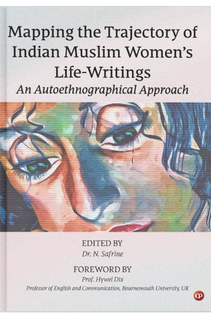
This chapter is a part of: Mapping the Trajectory of Indian Muslim Women’s Life-Writings: An Autoethnographical Approach from India
ISBN (Ebook): 978-93-49926-50-9
ISBN (Hardcover Print): 978-93-49926-84-4
ISBN (Softcover Print): 978-93-49926-34-9
© CSMFL Publications & its authors.
Published: April 15, 2026
Abstract
This paper conducts a comparative literary analysis of A Life in Words by Ismat Chughtai and Zeba: An Unveiling by Anees Jung to explore how Muslim women authors employ contrasting narrative modes, autobiography and prose fiction, to create and narrate their life narratives. By placing the authors’ generic and representational choices under critical examination, the book reveals how each text negotiates identity, agency, and embodied life in opposition to specific configurations of a socio-political and cultural order. Based on autoethnography and feminist literary theory, the research illustrates how the authors navigate constructs of identity, desire, resistance, and the public-private split of the female self. Based on the argument in the paper, it is not merely individual works of storytelling for Chughtai and Jung but powerful socio-cultural texts that shed light on the changing place of Indian Muslim women. The longer quotes from the text allow a close reading of how these texts reflect their era, resist patriarchal limitations, and establish a canon of literary resistance.
Keywords: Indian Muslim Women, Autobiographical Fiction, Ismat Chughtai, Anees Jung, Feminist Narrative, Cultural Identity, Resistance, Postcolonial Literature, Gender Studies, Autoethnography
References
- Ali, S. (2004). Madras on Rainy Days. Farrar, Straus and Giroux.
- Butalia, U. (2000). The Other Side of Silence: Voices from the Partition of India. Duke University Press.
- Chughtai, I. (2009). A Life in Words: Memoirs (M. Asaduddin, Trans.). Penguin Books.
- Crenshaw, K. (1991). Mapping the margins: Intersectionality, identity politics, and violence against women of color. Stanford Law Review, 43(6), 1241–1299.
- Hooks, b. (1984). Feminist Theory: From Margin to Center. South End Press.
- Jung, A. (1992). Zeba: An Unveiling. Penguin Books.
- Khan, U. A. (2003). Trespassing. Flamingo.
- Kumar, R. (1993). The History of Doing: An Illustrated Account of Movements for Women’s Rights and Feminism in India, 1800–1990. Zubaan.
- Lal, M. (1995). The Law of the Threshold: Women Writers in Indian English. Indian Institute of Advanced Study.
- Mohanty, C. T. (2003). Feminism Without Borders: Decolonizing Theory, Practicing Solidarity. Duke University Press.
- Sarkar, T., & Butalia, U. (Eds.). (1995). Women and the Hindu Right: A Collection of Essays. Kali for Women.
- Zecchini, L. (2017). Ismat Chughtai: A Fearless Voice. Speaking Tiger Publishing.
- Chughtai, Ismat. A Life in Words: Memoirs. Translated by M. Asaduddin, Penguin Books, 2012.
- Das, Kamala. My Story. Sterling Publishers, 1976.
- Hossain, Rokeya Sakhawat. Sultana’s Dream and Selections from The Secluded Ones. Edited and introduced by Roushan Jahan, The Feminist Press, 1988.
- Hyder, Qurratulain. River of Fire. Translated by the author, New Directions, 1998.
- Hosain, Attia. Sunlight on a Broken Column. Chatto & Windus, 1961.
- Mernissi, Fatima. Dreams of Trespass: Tales of a Harem Girlhood. Perseus Books, 1994.
- Sajjad Zaheer, Razia. Sare Jahan ka Dard: A Biography of Sajjad Zaheer. Translated by Amina Azfar, Oxford University Press, 2006.
- Yousafzai, Malala, with Christina Lamb. I Am Malala: The Girl Who Stood Up for Education and Was Shot by the Taliban. Little, Brown, 2013 https://www.researchgate.net/publication/318858682_Autoethnography
This book is available worldwide via EBSCOhost Academic Collection, EBSCO E- books, Google Play Books, Amazon, World Cat Discovery Service/OCLC, CSMFL Bookstore, and 200+ book resellers and academic content vendors.
Statement on Publication Ethics
We, at CSMFL Publications, are committed to ensure the unbiased and transparent publishing, and upholding the high standards of editorial integrity in our publications. To know more, please read our Statement on Publication Ethics, Editorial Integrity & Misconduct