Lives in the Shadows of Empire: Autoethnographic Perspectives on The Narratives of Jahanara Begum, Nur Jahan, and Zeb-Un-Nissa
Preeti Sharma
Assistant Professor, KCC Institute of Technology and Management, Greater Noida, India.
10.46679/9789349926509ch05
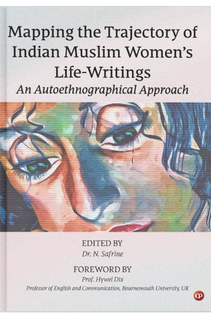
This chapter is a part of: Mapping the Trajectory of Indian Muslim Women’s Life-Writings: An Autoethnographical Approach from India
ISBN (Ebook): 978-93-49926-50-9
ISBN (Hardcover Print): 978-93-49926-84-4
ISBN (Softcover Print): 978-93-49926-34-9
© CSMFL Publications & its authors.
Published: April 15, 2026
Abstract
This research offers an auto-ethnographical evaluation of life-writings by and about Mughal women, for it focuses on their autobiographies, biographies, also personal narratives within the socio-political context of the Mughal Empire (16th–18th centuries). Nur Jahan, Jahanara Begum, and Zeb-un-Nissa played meaningful roles for the shaping of imperial politics, culture, and also society. However, Mughal royal women were historically sidelined in mainstream historiography. The study seeks illumination of the agency, voices, and multidimensional experiences of these women, often muted in patriarchal historical records, through critical engagement with their life-writings. The research also uses an autoethnographic approach while incorporating the scholar’s positionality with reflexive perceptions for deepening comprehension in how these women navigated complex intersections related to gender, power, and spirituality. This study examines how narratives mirror plus defy powerful socio-political dialogues during their era. Their narratives do reveal strategies for resistance, negotiation, and also influence within the Mughal court as well as beyond. This work improves the comprehension regarding women’s roles in early modern South Asia, as well as contributes to feminist historiography by bridging personal life stories with broader historical frameworks. This project ultimately stresses that we should revisit historical sources with a gendered lens and encourages reimagining subtle Mughal history that centres female subjectivities and agency.
Keywords: Feminist Historiography, Life-Writings, Mughal Women, South Asian History, Gender and Power, Autoethnography
References
- Aquil, R. (2017). The Muslim Question: Understanding Islam and Indian History. Penguin Viking.
- Butalia, U. (1998). The other side of silence: Voices from the partition of India. Duke University Press.
- Chughtai, I. (2018). A life in words: Memoirs. (M. Asaduddin, Trans.). Penguin Books.
- Crenshaw, K. (1991). Mapping the margins: Intersectionality, identity politics, and violence against women of color. Stanford Law Review, 43(6), 1241–1299.
- Davis, C. H. F., & Ellis, C. (2007). Autoethnographic introspection in ethnographic fiction: Authenticity, reflexivity, and voice. The Review of Communication, 7(1), 1–19.
- Ellis, C., Adams, T. E., & Bochner, A. P. (2011). Autoethnography: An overview. Forum: Qualitative Social Research, 12(1), Article 10.
- Findly, E. B. (1993). Nur Jahan: Empress of Mughal India. Oxford University Press.
- Gulbadan Begum. (2001). The history of Humāyūn (Humāyūnnāma) (A. Beveridge, Trans.). Rupa & Co.
- Hasan, M. (2007). Legacy of a divided nation: India’s Muslims since independence. Oxford University Press.
- Hosain, A. (2001). Sunlight on a broken column. Penguin Books.
- Jahanara Begum. (1998). The princess who built tombs: Jahanara Begum’s Sufi biography of Moinuddin Chishti (A. Schimmel, Ed. & Trans.). Oxford University Press.
- Kumar, S. (2006). The emergence of the Delhi Sultanate: Transition from post-Gupta to early medieval India. Social Scientist, 34(9/10), 3–25.
- Lal, R. (2005). Domesticity and power in the early Mughal world. Cambridge University Press.
- Lal, R. (2020). Empress: The astonishing reign of Nur Jahan. W. W. Norton & Company.
- Minault, G. (1998). Secluded scholars: Women’s education and Muslim social reform in colonial India. Oxford University Press.
- Mohanty, C. T. (2003). Feminism without borders: Decolonizing theory, practicing solidarity. Duke University Press.
- Pasha, K. (2022). Women and gender in Islam: Historical roots of a modern debate. Yale University Press.
- Schimmel, A. (1992). Islamic mysticism. University of North Carolina Press.
- Sikand, Y. (2006). Voices of peace: Muslim women’s views on communalism and violence in India. Contemporary South Asia, 15(2), 157–173.
- Zeb-un-Nissa. (2011). The diwan of Zeb-un-Nissa (R. C. Prinsep, Trans.). Kessinger Publishing.
This book is available worldwide via EBSCOhost Academic Collection, EBSCO E- books, Google Play Books, Amazon, World Cat Discovery Service/OCLC, CSMFL Bookstore, and 200+ book resellers and academic content vendors.
Statement on Publication Ethics
We, at CSMFL Publications, are committed to ensure the unbiased and transparent publishing, and upholding the high standards of editorial integrity in our publications. To know more, please read our Statement on Publication Ethics, Editorial Integrity & Misconduct