Lives in Fragments: Narrating Resistance and Identity in Life-Writings of Indian Muslim Women
Rijul Singh
PhD Research Scholar, Department of English, Banaras Hindu University, India.
10.46679/9789349926509ch06
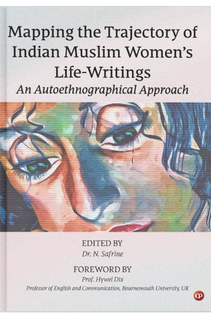
This chapter is a part of: Mapping the Trajectory of Indian Muslim Women’s Life-Writings: An Autoethnographical Approach from India
ISBN (Ebook): 978-93-49926-50-9
ISBN (Hardcover Print): 978-93-49926-84-4
ISBN (Softcover Print): 978-93-49926-34-9
© CSMFL Publications & its authors.
Published: April 15, 2026
Abstract
The life-writings of Indian Muslim women writers reflect nuanced negotiations of identity, resistance, and memory within a deeply gendered and communally charged socio-political landscape. This chapter examines autobiographical and semi-autobiographical works by writers such as Ismat Chughtai (Kaghazi Hai Pairahan) and Attia Hosain (Sunlight on a Broken Column), who craft narratives that intertwine the personal with the political amid the backdrop of colonial decline, nationalist movements, and Partition. Their writings illuminate how gender, religion, and class intersect to shape the inner and outer lives of Muslim women, revealing acts of subtle defiance against patriarchal and colonial structures. Expanding the scope to contemporary regional literature, the chapter engages with Heart Lamp: Selected Stories by Banu Mushtaq, originally written in Kannada and translated into English by Deepa Bhasthi. Published in 2024 and winner of the International Booker Prize in 2025, this collection offers a vital counterpoint to earlier life-writings by fictionalising everyday experiences of Muslim women in southern India. Mushtaq’s stories – spanning over three decades – offer a grounded, intimate view into lives marked by systemic gender inequality, yet resilient in the face of oppression. The chapter also draws connections with memoirs such as Qurratulain Hyder’s Kar-e-Jahan Daraz Hai and contemporary interventions like Sabyn Javeri’s essays, to trace a literary continuum that resists marginalisation and asserts voice. Through a comparative analysis, this chapter positions these life-writings within the broader framework of postcolonial feminist theory, foregrounding how Indian Muslim women use literature as a space for reclaiming agency and narrating survival.
Keywords: Indian Muslim women writers, life-writing, Partition literature, Ismat Chughtai, Banu Mushtaq, Heart Lamp, postcolonial feminism, gender and identity, Kannada literature, resistance narratives
References
- Anzaldúa, Gloria. Borderlands/La Frontera: The New Mestiza. Aunt Lute Books, 1987.
- Butler, Judith. Gender Trouble: Feminism and the Subversion of Identity. Routledge, 1990.
- Chatterjee, Partha. “The Nationalist Resolution of the Women’s Question.” Recasting Women: Essays in Colonial History, edited by Kumkum Sangari and Sudesh Vaid, Zubaan, 2003, pp. 233–253.
- Chughtai, Ismat. A Life in Words: Memoirs. Translated by M. Asaduddin, Penguin Books India, 2012.
- The Quilt and Other Stories. Translated by Tahira Naqvi and Syeda Hameed, Penguin Books India, 2001.
- De Beauvoir, Simone. The Second Sex. Translated by Constance Borde and Sheila Malovany-Chevallier, Vintage Books, 2011.
- Ghosh, Bishnupriya. “When Borne Across: Literary Cosmopolitics in the Contemporary Indian Novel.” Literary Cultures in History: Reconstructions from South Asia, edited by Sheldon Pollock, University of California Press, 2003, pp. 653–685.
- Hosain, Attia. Sunlight on a Broken Column. Chatto & Windus, 1961.
- Hyder, Qurratulain. River of Fire. Translated by the author, Women Unlimited, 2003.
- Javeri, Sabyn. Hijabistan. HarperCollins India, 2019.
- Khan, Nyla Ali. The Fiction of Nationality in an Era of Transnationalism. Routledge, 2005.
- Lal, Malashri. In Search of Sita: Revisiting Mythology. Penguin India, 2009.
- Loomba, Ania. Colonialism/Postcolonialism. 3rd ed., Routledge, 2015.
- Mohanty, Chandra Talpade. “Under Western Eyes: Feminist Scholarship and Colonial Discourses.” Boundary 2, vol. 12/13, no. 3/1, 1984, pp. 333 358. JSTOR, https://www.jstor.org/stable/302821.
- Mushtaq, Banu. Heart Lamp. Translated by Deepa Bhasthi, Penguin Random House India, 2025.
- Naim, C. M. “A Process of ‘Retelling’ Urdu Literature.” Annual of Urdu Studies, vol. 10, 1995, pp. 1–10.
- Raza, Gauhar. “Being Muslim in India: Identity and Exclusion.” Social Scientist, vol. 45, no. 1–2, 2017, pp. 53–63.
- Spivak, Gayatri Chakravorty. “Can the Subaltern Speak?” Colonial Discourse and Post-Colonial Theory: A Reader, edited by Patrick Williams and Laura Chrisman, Columbia University Press, 1994, pp. 66–111.
- Tharu, Susie, and K. Lalita, editors. Women Writing in India: 600 B.C. to the Present. Vol. 2, Feminist Press at the City University of New York, 1993.
- Trivedi, Harish. “Translating Culture vs Cultural Translation.” Translation: A Multidisciplinary Approach, edited by Juliane House, Palgrave Macmillan, 2014, pp. 91–104.
This book is available worldwide via EBSCOhost Academic Collection, EBSCO E- books, Google Play Books, Amazon, World Cat Discovery Service/OCLC, CSMFL Bookstore, and 200+ book resellers and academic content vendors.
Statement on Publication Ethics
We, at CSMFL Publications, are committed to ensure the unbiased and transparent publishing, and upholding the high standards of editorial integrity in our publications. To know more, please read our Statement on Publication Ethics, Editorial Integrity & Misconduct