Rescued or Repressed? Muslim Women’s Displacement and Silencing in Partition Literature
Rubaiya Nasrin
Former Senior Research Fellow (UGC-NET JRF), PhD Research Scholar, Department of English, Jadavpur University, Kolkata, India.
10.46679/9789349926509ch07
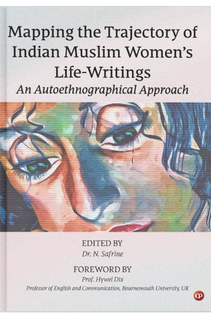
This chapter is a part of: Mapping the Trajectory of Indian Muslim Women’s Life-Writings: An Autoethnographical Approach from India
ISBN (Ebook): 978-93-49926-50-9
ISBN (Hardcover Print): 978-93-49926-84-4
ISBN (Softcover Print): 978-93-49926-34-9
© CSMFL Publications & its authors.
Published: April 15, 2026
Abstract
This chapter questions the layered victimhood and artistic silencing of Muslim women during the Partition of India, concentrating on River of Fire (Qurratulain Hyder), Aangan (Khadija Mastur), and The Freedom’s Shade (Anis Kidwai). Utilising an autoethnographic and feminist framework, this analysis studies how Muslim women’s lives were fractured not exclusively by intra-community patriarchy but also by the brutality of nation-building schemes and state-sanctioned “rescue” narratives that performed communal majoritarianism. It raises crucial inquiries: How were Muslim women subjected to numerous forms of marginalisation—through household patriarchy, political brutality, and state supervision camouflaged as a safeguard? Prominent to this examination is the Islamic spatial construct of zenana (women’s quarters) and mardana (men’s quarters), which perform as symbolic and lived areas within Muslim cultural life. Instead of considering the zenana exclusively as a zone of repression, the paper emphasises it as a complex arena of female solidarity, memory-making, and modest opposition. In Aangan, the zenana evolves as a feminised archive of political consciousness, where women mediate quietness and suffering while cultivating ideological transparency. In River of Fire, Hyder disrupts civilizational binaries by intertwining a documented continuum in which Muslim women inhabit and transform gendered areas of both zenana and mardana. The Freedom’s Shade, grounded in lived experience, starkly illustrates the physical and symbolic infringements of Muslim women’s bodies during rescue and rehabilitation, and their dislocation from familiar household areas. Ultimately, this chapter critiques prevalent nationalist and communal frameworks that render Muslim women passive or mute. Rather, it foregrounds their nuanced agency within and beyond the zenana, placing these literary portrayals as cultural counter-memory and opposition against historical erasure. The study contributes to a profound understanding of Muslim women’s life writings as rich sites of autoethnographic truth, where tahzheeb, household spatiality, and trauma converge in shaping gendered subjectivity during national turmoil.
Keywords: Partition Literature, Muslim Women’s Life-Writings, Zenana and Mardana, Feminist Autoethnography, Cultural Displacement
References
- Ahmed, L. (1992). Women and gender in Islam: Historical roots of a modern debate. Yale University Press.
- Ahmed, S. (2006). Queer phenomenology: Orientations, objects, others. Duke University Press.
- Ali, R. U. (2015). Muslim women and narratives of trauma: Gendered memory of Partition in South Asia. South Asian Review, 36(3), 78–90. https://doi.org/10.1080/02759527.2015.1111947
- Anand, M., & Sharma, P. (2000). Rescuing the nation’s honour: Women and nationalism during Partition. In K. Sangari & S. Vaid (Eds.), Recasting women: Essays in Indian colonial history (pp. 119–138). Rutgers University Press.
- Anand, M., & Sharma, P. (2024). Rescuing the nation’s honour: Women and nationalism during Partition. Zubaan.
- Butalia, U. (1998). The other side of silence: Voices from the Partition of India. Duke University Press.
- Das, V. (1995). Critical events: An anthropological perspective on contemporary India. Oxford University Press.
- Ellis, C. (2004). The ethnographic I: A methodological novel about autoethnography. AltaMira Press.
- Haider, N. (2011). A syncretic vision of culture: Qurratulain Hyder’s Aag Ka Darya. South Asian History and Culture, 2(4), 575–588. https://doi.org/10.1080/19472498.2011.601168
- Haider, N. (2018). Becoming-woman and cultural memory in Qurratulain Hyder’s River of Fire. Journal of Postcolonial Writing, 54(1), 95–110.
- Hyder, Q. (2019). River of fire (A. Agha, Trans.). New Directions. (Original work published 1959)
- Kidwai, A. (2011). In freedom’s shade (A. Kidwai, Trans.). Penguin Books India. (Original work published 1974)
- Khanam, J. (1991). Muslim women’s autobiographies and Partition trauma. Journal of South Asian Literature, 26(2), 45–60.
- Lambert-Hurley, S. (2007). Muslim women, reform and Princely Hyderabad: Narratives of royal women, 1857–1947. Routledge.
- Mahmood, S. (2005). Politics of piety: The Islamic revival and the feminist subject. Princeton University Press.
- Mastoor, K. (2018). The women’s courtyard (B. Mirza, Trans.). Penguin Random House India. (Original work published 1953)
- Menon, R., & Bhasin, K. (1998). Borders and boundaries: Women in India’s Partition. Rutgers University Press.
- Mohanty, C. T. (1988). Under Western eyes: Feminist scholarship and colonial discourses. Feminist Review, 30, 61–88. https://doi.org/10.1057/fr.1988.42
- Penguin India. (2011). In Freedom’s Shade by Anis Kidwai [Book blurb]. https://penguin.co.in/book/in-freedoms-shade/
- Rashid, F. (2021). Rewriting women in the shadows: A feminist reading of Khadija Mastoor’s Aangan. Pakistaniaat: A Journal of Pakistan Studies, 9(2), 20–30.
- Shamsie, M. (2017). Hybrid tigers: The women’s narratives of Partition. Oxford University Press.
- Spivak, G. C. (1988). Can the subaltern speak? In C. Nelson & L. Grossberg (Eds.), Marxism and the interpretation of culture (pp. 271–313). University of Illinois Press.
- Wadud, A. (1999). Qur’an and woman: Rereading the sacred text from a woman’s perspective. Oxford University Press.
- Wadud, A. (2006). Inside the gender jihad: Women’s reform in Islam. Oneworld Publications.
This book is available worldwide via EBSCOhost Academic Collection, EBSCO E- books, Google Play Books, Amazon, World Cat Discovery Service/OCLC, CSMFL Bookstore, and 200+ book resellers and academic content vendors.
Statement on Publication Ethics
We, at CSMFL Publications, are committed to ensure the unbiased and transparent publishing, and upholding the high standards of editorial integrity in our publications. To know more, please read our Statement on Publication Ethics, Editorial Integrity & Misconduct