Muslim Women Negotiating Representation, Region, and Religion: Shamshad Hussain’s Autoethnographic Documentation of The Lives of Muslim Women in Malappuram, Kerala
Safwana Arayapurath
Senior Research Fellow, Department of English and Comparative Literature, Central University of Kerala, India.
10.46679/9789349926509ch08
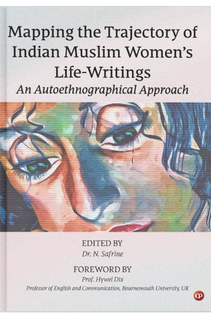
This chapter is a part of: Mapping the Trajectory of Indian Muslim Women’s Life-Writings: An Autoethnographical Approach from India
ISBN (Ebook): 978-93-49926-50-9
ISBN (Hardcover Print): 978-93-49926-84-4
ISBN (Softcover Print): 978-93-49926-34-9
© CSMFL Publications & its authors.
Published: April 15, 2026
Abstract
Malappuram Penninte Aathmakatha [Autobiography of a Malappuram Woman] (2024), a memoir by Shamshad Hussain, an acclaimed writer and academic from Kerala, reflects on the personal and collective experiences of Muslim women in and around the Malappuram region, Kerala. Shamshad Hussain challenges the hegemonic, monolithic representations of Muslim women and puts forward a counternarrative about a meagrely represented group of Muslim women, critiquing the overarching orientalist and fundamentalist narratives. She documents the invisible Muslim women from an inadequately represented location in South Asia, that is, the South Indian state of Kerala. The memoir examines the crossroads of intersection of religion, region, family, and gender. Employing the tool of memory, Hussain upends preconceived notions and does not fit into compartments made by both religion and secular liberals. Hussain looks into the agency exercised by the Muslim women of the region in producing, disseminating, and conserving alternative forms of knowledge. The memoir examines the crossroads of intersection of religion, region, family, and gender. The memoir shares the glimpses of the Muslim ‘everyday’ in the region, drawing attention to its nuances. Here, the autoethnographic account of a Muslim woman academic intersects with the collective ethnography of women, the region, its culture, and politics, as well as how Muslim women navigate institutions such as family, marriage, religion, and academia.
Keywords: Kerala Muslim Women, Memoir, Autoethnography, Lived Islam, Malabar, South Asian Islam
References
- Bose, A.L. (2020). Writing (Them)Selves: Women’s Autobiographies around the World. In Bose, A. L. (ed.), Writing Gender Writing Self: Memory, Memoir and Autobiography (1st ed.). Routledge.
- Hussain, Shamshad. (2024). Malappuram Penninte Aathmakatha [Autobiography of a Malappuram Woman]. Rat Books.
- Ilias, M. H., & Hussain, Shamshad. (2023). Literate illiterates: Arabi-Malayalam and parallel process of knowledge production among Muslims in Kerala. In Dilip M. Menon & Nishat Zaidi (Eds.), Cosmopolitan cultures and oceanic thought (pp. 181-196). Routledge.
- Minault, Gail. (1998). Secluded Scholars: Women’s Education and Muslim Social Reform in Colonial India. Delhi: Oxford UP.
This book is available worldwide via EBSCOhost Academic Collection, EBSCO E- books, Google Play Books, Amazon, World Cat Discovery Service/OCLC, CSMFL Bookstore, and 200+ book resellers and academic content vendors.
Statement on Publication Ethics
We, at CSMFL Publications, are committed to ensure the unbiased and transparent publishing, and upholding the high standards of editorial integrity in our publications. To know more, please read our Statement on Publication Ethics, Editorial Integrity & Misconduct