Oppositional Gaze on Home and Domesticity in The Selected Fiction of Nazar Sajjad Hyder and Ismat Chughtai
Malabi Ghosh
Doctoral Fellow at IISER Mohali, India.
10.46679/9789349926509ch09
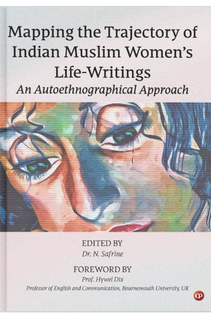
This chapter is a part of: Mapping the Trajectory of Indian Muslim Women’s Life-Writings: An Autoethnographical Approach from India
ISBN (Ebook): 978-93-49926-50-9
ISBN (Hardcover Print): 978-93-49926-84-4
ISBN (Softcover Print): 978-93-49926-34-9
© CSMFL Publications & its authors.
Published: April 15, 2026
Abstract
This essay examines the contested discourse of “home” in colonial India by tracing its critical reimagining in the fiction of Urdu-speaking female Muslim writers. It focuses on short stories by Nazar Sajjad Hyder and Ismat Chughtai, situating their work within the ideological framework of Victorian domesticity, colonial modernity, and indigenous reformism, which collectively idealized the home as a moral and private sphere. In opposition to this normative construction, women writers developed a counter-narrative that exposes the home as a site of material deprivation, gendered violence, and class exploitation, particularly for the women of the household and female domestic servants. The essay demonstrates that fiction served as a crucial medium for critiquing the duplicity of the nationalist, reformist, and patriarchal authority. Drawing on the feminist theory of standpoint epistemology, especially Bell Hooks’s concept of “homeplace,” and the oppositional gaze, the analysis contends that these authors exposed the darker side of dwelling.
Keywords: Urdu Fiction, Muslim Women’s Writings, Homeplace, Gendered Poverty and Violence, Domesticity in Late Colonial India
References
- Allen, C., Howard, J. A., & Saliba, T. (Eds.). (2005). Gender, politics and Islam. Orient Blackswan.
- Ali, A. A. (2000). The emergence of feminism among Indian Muslim women, 1920–1947. Oxford University Press.
- Arendt, H. (2022). In E. N. Zalta & U. Nodelman (Eds.), The Stanford Encyclopedia of Philosophy (Fall 2022 ed.). https://plato.stanford.edu/archives/fall2022/entries/arendt/
- Chakrabarti, A. (2020). Sob pakhi ghore phere: Ghor chhere ghore pherar baastu darshan. In E tanu bhoriya. Anushtup.
- Chatterjee, R. (n.d.). The Indian prostitute as a colonial subject Bengal 1864–1883. Canadian Woman Studies/Les Cahiers De La Femme, 13(1).
- Coppola, C. (Ed.). (1974). Marxist influence and South Asian literature (Vol. I). Asian Studies Centre, Michigan State University.
- Deutsch, K. A. (1998). Muslim women in colonial North India circa 1920–1947: Politics, law and community identity [Doctoral dissertation, SOAS University of London]. SOAS Research Online.
- Devji, F. F. (1991). Gender and the politics of space: The movement for women’s reform in Muslim India, 1857–1900. South Asia: Journal of South Asian Studies, 14(1), 141–153.
- Duncan, N. (Ed.). (1996). Bodyspace: Destabilizing geographies of gender and sexuality. Routledge.
- Jalil, R. (2014). Liking progress, loving change: A literary history of the Progressive Writers’ Movement in Urdu. Oxford University Press.
- Jalil, R. (2017). An uncivil woman: Essays on Ismat Chughtai. Oxford University Press.
- Minault, G. (1998). Secluded scholars: Women’s education and Muslim social reform in colonial India. Oxford University Press.
- Minault, G. (2009). Gender, language and learning: Essays in Indo-Muslim cultural history. Permanent Black.
- Rubin, G. (1975). The traffic in women: Notes on the “political economy” of sex. In R. Reiter (Ed.), Toward an anthropology of women (p. 175). Monthly Review Press.
- Shah, S. P. (2009, Summer). Sexuality and “The Left”: Thoughts on intersections and visceral others. The Scholar and Feminist Online, 7(3).
- Tharu, S. J., & Lalita, K. (1993). Women writing in India: 600 B.C. to the present: 600 B.C. to the early twentieth century. Oxford University Press.
- Warhol, R., & Herndl, D. P. (Eds.). (1993). Feminism: An anthology of literary theory and criticism. Rutgers University Press.
- Young, I. M. (2005). On female body experience: “Throwing like a girl” and other essays. Oxford University Press.
This book is available worldwide via EBSCOhost Academic Collection, EBSCO E- books, Google Play Books, Amazon, World Cat Discovery Service/OCLC, CSMFL Bookstore, and 200+ book resellers and academic content vendors.
Statement on Publication Ethics
We, at CSMFL Publications, are committed to ensure the unbiased and transparent publishing, and upholding the high standards of editorial integrity in our publications. To know more, please read our Statement on Publication Ethics, Editorial Integrity & Misconduct