Colonial Construction of Women’s Empowerment: (A)Historical Orientalisation of Awadh Begums
Sreemoyee Sarkar
Assistant Professor (History), Department of International Studies, Political Science and History, CHRIST (Deemed to be University), Bangalore, India.
10.46679/9789349926509ch10
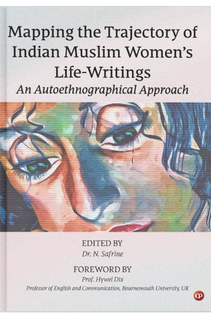
This chapter is a part of: Mapping the Trajectory of Indian Muslim Women’s Life-Writings: An Autoethnographical Approach from India
ISBN (Ebook): 978-93-49926-50-9
ISBN (Hardcover Print): 978-93-49926-84-4
ISBN (Softcover Print): 978-93-49926-34-9
© CSMFL Publications & its authors.
Published: April 15, 2026
Abstract
Bahu Begum and Malika Kishwar were the begums from the royal house of Awadh. Their lives uncover the intriguing early modern world of Indian women. They lived in an ivory tower. Nevertheless, they embarked on a riveting journey of diverse female roles, complexities and empowerment. The achievements of Bahu Begum and Malika Kishwar offer a dissenting perspective against the colonial notion of a civilising mission and foreground women’s empowerment before western feminism. Ahistoricity about early modern Indian gender constructs provided theoretical grounds for such colonialist perceptions. The advent of historical thinking is also a missed opportunity, as the struggles of Bahu Begum and Malika Kishwar are absent in the simultaneous embrace of heroic historicism in the line of Manikarnika, Kittur Rani Chennamma or others. The idea of empowered women during colonial India and women’s participation in the Indian freedom struggle still suffers from gender myopia and lacks historical reasoning. Edward Said’s critique of Orientalism provokes a comprehensive review of the colonial construction of women’s empowerment in India. Hence, the present article analyses the nationalist obsession with Indian women in colonial India, focusing on the history of ‘strong’ women, ‘wise’ women, and ‘powerful’ women in Indian tradition vis-à-vis colonialism-induced women’s emancipation through different social reform movements. It also attempts to gauge the orientalisation of Bahu Begum and Malika Kishwar against the British imperialist ventures and dismantle the colonial construction of women empowerment dichotomous rhetoric in early modern India.
Keywords: Awadh Begums, Bahu Begum, Malika Kishwar, Woman Empowerment, 18th Century India, British Imperialism
References
- Abbott, N. J. (2022). It all comes from me: Bahu Begam and the making of the Awadh Nawabi, circa 1765–1815. “Modern Asian Studies,” 57(2), 458–486. https://doi.org/10.1017/s0026749x22000178
- Ahmed, R. (2021, 19 November). Forgotten Queen of Oudh Malika Kishwar. “The Asian Age.” https://www.dailyasianage.com/news/206071/forgotten-queen-of-oudh–malika-kishwar
- Ahmed, S. (2002). The theater of the civilised self: Edmund Burke and the East India trials. “Representations,” 78(1), 28–55. https://doi.org/10.1525/rep.2002.78.1.28
- Alavi, S. (2008). “The eighteenth century in India.” https://ci.nii.ac.jp/ncid/BA61328940
- Bandyopadhyay, S. (2004). “From Plassey to Partition: A history of modern India.” Orient Longman.
- Bayly, C. A. (2012). “Rulers, townsmen and bazaars: North Indian society in the age of British expansion, 1770–1870.” Oxford University Press.
- Bodmin Keep, Cornwall’s Army Museum. (2021, 25 August). What happened at Lucknow? https://www.bodminkeep.org.uk/museum-history/exhibitions/1857-and-the-siege-of-lucknow/what-happened-at-lucknow
- Dasgupta, S. (2016, 22 August). The fictional women of 1857: Re-imagining the revolt. “The Wire.” https://thewire.in/history/the-fictional-women-of-1857-re-imagining-the-revolt
- Devereaux, S. (1994). Review of Toward a feminist theory of the state, Catharine A. MacKinnon. “Canadian Journal of Law and Society,” 9(2), 219–221. https://doi.org/10.1017/s0829320100003744
- Fischer-Tin, H., & Framke, M. (Eds.). (2021). “Routledge handbook of the history of South Asian colonialism” (1st ed.). Routledge. https://doi.org/10.4324/9780429431012
- Harris, K. M. (2023, 28 October). Queen of Oude Sauce, Merganthaler recipe scrapbook. “Old Line Plate.” https://www.oldlineplate.com/queen-of-oude-sauce
- Hasan, M. M. (2005). The orientalization of gender. “American Journal of Islam and Society,” 22(4), 28–56. https://doi.org/10.35632/ajis.v22i4.460
- Katti, M. (2023, 1 March). The forgotten tales of Queen Malika Kishwar, the mother of the last king of Awadh. “Peepul Tree.” https://www.peepultree.world/livehistoryindiastorypeople/the-forgotten-tale-of-queen-malika-kishwar-the-mother-of-the-last-king-of-awadh
- Khan, V. (n.d.). Glimpses into the life and times of the Begums of Avadh. House of Oudh. http://www.oudh.tripod.com/oudhbegamvnawab.htm
- Kiran, N. (2021). Stratification and role of the elite Muslim women in the state of Awadh, 1742–1857. “Athens Journal of History,” 7(4), 289–294. https://doi.org/10.30958/ajhis.7-4-2
- Mukhoti, I. (2023, 3 March). How the Begums of Awadh had stood up to the East India Company. “Open the Magazine.” https://www.openthemagazine.com/essay/how-the-begums-of-awadh-had-stood-up-to-the-east-india-company
- Mukhoty, I. (2024). The lion and the lily: The making of the Nawabs of Awadh. Aleph.
- Pal, S. (2018, 9 June). Malika Kishwar, the Awadh queen who rests in France’s most famous cemetery. “The Better India.” https://www.thebetterindia.com/144545/malika-kishwar-awadh-queen-france-paris-cemetery/
- Peers, D. M. (1995). “Between Mars and Mammon: Colonial armies and the garrison state in 19th-century India.” Tauris Academic Studies. https://archive.org/details/betweenmarsmammo0000peer
- Pillai, M. S. (2018, 13 January). Malika Kishwar: A forgotten Indian queen in Paris. “Mini Loung.” https://www.manuspillai.com/20180112/malika-kishwar-a-forgotten-indian-queen-in-paris-13-january-2018
- Premchand, M. (2021). “Shatranj Ke Khiladi & Other Stories” (A.H.W. Sameer Series). Diamond Pocket Books.
- Rajan, R. (2022, 1 May). Malika Kishwar, the forgotten Indian queen who rests in France’s most famous cemetery. “HubPages.” https://discover.hubpages.com/education/The-Tragic-Story-of-the-Forgotten-Indian-Queen-in-Paris
- Ray, S. (Director). (1977). “Shatranj Ke Khilari” [Film]. https://www.youtube.com/watch?v=A3Fgm0yaWbA
- Robert, A. H. C. (1857). « Nena-Sahib, ou l’Insurrection des Indes.” L’Estafette.
- Roy, A. (2018, 10 February). Bahu Begum: The Queen Bride of Ajodhya. “The Indian Quest Digital.” https://www.theindianquest.com/blog-details/Bahu-Begum—The-Queen-Bride-of-Ajodhya
- Roy, S. (2012). Inside the royal zenanas in colonial India: Avadhi and other begums in the travel accounts of Fanny Parkes. “Studies in Travel Writing,” 16(1), 47–63. https://doi.org/10.1080/13645145.2012.641810
- Safvi, R. (2024, 27 July). The Lion and the Lily: Ira Mukhoty’s new book on Awadh history resurrects Nawab Begum, Bahu Begum. “Scroll.in.” https://scroll.in/article/1070769/the-lion-and-the-lily-ira-mukhotys-new-book-on-awadh-history-resurrects-nawab-begum-bahu-begum
- Said, E. W. (2014). “Orientalism.” Vintage.
- Santha, K. S. (1980). Bahu Begum and the gendered struggle for power. “Indian History Collective.” http://indianhistorycollective.com/bahu-begum-and-the-gendered-struggle-for-power-daulah-asaf-shuja-nawab-murtaza-faizabad-lucknowcity-jagirsinhistory-mirza-historyofindia-womeninhistory
- Taylor, D. F. (2012). Tyranny in India—or, Britain’s Character Lost: A Tragedy. In “Oxford University Press eBooks (pp. 67–118). https://doi.org/10.1093/acprof:oso/9780199642847.003.0004
- Umar, M. (2001). “Urban culture in Northern India during the eighteenth century.” Munshirm Manoharlal Pub Pvt. Ltd.
- Vijan, S. (2020, 28 January). Malika Kishwar: The queen who ventured beyond the zenana. “Feminism in India.” https://feminisminindia.com/2020/01/27/malika-kishwar-queen-ventured-beyond-zenana
- Wagle, N. K., & Alam, M. (1991). The crisis of empire in Mughal North India: Awadh and the Punjab, 1707–48. “The American Historical Review,” 96(1), 243. https://doi.org/10.2307/2164185
- Role and the Rule of Women in Awadh. (2021, 21 February). “Lucknowledge, Tornos.” https://www.tornosindia.com/role-and-the-rule-of-women-in-awadh
This book is available worldwide via EBSCOhost Academic Collection, EBSCO E- books, Google Play Books, Amazon, World Cat Discovery Service/OCLC, CSMFL Bookstore, and 200+ book resellers and academic content vendors.
Statement on Publication Ethics
We, at CSMFL Publications, are committed to ensure the unbiased and transparent publishing, and upholding the high standards of editorial integrity in our publications. To know more, please read our Statement on Publication Ethics, Editorial Integrity & Misconduct