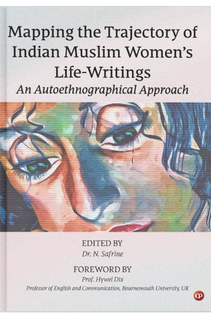
Foreword: Mapping the Trajectory of Indian Muslim Women’s Life-Writings: An Autoethnographical Approach
Hywel Dix
Professor of English and Communication, Bournemouth University, UK.
10.46679/97893499265090
This chapter is a part of: Mapping the Trajectory of Indian Muslim Women’s Life-Writings: An Autoethnographical Approach from India
ISBN (Ebook): 978-93-49926-50-9
ISBN (Hardcover Print): 978-93-49926-84-4
ISBN (Softcover Print): 978-93-49926-34-9
© CSMFL Publications & its authors.
Published: April 15, 2026
Foreword
It gives me great pleasure to contribute the Foreword to this timely and innovative volume of essays on the life writings of Indian Muslim writers for which Dr N. Safrine has assembled an impressive group of scholars and researchers. There has been a notable increase in critical interest in forms of life writing in recent years and indeed I first worked with Dr Safrine when I examined her doctorate on Attia Hosain and Ismat Chughtai (as well as Zarina Bhatty) at the University of Madras in 2022. Critical discussion of these authors forms the basis of the current book too, but the scope has been significantly expanded to encompass analyses of a number of additional writers from a wide range of historical periods and geographical regions, and working in a variety of different genres and formats.
In many cases, the writers discussed have been somewhat critically neglected so that restoring these authors and their works to view is one of the most valuable contributions to be made by the volume. Overall, the collection is likely to be of interest to anyone with a scholarly interest in 1) An Autoethnographical evaluation of life-writings by/on Mughal women; 2) Life-writings of prominent Indian Muslim women writers; and 3) Exploring the experience of Indian Muslim women through literature.
Autoethnography provides a valuable lens through which to analyse life writing because although it has primarily been applied to non-fictional genres, it could also fruitfully be applied to discussions of the novel in cases where writers are members of the communities in which they live and work and which they research in the course of their writing so that they are in effect researching aspects of their own lives alongside those of the community. Indeed, one of the implicit suggestions made here is that because autoethnography deals with memory (which is famously subject to gaps and blockages) and because fiction also is typically interested in things like aporia and shortcomings, autobiographical fiction might in fact be a highly appropriate mode for autoethnographic writing.
Throughout these pages the volume implicitly (and at times explicitly) argues that Hosain and Chughtai refute the category of domestic writing that has conventionally been attributed to India’s female Muslim writers and so resist the way that they been marginalised within both Indian society as a whole and also within India’s mainstream women’s movement. Much of this is also true of the numerous other writers discussed, thus highlighting the tension that exists between treating writers as representative members of their community, while at the same time acknowledging that they come from backgrounds that have been marginalised within the wider society of which they are not typical and whose dominant assumptions and ideologies they in fact positively seek to challenge.
The chapters additionally explore how India’s Muslim female writers use an autoethnographic approach to provide first-hand testimony of the process by which they struggle to break the social constraints imposed by the orthodox Muslim family. As the contributors demonstrate, this struggle implies a conflict between individual self and wider community in which whether the desires of the self or the rules of the community prevails depends on the efficacy of the self in establishing its uniqueness amidst the conflicts.
Yet Muslim women are never homogenised or treated in the singular: the chapters show that individual lives are complicated in all sorts of ways, from attitudes to marriage to relationships between classes, and from attitudes to British colonisation to the experience of partition. In many cases, the resources provided for Indian Muslim women by their community also turn out to set the definitive limitations and restrictions against which they rebel so that they are faced by a number of dilemmas that are simultaneously personal and cultural and their experiences, particular to themselves, cannot be generalised. What emerges is an account of how the very rich cultural resources provided for a community by its cultural traditions can be empowering, but can also be both stifling and restricting – especially for women. This is the tightrope that the many different Indian Muslim women writers discussed in these pages had to tread, and which the reader is invited to explore again with them.
This book is available worldwide via EBSCOhost Academic Collection, EBSCO E- books, Google Play Books, Amazon, World Cat Discovery Service/OCLC, CSMFL Bookstore, and 200+ book resellers and academic content vendors.
Statement on Publication Ethics
We, at CSMFL Publications, are committed to ensure the unbiased and transparent publishing, and upholding the high standards of editorial integrity in our publications. To know more, please read our Statement on Publication Ethics, Editorial Integrity & Misconduct