Variational Translation Theory-Based Pedagogy for Machine Translation Post-Editing: A Case Study
Shenghua Luo
School of Foreign Studies, Yangtze University, Jingzhou, China.
10.46679/9789349926769ch06
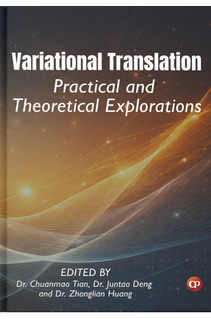
This chapter is a part of: Variational Translation: Practical and Theoretical Explorations from India
ISBN (Ebook):978-93-49926-76-9
ISBN (Hardcover Print):978-93-49926-38-7
ISBN (Softcover Print):978-93-49926-07-3
© CSMFL Publications & its authors.
Published: January 5, 2026
Abstract
In the AI era, Machine Translation Post-editing has become the dominant workflow paradigm, yet there is still a lack of a systematic framework for cultivating post-editing competence in college English translation teaching. Based on Variational Translation Theory, the study proposes an innovative pedagogical model for machine translation post-editing in college English translation teaching. Addressing the current absence of systematic pedagogical frameworks, the model shifts from “error-correction-focused” to “variational translation-oriented,” prioritizing competence at syntactic and discourse levels. Through two controlled experiments with the 2023 cohort (N=117) utilizing neural machine translation and the 2024 cohort (N=181) employing large language models, the findings reveal: (1) altered translation (改译, gaiyi), edited translation (编译, bianyi), and annotated translation (阐译, chanyi) were the most frequently utilized; (2) AI-assisted instruction should shift its focus from lexical correction to syntactic restructuring and discourse optimization. The research has established Variational Translation Theory as a foundational framework for MTPE pedagogy, potentially transforming conventional practices in college English translation teaching through the theoretical perspectives and practical methodology.
Keywords: Variational Translation Theory, Machine Translation Post-Editing, Pedagogical Model, College English Translation Teaching
References
- Bassnett, S., & Lefevere, A. (2001) Constructing Cultures: Essays on Literary Translation. Shanghai: Shanghai Foreign Language Education Press.
- Carl, M., & Toledo Baez, M. C. (2019). Machine translation errors and the translation process: A study across different languages. The Journal of Specialised Translation, (31):107-132.
- Fan, Z.R., & Yang, W.D. (2024). Principles and Strategies of Post-editing in the Human-machine Coupling Era. Shanghai Journal of Translators, (4): 29-34.
- Feng, Q., & Cui, Q. (2016). Research Focuses and Trends in Post-editing of Machine Translation. Shanghai Journal of Translators, (6): 67-74+89+94.
- Geng, F., & Hu, J. (2023). New Direction for Post-Editing by Artificial Intelligence Translation: A Case Study of ChatGPT Translation. Foreign Languages in China, 20(3): 41-47.
- Huang, Z.L. (2002). Variational Translation Theory. Beijing: China Translation & Publishing Corporation.
- Huang, Z.L. (2012). A New Interpretation of “Translation”: A Response to Mr. Zhou Lingshun on “Variational Translation.” Foreign Language Research, (1): 81-84.
- Huang, Z.L., & Li, M.D. (2014). A Comparative Study on Translation Methods in Translation Variation. Foreign Language Research, 181(6): 88-91.
- Huang, Z.L., & Chen, Y.F. (2016). The Process from Adaptation Techniques to Translation Variation Theory. Foreign Languages and Their Teaching, (1): 98-106+149.
- UNESCO. (2009). Intangible Cultural Heritage of Humanity-Representative List of the Intangible Cultural Heritage of Humanity. Paris: UNESCO.
- ISO 18587: 2017- Translation Services – Post-editing of Machine Translation Output – Requirements. Available online: https://www.iso.org/standard/62970.html (accessed on 22 May 2025)
- Jia, Y.F. (2024). Integrating translation project management platforms with generative AI technologies: An investigation into the translation process through human-machine interaction. Foreign Language Teaching and Research, 56(6): 937-949+961.
- Koponen, M. (2016). Is Machine Translation Post-editing Worth the Effort? A Survey of Research into Post-editing and Effort. The Journal of Specialised Translation, (25): 131-148.
- Luo, S.H. (2025). Charting the Integration of Machine Translation Post-editing into College English Translation Teaching. Education Journal, 8(4): 236-248.
- Meng, F.Y., & Tang, X.R. (2020). Efficiency First: Reviewing Technologies of Machine Translation Post-Editing. Computer Engineering and Applications, 56(22): 25-32.
- Nitzke, J., Hansen-Schirra, S., & C. Canfora. (2019). Risk management and post-editing competence. The Journal of Specialised Translation, (31): 239-259.
- Qian. J.J., Xiao, W.Q., Li, Y., & Xiang, X. (2022) Impact of neural machine translation error types on translators’ allocation of attentional resources: Evidence from eye-movement data. Foreign Language Teaching and Research, 54(5): 750-761+800-801.
- Qiu, B.L., Wang, M.W., Li, M.X., Chen C., & Xu, F. (2022) Construction of Fine-Grained Error Analysis Corpus of English-Chinese Machine Translation. Journal of Chinese Information Processing, 36(1): 47-55.
- Robert, I.S., Remael, A., & Ureel, J.J.J. (2017). Towards a model of translation revision competence. The Interpreter and Translator Trainer, 11(1): 1-19.
- Wang, G.Z. (2023). Re-interpretation of the Translation Right System in the Scene of artificial Intelligence Machine Translation. Journal of Political Science and Law, 3: 79-89.
- Wang, X.L., Li, X.Y., & Chen, G.J. (2024). Comparing translation revision and machine translation post-editing: Evidence from keylogging, retrospection and questionnaire. Foreign Language Learning Theory and Practice, 5: 88-97.
- Xia, L.; Li, Y.M., & Li, H.W. (2022) Machine translation and post editing of English abstracts in the context of artificial intelligence. Acta Editologica, 34(4): 396-401+406.
- Yang, Y.X., & Wei, X.Q. (2023). An analysis on machine translation post-editing competence and its cultivation from the perspective of categorization theory. Foreign Language Education, 44(1): 90-96.
- Yao, B. (2024). Exploration into Problems in Machine Translation and Post-Editing of United Nations Documents. Chinese Translators Journal, 45(04): 144-151.
- Zhong, W., & Shu, C. (2020). Competence Structure and Course Design of Post-Editing — A Frontier Analysis Based on Foreign Post-Editing Courses. Technology Enhanced Foreign Language Education, 6: 86-91+7.
This book is available worldwide via EBSCOhost Academic Collection, EBSCO E- books, Google Play Books, Amazon, World Cat Discovery Service/OCLC, CSMFL Bookstore, and 200+ book resellers and academic content vendors.
Statement on Publication Ethics
We, at CSMFL Publications, are committed to ensure the unbiased and transparent publishing, and upholding the high standards of editorial integrity in our publications. To know more, please read our Statement on Publication Ethics, Editorial Integrity & Misconduct