Implementing Universal Design for Learning in Large Post-Secondary Classrooms: Marking Inclusive Design A Reality Within the Neo-Liberal Constraints of the Enterprise Academy
Ann Marie Farrell1, Frederic Fovet2
1Dublin City University, Republic of Ireland; 2Thompson Rivers University, Canada.
10.46679/9789349926912ch13
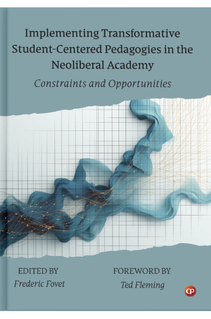
This chapter is a part of: Implementing Transformative Student-Centered Pedagogies in the Neoliberal Academy: Constraints and Opportunities
ISBN (Ebook): 978-93-49926-91-2
ISBN (Hardcover Print): 978-93-49926-11-0
ISBN (Softcover Print): 978-93-49926-31-8
© CSMFL Publications & its authors.
Published: May 05, 2026
Abstract
Universal Design for Learning (UDL) has been catching the interest of post-secondary faculty for now over a decade, both in North America and Europe. There has been an increasing volume of field initiatives and research projects which examine the ability of the UDL framework to provide authentic inclusive classroom provisions to the full spectrum of diverse learners present in the tertiary sector. This chapter, however, identifies and examines a tension which emerges between the transformative aims of UDL as a process for inclusion on the one hand, and the business-model pressures of the neo-liberal academy on the others. One example, in particular, highlights this tension: the large tertiary classroom, and the chapter analyzes whether it is ever possible to fully implement UDL within the parameters for the large lecture hall. Business model considerations make increasing class sizes in undergraduate education increasingly appealing. This seems to create pragmatic limitations to any effort to implement UDL in these spaces. The chapter brings together the voice of two UDL scholars: one, based in North America, examines this tension from a theoretical perspective, while the second, writing from Ireland, addresses the concerns raised and demonstrates ways to achieve UDL integration even in these challenging neo-liberal formats. The chapter offers recommendations to the international reader on how to navigate this tension within their own post-secondary landscape.
Keywords: UDL, Inclusion, Post-Secondary Landscape, Large Classrooms, Neo-Liberalism, Diverse Learners
References
- AccessATE (2025) UDL Case Study: Accessible Lab Spaces and Experiences. Delagado Community College. https://accessate.net/casestudy/accessible-lab-spaces-and-experiences
- Adam, S., & Koutsoklenis, A. (2023). Who needs the social model of disability? Frontiers in Sociology, 8. doi: 10.3389/fsoc.2023.1305301
- Ahmed, A., & Morgan, B. (2026). Exploring the transformative potential of duoethnography for critical language teaching. Critical Inquiry in Language Studies, 1–27. https://doi.org/10.1080/15427587.2025.2612469
- Allais, S. (2014). A critical perspective on large class teaching: the political economy of massification and the sociology of knowledge. Higher Education, 67, 721-734. https://www.jstor.org/stable/43648686
- Almanssori, S., & Paskaran, L. (2025). An intersectional narrative inquiry into why Black and racialized teachers quit the profession. Equity in Education & Society. https://doi.org/10.1177/27526461251326911
- Almeqdad, Q. I., Alodat, A. M., Alquraan, M. F., Mohaidat, M. A., & Al-Makhzoomy, A. K. (2023). The effectiveness of universal design for learning: A systematic review of the literature and meta-analysis. Cogent Education, 10(1). https://doi.org/10.1080/2331186X.2023.2218191
- AlRawi, J. M., & AlKahtani, M. A. (2021). Universal design for learning for educating students with intellectual disabilities: a systematic review. International Journal of Developmental Disabilities, 68(6), 800–808. https://doi.org/10.1080/20473869.2021.1900505
- Anastasiou, D., & Kauffman, J.M. (2013). The Social Model of Disability: Dichotomy between Impairment and Disability. The Journal of Medicine and Philosophy: A Forum for Bioethics and Philosophy of Medicine, 38(4), 441–459. https://doi.org/10.1093/jmp/jht026
- Arvanitakis, J. (2014). Massification and the large lecture theatre: from panic to excitement. Higher Education, 67, 735-745. https://doi.org/10.1007/s10734-013-9676-y
- Ashwin, P. (2022). The educational purposes of higher education: changing discussions of the societal outcomes of educating students. Higher Education, 84, 1227-1244. doi.org/10.1007/s10734-022-00930-9
- Bamberger, A., Morris, P., & Yemini, M. (2019). Neoliberalism, internationalisation and higher education: connections, contradictions and alternatives. Discourse: Studies in the Cultural Politics of Education, 40, 203-216. https://doi.org/10.1080/01596306.2019.1569879
- Barnes, M. (2024). Community College Faculty Use of Universal Design for Learning (UDL): A Participatory Action Research Dissertation Study. EdD Thesis, Educational Leadership, College of Education, Rowan University. Theses and Dissertations. 3319. https://rdw.rowan.edu/etd/3319
- Barnes, C. (2020). Understanding the social model of disability: past, present and future. In N. Watson and S. Vehmas (Eds.) Routledge Handbook of Disability Studies, (pp. 14-31), 2nd Ed, Routledge.
- Bastidas Martinez, G., Cabrera Narváez, S., De La Cruz Quinteros, G., Vizcaíno Peñafiel, L.A. (2025). The Impact of Universal Design for Learning (UDL) on Inclusive Education: An Analysis of Participation and Academic Performance. Architecture Image Studies, 6(3), 1160-1167. https://doi.org/10.62754/ais.v6i3.419
- Beaudry, S. G., Lennox Terrion, J., Rocchi, M., & Bartleman, M. (2024). Relational Teaching Behaviours in the Large University Class: An Observational Study. The Canadian Journal for the Scholarship of Teaching and Learning, 15(3). https://doi.org/10.5206/cjsotlrcacea.2024.3.17502
- Becker, L., & Denicolo, P. (2013). Teaching in Higher Education. London: SAGE Publications Ltd. https://doi.org/10.4135/9781526435996
- Billot, J. (2010). The imagined and the real: identifying the tensions for academic identity. Higher Education Research & Development, 29(6), 709-721. DOI: 10.1080/07294360.2010.487201
- Bray, A., Devitt, A., Banks, J., Sanchez Fuentes, S., Sandoval, M., Riviou, K., Byrne, D., Flood, M., Reale, J., & Terrenzio, S. (2024). What next for Universal Design for Learning? A systematic literature review of technology in UDL implementations at second level. British Journal of Educational Technology, 55, 113–138. https://doi.org/10.1111/bjet.13328
- Brulé, V., Ferris, J., Parent, J. & Slapcoff, M. (2025). Teaching large classes online: bringing many voices into the conversation. To Improve the Academy: A Journal of Educational Development, 44(2). doi: https://doi.org/10.3998/tia.6951
- Buckley, K., Stone, S., Farrell, A. M., Glynn, M., Lowney, R., & Smyth, S. (2021). Learning from student experience: large, higher education classes transitioning online. Irish Educational Studies, 40(2), 399–406. https://doi.org/10.1080/03323315.2021.1916566
- Capp, M. J. (2017). The effectiveness of universal design for learning: A meta-analysis of literature between 2013 and 2016. International Journal of Inclusive Education, 21(8), 791–807. https://doi.org/10.1080/13603116.2017.1325074
- Carlos, V., Rodrigues, M., Matos, B., Gonçalves, L., Ribeiro, F. & Fardilha, M. (2023). Engaging large classes of higher education students: a combination of spaced learning and team-based learning. Frontiers in Education, 8. doi: 10.3389/feduc.2023.1129763
- Cash, C. B., Letargo, J., Graether, S. P., & Jacobs, S. R. (2017). An Analysis of the Perceptions and Resources of Large University Classes. CBE life sciences education, 16(2), 33. https://doi.org/10.1187/cbe.16-01-0004
- Chaaban, Y., Al-Thani, H., Du, X. (2021). A narrative inquiry of teacher educators’ professional agency, identity renegotiations, and emotional responses amid educational disruption. Teaching and Teacher Education, 108. https://doi.org/10.1016/j.tate.2021.103522
- Chapman, R. (2024). Universal Design for Learning (UDL) in Graduate Education: Investigating Faculty Perspectives. Master Thesis. Department of Education, Counseling, and Leadership, Bradly University.
- Chick, J. C., Morello, L., & Vance, J. (2025). Universal Design for Learning as an Equity Framework: Addressing Educational Barriers and Enablers for Diverse Non-Traditional Learners. Education Sciences, 15(9), 1265. https://doi.org/10.3390/educsci15091265
- Clegg, S. (2008). Academic identities under threat? British Educational Research Journal, 34(3), 329-345. DOI: 10.1080/01411920701532269
- de Macedo Steffen, G., Pacheco Lacerda, D., Richter, C., & de Souza Gomes, R.F. (2025). Leading adaptive risk context: Contingent plans of Covid-19 at universities. International Journal of Disaster Risk Reduction, 120. https://doi.org/10.1016/j.ijdrr.2025.105385
- Dean, T., Lee-Post, A., & Hapke, H. (2017). Universal Design for Learning in Teaching Large Lecture Classes. Journal of Marketing Education, 39(1), 5-16. https://journals.sagepub.com/doi/10.1177/0273475316662104
- Del Paggio, J. (2025). Towards a Market-Based Vision: Canadian Universities in the Era of Neoliberalism. Canadian Journal for New Scholars in Education/Revue canadienne des jeunes chercheures et chercheurs en éducation, 16(1). https://share.google/czhjDLU9cyL9IZu2P
- De Matos-Ala, J., & Hornsby, D. (2015). Introducing international studies: student engagement in large classes. International Studies Perspectives, 16(2), 156-172. https://dx.doi.org/10.2139/ssrn.2001968
- DeRogatis, A., Honerkamp, K., McDaniel, J., Medine, C., Nyitray, V., & Pearson, T. (2014). Teaching very large classes. Teaching Theology & Religion, 17(4), 352-368. https://doi.org/10.1111/teth.12246
- Duncan, J., Butler, K., Leonard, C., Foggett, J., Page, A., & Roche, L. (2025). Uncovering Challenges in Universal Design for Learning in Higher Education. Australasian Journal of Special and Inclusive Education, 49(2), 94–110. doi:10.1017/jsi.2025.10003
- Ecle, K.L., & Salic-Hairulla, M.A. (2026). Effects of Universal Design for Learning (UDL) on Students’ Academic Achievement and Motivation in Chemistry. International Journal of Research and Innovation in Social Science (IJRISS), 10(1). https://doi.org/10.47772/IJRISS.2026.10100212
- Espartinez, A. S. (2025). Between Innovation and Tradition: A Narrative Inquiry of Students’ and Teachers’ Experiences with ChatGPT in Philippine Higher Education. Social Sciences, 14(6), 359. https://doi.org/10.3390/socsci14060359
- Exeter, D.J., Ameratunga, S., Ratima, M., Morton, S., Dickson, M., Hsu, D., & Jackson, R. (2010). Student engagement in very large classes: the teacher’s perspective. Studies in Higher Education, 35(7), 761-775. DOI:10.1080/03075070903545058
- Fabre-Mitjans, N., & Jiménez-Valverde, G. (2026). Implementing Universal Design for Learning to Transform Science Education. Encyclopedia, 6(1), 24. https://doi.org/10.3390/encyclopedia6010024
- Farrell, A.M. (2020, November). Online continuous assessment. In: TEU, DCU Edge of Discovery Podcast Series. Dublin City University: Teaching Enhancement Unit. https://www.dcu.ie/teu/what-works-and-why
- Farrell, A.M. (2021). Embedding Universal Design for Learning in the Large Class Context: Reflections on Practice. In: F.Fovet (Ed.) Handbook of research on applying universal design for learning across disciplines: concepts, case studies, and practical implementation, (pp.365-388). IGI Global.
- Farrell, A.M. (2022). Developing a sense of community in a large class context. International Pedagogy for Higher Education Large Classes Symposium, 10 June, Dublin & Online. https://doi.org/10.5281/zenodo.6949117
- Farrell, A.M., & Logan, A. (2018). Increasing engagement and participation in a large, third-level class setting using co-teaching. International Conference on Higher Education Advances (HEAd), 19-22 June, Valencia. DOI: http://dx.doi.org/10.4995/HEAd18.2018.8209
- Farrell, A.M., & Logan, A. (2024, December). Pedagogy for large classes. In: J.Kane & R. Mushtare. Tea for Teaching Podcast Series, Oswego State University of New York. https://teaforteaching.podbean.com/e/pedagogy-for-large-classes/
- Farrell, A.M., Hannify, C., Taibi, H., & Lowney, R. (2026). Designing authentic assessment in partnership with recently qualified teachers: Preparing student teachers for inclusive pedagogy. Paper Presentation Assessment in Higher Education (AHE) Conference, Manchester, 18-19 June. https://virtual.oxfordabstracts.com/event/76236/submission/157
- Felten, P., & Farrell, A.M. (2024). Relationship rich education at scale. International Pedagogy for Higher Education Large Classes (PHELC) Symposium, 7 June, Online. https://doi.org/10.5281/zenodo.12532610
- Foley, A.R., & Masingila, J.O. (2014). Building capacity: Challenges and opportunities in large class pedagogy (LCP) in Sub-Saharan Africa. Higher Education, 67(6), 798-808. https://doi-org.dcu.idm.oclc.org/10.1007/s10734-013-9697-6
- Fortes, P.C., & Tchantchane, A. (2010). Dealing with Large Classes: A Real Challenge. Procedia – Social and Behavioral Sciences, 8. https://doi.org/10.1016/j.sbspro.2010.12.037
- Fovet, F. (2014). Social model as catalyst for innovation in design and pedagogical change. Widening Participation through Curriculum 2014 Conference Proceedings, Milton Keynes
- Fovet, F. (2020). Universal Design for Learning as a Tool for Inclusion in the Higher Education Classroom: Tips for the Next Decade of Implementation. Education Journal. Special Issue: Effective Teaching Practices for Addressing Diverse Students’ Needs for Academic Success in Universities, 9(6), 163-172. http://www.sciencepublishinggroup.com/journal/paperinfo?journalid=196&doi=10.11648/j.edu.20200906.13
- Fovet, F. (2021). Developing an Ecological Approach to Strategic UDL Implementation in Higher Education. Journal of Education and Learning, 10(4). https://files.eric.ed.gov/fulltext/EJ1309836.pdf
- Fovet, F. (2023). Accommodations 2.0: Reflecting on the future of post-secondary accommodations in a UDL landscape. The AHEAD Journal, 17. https://www.ahead.ie/journal/Accommodations-2-Reflecting-on-the-future-of-post-secondary-accommodations-in-a-UDL-landscape
- Fovet, F. (2025a, June). Growth of UDL Implementation among faculty: Understanding the risks that lead to instructors losing momentum. [Conference presentation] 2025 ADCET UDL Symposium, University of Sydney, June.
- Fovet, F. (2025b, June). ‘Beyond the PD piece’: supporting instructor resilience with UDL in a challenging and dynamic tertiary landscape. [Conference presentation] 2025 European Access Network Conference, Galway.
- Gabel, S., & Peters, S. (2004). Presage of a paradigm shift? Beyond the social model of disability toward resistance theories of disability. Disability & Society, 19(6), 585-600. http://dx.doi.org/10.1080/0968759042000252515
- Garrad, TA., & Nolan, H. (2023). Rethinking higher education unit design: Embedding universal design for learning in online studies. Student Success, 14(1), 1-8. https://doi.org/10.5204/ssj.230
- Giani, M. (2025). Globalization, Higher Education, and Neoliberal Values: Evidence from the Bologna Process. British Journal of Political Science, 55, e145. doi:10.1017/S0007123425100963
- Goering S. (2015). Rethinking disability: the social model of disability and chronic disease. Current Reviews in Musculoskeletal Medicine, 8(2), 134–138. https://doi.org/10.1007/s12178-015-9273-z
- Ghosh, S., & Coppola, S. (2024). This Class Isn’t Designed For Me: Recognizing Ableist Trends In Design Education, And Redesigning For An Inclusive And Sustainable Future. In C. Gray, E. Ciliotta Chehade, E., P. Hekkert, L. Forlano, P. Ciuccarelli, and P. Lloyd (Eds.), DRS2024: Boston, 23–28 June. https://doi.org/10.21606/drs.2024.1070
- Griful-Freixenet, J., Struyven, K., & Vantieghem, W. (2021). Exploring pre-service teachers’ beliefs and practices about two inclusive frameworks: Universal Design for Learning and differentiated instruction. Teaching and Teacher Education, 107. https://doi.org/10.1016/j.tate.2021.103503
- Güneyli, A., Korkmaz, S., Karabacak, H. E., & Aslantürk Altıntuğ, F. (2026). A Phenomenological Investigation of Teacher Candidates’ Metaphorical Views on AI in Language Learning. AI, 7(3), 100. https://doi.org/10.3390/ai7030100
- Hallett, F. (2010). Do we practise what we preach? An examination of the pedagogical beliefs of teacher educators, Teaching in Higher Education, 15(4), 435-448. DOI: 10.1080/13562517.2010.493347
- Hannify, C., & Farrell, A.M. (2025). Pedagogical Challenges and Opportunities when Teaching Large Class Cohorts. In: A.M. Farrell, M. Crehan & P. Flanagan eds. Making authentic assessment work at scale: Lessons and limitations – warts and all. Dublin: Dublin City University. https://doi.org/10.5281/zenodo.18797884
- Heffernan, T., & Smithers, K. (2026). The rise of the pro-sessional: precarious employees taking on complex and faculty-critical roles. Discourse: Studies in the Cultural Politics of Education, 47(1), 126–137. https://doi.org/10.1080/01596306.2025.2493862
- Hollingshead, A., Lowrey, K. A., & Howery, K. (2022). Universal Design for Learning: When Policy Changes Before Evidence. Educational Policy, 36(5), 1135-1161. https://journals.sagepub.com/doi/10.1177/0895904820951120
- Hornsby, D., & Osman, R. (2014). Massification in higher education: large classes and student learning. Higher Education, 67(6), 711-719. https://doi.org/10.1007/s10734-014-9733-1
- Kahn, P., Moreau, M. P., & Gagnon, J. (2024). Precarity and illusions of certainty in higher education teaching. Teaching in Higher Education, 29(3), 699–706. https://doi.org/10.1080/13562517.2024.2326403
- Kaasila, R., Lutovac, S., Komulainen, J., & Maikkola, M. (2021). From fragmented towards relational academic teacher identity: the role of research-teaching nexus. Higher Education, 82(3), 583-598. DOI: /10.1007/s10734-020-00670-8
- Kennette, L., & Chapman, M. (2024). Shaping Inclusive Learning: A Comparative Study Of UDL Engagement Pre- And Post-Pandemic In One Ontario College. Papers on postsecondary Teaching and Learning, 7, Blended and Online Learning in Postsecondary Education. https://journalhosting.ucalgary.ca/index.php/pplt/article/view/77483
- Kerr, A. (2011). Teaching and Learning in Large Classes at Ontario Universities: An Exploratory Study. Higher Education Quality Council of Ontario. https://heqco.ca/wp-content/uploads/2020/03/Teaching-and-Learning-in-Large-Classes-ENG.pdf
- Larey, D.P. (2025). Neoliberalism and the changing direction of schools: an edupreneurial leadership approach. International Journal of Educational Management, 39(8), 41–56. doi: https://doi.org/10.1108/IJEM-01-2023-0033
- Larner, W. (2006). Neoliberalism: Policy, Ideology, Governmentality. In: M. de Goede (ed) International Political Economy and Poststructural Politics. International Political Economy Series. Palgrave Macmillan. https://doi.org/10.1057/9780230800892_11
- Leijon, M., Nordmo, I., Tieva, Å., & Troelsen, R. (2024). Formal learning spaces in Higher Education – a systematic review. Teaching in Higher Education, 29(6), 1460–1481. https://doi.org/10.1080/13562517.2022.2066469
- Li, X., & Fovet, F. (2025, June). Finding the resilience to make one’s inclusive redesign durable and sustainable: Examining, with the Irish tertiary sector, the factors of resilience that support instructors to continue Universal Design for Learning implementation after an initial exposure to professional development [Conference presentation]. CSSE, Toronto.
- Lund Dean, K., & Wright, S. (2017). Embedding engaged learning in high enrolment lecture-based classes. Higher Education, 74(4), pp. 651-668. https://www.jstor.org/stable/26448790
- Luo, Y., Bi, Y., & Wang, L. (2026). Examining the impact of growth mindset and lifelong learning on teacher performance among university faculty: The mediating role of professional development. PloS One, 21(2). https://doi.org/10.1371/journal.pone.0341741
- Magowan, M. (2026). Embracing Universal Design for Learning (UDL) in Physical Education: Inclusive Movement. In A Beighle, D. Watts, and H. Erwin (Eds.) Teaching Physical Education in International Schools. Routledge.
- Mantai, L., & Huber, E. (2021). Networked teaching: overcoming the barriers to teaching experiential learning in large classes. Journal of Management Education, 45(5), 715-738. doi-org.dcu.idm.oclc.org/10.1177/105256292098
- Maringe, F., & Sing, N. (2014). Teaching large classes in an increasingly internationalising higher education environment: Pedagogical, quality and equity issues. Higher Education, 67(6), 761–782. https://doi.org/10.1007/s10734-013-9710-0
- Morettini, B. W., Accardo, A., Prentice, K. & Alharbi, H. (2025). The professor of the future: Perspectives of university faculty implementing Universal Design for Learning. To Improve the Academy: A Journal of Educational Development, 44(1), 4. doi: https://doi.org/10.3998/tia.5596
- Moriña, A., Carballo, R., & Doménech, A. (2025). Transforming higher education: a systematic review of faculty training in UDL and its benefits. Teaching in Higher Education, 30(7), 1722–1739. https://doi.org/10.1080/13562517.2025.2465994
- Mulryan-Kyne, C. (2010). Teaching large classes at college and university level: challenges and opportunities. Teaching in Higher Education, 15(2), 175–185. https://doi.org/10.1080/13562511003620001
- Nakata, Y., Miyazaki, T., & Matano, C. (2025). Narrative Inquiry as a Relational Methodology: What and How Can Two Teachers and a Teacher Educator Learn From Each Other? International Journal of Applied Linguistics. https://doi.org/10.1111/ijal.70003
- NCFDD (2026, March 26). New Survey: Faculty Support Falls While Pressure Rises, Faculty Well-Being Declines Dramatically Amid Funding Cuts. Resources and Insights. https://www.ncfdd.org/resources/press-release-faculty-support-declines-well-being-survey/
- Nicholl, T.A., & Lou, K. (2012). A model for small-group problem-based learning in a large class facilitated by one instructor. American Journal of Pharmaceutical Education, 76(6), 117. https://pmc.ncbi.nlm.nih.gov/articles/PMC3425932/
- Nind, M., Curtin, A., & Hall, K. (2016). Research methods for pedagogy. London: Bloomsbury.
- Nisker, J. (2019). Social model of disability must be a core competency in medical education. CMAJ, 191(16). DOI: 10.1503/cmaj.71861
- O’Connor, C., Mullane, K., & Luethge, D. (2021). The management and coordination of virtual teams in large classes: facilitating experiential learning. Journal of Management Education, 45(5), 739-759. https://doi-org.dcu.idm.oclc.org/10.1177/1052562921995550
- Ok, M. W., Rao, K., Bryant, B. R., & McDougall, D. (2017). Universal Design for Learning in Pre-K to Grade 12 Classrooms: A Systematic Review of Research. Exceptionality, 25(2), 116–138. https://doi.org/10.1080/09362835.2016.1196450
- Park, L. (2026). Interactive Narrative Inquiry as an Approach to Self-Study in Language Teacher Education: The Power of Immersion and Interactivity. Journal of Language, Identity & Education, 25(2), 266–279. https://doi.org/10.1080/15348458.2025.2592859
- Parker, L. (2025). A Window into Public Education: Documenting Neoliberal Capitalism’s Harms, Advocating for Alternatives. Critical Education, 16(1), 71–79. https://doi.org/10.14288/ce.v16i1.187111
- Peck, J. (2013). Explaining (with) Neoliberalism. Territory, Politics, Governance, 1(2), 132–157. https://doi.org/10.1080/21622671.2013.785365
- Peters, M. (2001). Neoliberalism, Postmodernity and the Reform of Education in Aotearoa/New Zealand. Access: Contemporary Issue in Education, 21(1), 2-17. https://pesaagora.com/access-archive-files/ACCESSAV21N1_002.pdf
- Priyadharsini, V., & Sahaya Mary, R. (2024). Universal Design for Learning (UDL) in Inclusive Education: Accelerating Learning for All. International Journal of Arts, Science, and Humanities, 11(4). https://shanlaxjournals.in/journals/index.php/sijash/article/view/7489
- Quirke, M., & McCarthy, P. (2020). A Conceptual Framework of Universal Design for Learning (UDL) for the Irish Further Education and Training Sector. An tSeirbhís Oideachais Leanúnaigh agus Scileanna. https://www.solas.ie/f/70398/x/b1aa8a51b6/a-conceptual-framework-of-universal-design-for-learning-udl-for-the-ir.pdf
- Rao, K., & Meo, G. (2016). Using Universal Design for Learning to Design Standards-Based Lessons. Sage Open, 6(4). https://journals.sagepub.com/doi/10.1177/2158244016680688
- Rose, D.H., Robinson, K., Hall, T., Coyne, P., Jackson, R., Stahl, M., & Wilcauskas, S. (2018). Accurate and Informative for All: Universal Design for Learning (UDL) and the Future of Assessment. In: Elliott, S., Kettler, R., Beddow, P., Kurz, A. (eds) Handbook of Accessible Instruction and Testing Practices. Springer. https://doi.org/10.1007/978-3-319-71126-3_11
- Schreiner, N., Rebagay, N., & Cavendish, W. (2024). Universal Design for Learning in Higher Education to Improve Instruction in Inclusive Settings. In: Bennett, G., Goodall, E. (eds) The Palgrave Encyclopedia of Disability. Palgrave Macmillan. https://doi.org/10.1007/978-3-031-40858-8_41-1
- Serrano, O. M. E., Miranda González, F. J., & Mourato, J. A. B. (2025). Determinants of the effectiveness of quality assurance systems and institutional performance in higher education. Cogent Education, 12(1). https://doi.org/10.1080/2331186X.2025.2581411
- Sofia, A., & Athanasios, K. (2023). Who needs the social model of disability? Frontiers in Sociology, 8. DOI=10.3389/fsoc.2023.1305301
- Speri, A. (2026, January). ‘Just not monetizable’: humanities programs face existential crisis at US universities. The Guardian. https://www.theguardian.com/us-news/2026/jan/20/universities-humanities-programs
- Starr, K. (2021). Neoliberalism, Education Policy, and Leadership Observations. In: The Palgrave Handbook of Educational Leadership and Management Discourse. Palgrave Macmillan. https://doi.org/10.1007/978-3-030-39666-4_98-1
- Star, A. A., Chik, A., & Tan, D. W. (2025). Universal design for learning in higher education and its impact on neurodivergent students’ experiences: a systematic review. OSF, Macquarie University. https://doi.org/10.35542/osf.io/jpvud_v2
- Steger, M. B., & Ravi K. R. (2013). First-wave neoliberalism in the 1980s: Reaganomics and Thatcherism. Neoliberalism: A Very Short Introduction. Very Short Introductions, Oxford. https://doi.org/10.1093/actrade/9780199560516.003.0002
- Stoerger, S., & Krieger, D. (2016). Transforming a large-lecture course into an active, engaging, and collaborative learning environment. Education for Information, 32(1), 11-26. DOI: 10.3233/EFI-150967
- Taylor, L. (2023). “If I was better at managing all this”: The role of neoliberal logic in framing one teacher’s narratives about accountability. Teaching and Teacher Education, 121. https://doi.org/10.1016/j.tate.2022.103944
- Terzi, L. (2004). The Social Model of Disability: A Philosophical Critique. Journal of Applied Philosophy, 21(2), 141–157. http://www.jstor.org/stable/24355191
- Thirkell, E. (2026). Frugal pedagogical innovation: reframing creativity in higher education teaching. Teaching in Higher Education, 1–21. https://doi.org/10.1080/13562517.2026.2630374
- Toplišek, A. (2019). Understanding (Neo)liberalism: The Relationship Between the Liberal State and Free Market Capitalism. In: Liberal Democracy in Crisis. The Theories, Concepts and Practices of Democracy. Palgrave Macmillan. https://doi.org/10.1007/978-3-319-97937-3_3
- Trinh, M.P., Van Esch, C., Martinez, H.A., & Messer, T. (2021). Appreciating large classes: using appreciative inquiry to foster a hospitable learning space for experiential learning. Journal of Management Education, 45(5), 786-819. https://doi-org.dcu.idm.oclc.org/10.1177/1052562920980125
- Tudor, D. (2012). Selling Nostalgia: Mad Men, Postmodernism and Neoliberalism. Neoliberalism and Media. Paper 4. http://opensiuc.lib.siu.edu/gmrc_nm/4
- Villarreal, S. R. (2023). A Narrative Inquiry of Latinx Undergraduates’ Participation in High-Impact Educational Practices. PhD Thesis, Graduate School of Leadership & Change Antioch University. https://aura.antioch.edu/etds/905
- Wilkinson, R. G., Finn, K., & Ingram, N. (2026). The contemporary contradictions of belonging in higher education: successful transitions in times of crisis. Critical Studies in Education, 1–20. https://doi.org/10.1080/17508487.2026.2628930
- Wilkerson, J., Baldwin, D., Chávez, K.R., Fure-Slocum, E., Goldstene, C., Langendorfer, A., Mittelstadt, J., Murch, D., & Orleck, A. (2026). What Universities Can Be: Strategizing amid the Crisis in Higher Education. Labor, 23(1), 105–126. doi: https://doi.org/10.1215/15476715-12191042
- Wilson, J. (2017). Reimagining Disability and Inclusive Education Through Universal Design for Learning. Disability Studies Quarterly, 37(2). doi: https://doi.org/10.18061/dsq.v37i2.5417
- Yazdankhoo, S., Abkhezr, P., McMahon, M., & McAuliffe, D. (2025). Multiple voices, intersecting identities, and relational landscapes: a narrative inquiry into migrant women’s career development. British Journal of Guidance & Counselling, 1–21. https://doi.org/10.1080/03069885.2025.2603600
- Young, P. (2010). Generic or discipline-specific? An exploration of the significance of discipline-specific issues in researching and developing teaching and learning in higher education. Innovations in Education and Teaching International, 47(1), 115-124.
- Zhang, X. (2024). How Does Neoliberalism Influence the Growing Trend of Higher Education? International Journal of Educational Reform. https://journals.sagepub.com/doi/10.1177/10567879241255316
This book is available worldwide via EBSCOhost Academic Collection, EBSCO E- books, Google Play Books, Amazon, World Cat Discovery Service/OCLC, CSMFL Bookstore, and 200+ book resellers and academic content vendors.
Statement on Publication Ethics
We, at CSMFL Publications, are committed to ensure the unbiased and transparent publishing, and upholding the high standards of editorial integrity in our publications. To know more, please read our Statement on Publication Ethics, Editorial Integrity & Misconduct