Variational Translation: Practical and Theoretical Explorations
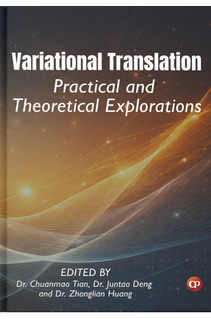
Editors
Dr. Tian Chuanmao1 , Dr. Deng Juntao2 & Dr. Zhonglian Huang3
1Director of the Centre for Translation Studies, Yangtze University, China; 2Vice Dean of the School of Foreign Languages, Wuhan Institute of Technology, China; 3Professor, Center for Translation Studies, Guangdong University of Foreign Studies, Guangzhou, China.
ISBN (Ebook): 978-93-49926-76-9
ISBN (Paperback): 978-93-49926-07-3
ISBN (Hardback): 978-93-49926-38-7
10.46679/9789349926769
This book is available worldwide via EBSCOhost Academic Collection, EBSCO E-books, GOBI, Google Play Books, Amazon, WorldCat Discovery Service/OCLC, CSMFL Bookstore, and 200+ book resellers and academic content vendors.
© CSMFL Publications & its authors.
Published: January 5, 2026
About the book
Variational Translation Theory (VTT), first formulated by Professor Huang Zhonglian in 1999, has incorporated both Chinese and foreign thought, especially the philosophy of change embodied in the ancient Chinese classic Book of Changes, and it sees change as a striking, gradual process. Compared with the change a text undergoes in complete translation, a change or “variation” in variational translation (VT) may be viewed as a kind of fast, thorough, and global changes, including instant, immediate, and substantial changes. VTT can help translators do their job more quickly and accurately with higher efficiency and better quality. Therefore, VT can be defined as an intelligent and intersemiotic activity in which a person or/and a machine uses one language to develop flexibly the cultural information in another language so as to meet the specific needs of specific readers under specific conditions (Huang, 2002: 97).
The chapters of this book address variational translation from multiple angles, making it one of the more thorough engagements the field has seen in recent years. Peihang Li and Chuanmao Tian open up the question of how variational translation theory can grow, offering concrete methods that go beyond incremental revision. Rongguang Yang takes on something that translation scholars have long skirted around: the ethical weight of decisions made when translators adapt, condense, omit, or rewrite. His argument that fidelity cannot be the only standard is not just a theoretical point; it reflects what practicing translators deal with every day. Yongzhong Zhang then makes a broader case for why variational translation deserves its own standing in the field, both as a theoretical category sitting alongside complete translation and as a practical force capable of breaking down barriers between different cultural traditions. Juan Wang and Tianxia Liu round out the theoretical section by tracing nearly three decades of scholarship through bibliometric analysis, giving readers a rare bird’s-eye view of how the field has developed in China and where it still needs to go.
What makes this book particularly useful is that it does not stop at theory. Feifei Ouyang and Chuanmao Tian show, through a detailed study of Chu ci translations in the West, how varied and inventive translators have been when carrying a classical Chinese text across cultural boundaries. Shenghua Luo takes the framework into the classroom, specifically into machine translation post-editing pedagogy, and finds that variational translation theory reshapes how we think about what students actually need to learn. Fang Wang’s study of Lin Shu’s literary translations gives the theory historical grounding, while Yujie Li brings it squarely into the present with her analysis of tourism text translation, where theoretical missteps have real consequences for how a culture is understood abroad. Read as a whole, these chapters show that variational translation is not an abstract concern. It is a working framework with something to say across history, pedagogy, literature, and intercultural communication. It is hoped that this volume can serve as a point of departure for new explorations of VT and VTT, and invite more translation scholars across the globe to study them from new perspectives.
Chapters
Introduction
by Dr. Tian Chuanmao, Dr. Deng Juntao and Dr. Zhonglian Huang
01: Notes On the Improvement and Innovation of Variational
by Peihang Li and Chuanmao Tian
02: Rethinking Translation Ethics in the Age of Variation: Toward A Framework for Variational Translation Ethics
by Rongguang Yang
03: On The Contemporary Value of Variational Translation: Theoretical and Practical Perspectives
by Yongzhong Zhang
04: A Bibliometric Study of Variational Translation Theory’s Development in China (1998-2025): A Citespace-Based Analysis
by Juan Wang and Tianxia Liu
05: Variational Translation Methods in English Translation and Research Texts of The Chu Ci
by Feifei Ouyang and Chuanmao Tian
06: Variational Translation Theory-Based Pedagogy for Machine Translation Post-Editing: A Case Study
by Shenghua Luo
07: Variational Translation Methods in Lin Shu’s Literary Translation
by Fang Wang
08: The C-E Translation of Web-Based Jingchu Culture Tourism Texts Under The Guidance Of Variational Translation Theory
by Yujie Li
Statement on Publication Ethics
We, at CSMFL Publications, are committed to ensure the unbiased and transparent publishing, and upholding the high standards of editorial integrity in our publications. To know more, please read our Statement on Publication Ethics, Editorial Integrity & Misconduct